ASPHALT TECHNICAL WORKSHOP 7th.

Monday July 4 took place in the Crystal Tower Hotel Montevideo 7th Asphalt Technical Seminar organized by the Uruguayan Association of Roads in conjunction with the Standing Committee of Asphalt Argentina. It was attended by nearly 110 national road technicians who listened and participated in conferences exhibitors from Uruguay, Argentina and Chile.

The talks were on current issues of technology paving Uruguay from the use of Capeseal, the bitumen stabilized materials as those used in Route 3, to the performance of thin asphalt mixes F10 type, such as that in Ruta Interbalnearia recently.
Mr. Paternostro began with “Cape Seal: General concepts, national specifications and local examples” showing the results of the first sections carried out in Uruguay, both in its good macro-texture and in its impermeability, as well as the specifications currently used. Then, Dr. Ing. Fernando Martínez (Argentina) from IMAE presented "Prediction models of the rheological properties of asphalt binders", in which empirical tests such as penetration, softening point and Brookfield viscosity are used to predict rheological properties of asphalt binders. asphalts quite tightly without the need to use an expensive rheometer (DSR).
Eng. Rosana Marcozzi and Dr. Francisco Morea (Argentina) from LEMIT presented us with “Experiences in Argentina with warm asphalt mix technologies. New tests applied to the characterization of its performance ”, showing the good behavior of this type of mixture in the experiences carried out and opening the debate on its application at the regional level. In Uruguay, only one section was completed in 2012 but we are working from BITAFAL to repeat the experience and draw better conclusions.
During the afternoon Ing. Germán Bavdaz (Argentina) told us about the "evolution of physical parameters of asphalt mixtures after 14 years of service", focused on the performance of such thin mixtures F10 on the Autopista del Oeste, one of the busiest in Argentina.
For closing Eng. Joaquim Kemp (Germany) made an interesting presentation on "BSM -Materials bitumen stabilized. Current state of technology ", a technology that is already being implemented in Route 3 and has a very promising future in Uruguay.

All of the photos ON HERE
MOBILE LABORATORY UP

The CITEVI few months ago is conducting the evaluation of the vials and esplanades mounting windmills in one of the parks that are under construction in the country.

Thanks to the modern equipment of our mobile laboratory measurements of density, moisture and bearing capacity are completed in minutes widely outperforming traditional assessment techniques.
In an average workday, with two operators, over 100 points dynamic modulus of the base 50 and moisture density determinations can be made.
If you require more information, contact mail: citevi@citevi.com.uy

WORKSHOPS CYCLE WITH Intendencias

This year we return to the cycles of technical workshops with departmental governments to discuss various topics paving technology. A classic workshops a few years ago on the use of emulsions, best practices for surface treatments and cold mix to add bacheo improved bases by in situ stabilization and paving new technologies.
It is a day of sharing experiences accompanied laboratory tests to better understand the management of asphalt products.
We started this month with the visit of the Municipality of Cologne. We invite you to participate in upcoming editions communicating mail: bitafal@bitafal.com.uy

TRAINING INTENDENCIA COLONIA_ MARCH 2011


GRAVILLADOS HOT IN WINTER

GRAVILLADOS HOT IN WINTER

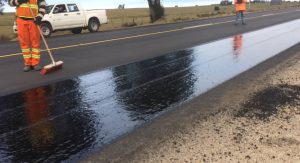
Last week with the company H & G successful tests gravillados hot in the shoulders of Route 3 were performed.

Because of the ban at this time governing a special binder it was developed to achieve full adherence of the aggregate used avoiding disadvantages of premature landslides and excess binder that can lead to exudates with the first warm days.

The developed binder BITAFLEX TERMOSEAL has various modifying additives to achieve immediate adhesion of stone (even when it contains dust) while maintaining a high viscosity to prevent exudates in warm periods.

This technology is used in Australia and New Zealand in winter periods with lower temperatures at local performing well and avoiding closures work both delay the execution of the works.
For implementing the binder is preheated and irrigated with sprinkler truck about 110 ° C noting that the range of irrigation fully open. There are no contraindications if it is cooled before the gravel is applied. In the video of the execution pe can be observed that the asphalt after application reaches 14 ° C and gravel applied almost 20 minutes after adhered smoothly.
In case of dirty stone, it must be dried by passing it through the asphalt plant until it reaches a temperature higher than 105ºC. In this way, the separation of the possible dust adhering to the stone is guaranteed (which once released, will not interfere during the irrigation as can be seen in the video). The graveling was carried out taking all the precautions corresponding to a work with hot binder and with ambient temperatures below 14 ° C. Once the binder and the gravel had been applied, it was compacted with a pneumatic compactor, making about 5 passes at 8 km / h.

The results were more than satisfactory in the first section executed, releasing the traffic immediately after compacting. To demonstrate the high adhesion between the BITAFLEX TERMOSEAL and gravel, it was circulated by the roadside traffic route without receiving any detachment. This technology can be applied even with cold gravels prewrapped with special asphalts or suitable emulsions prepared in times of good weather during the winter and apply automatic double spacing.


These tests were conducted in the presence of Ing. Jorge Galusso and MTOP assistants for the purpose of studying in situ the performance of technology.

VIDEO: https://youtu.be/WboY2CqnIKw

We use own and third party cookies to help us optimize your visit to our website and also to improve service delivery and thus adapt to their most relevant and useful to better their experience needs. When you click OK to continue with navigation and thus confirm that you have read the information and accept the activation of cookies.

You can allow or reject use at any time can change the Configuration Options Privacy - Cookies Policy -

Privacy settings

When you visit a website, you can store or retrieve information in your browser, mainly in the form of cookies. Check your personal services cookies here.


We track anonymous user information to improve our website.
.
  • _ga
  • _gid
  • _gat

Decline all Services
Accept all Services