Evaluation of penetration of the aggregate in the bases for surface treatments

Evaluation of penetration of the aggregate in the bases for surface treatments

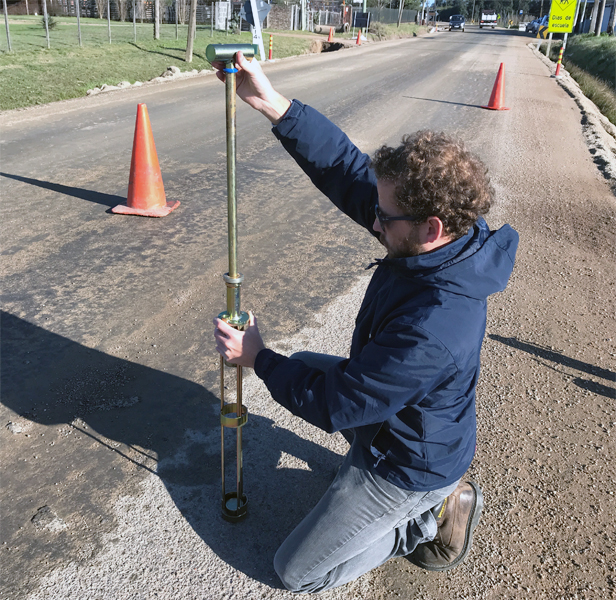
Using the penetrometer ball as quality control element base treatment.

In the path that is being traced at the national level to standardize design criteria for surface treatments, we believe the inclusion of the ball penetrometer test is of utmost importance. It determines if the base is in proper condition to receive initial treatment, or if it requires additional work. It is also an indicator of the degree of compaction that has been achieved and the moisture contained in the base. The test was originally developed by South Africans and is also used in Australia and New Zealand to quantitatively measure the penetration potential of aggregate into the base.

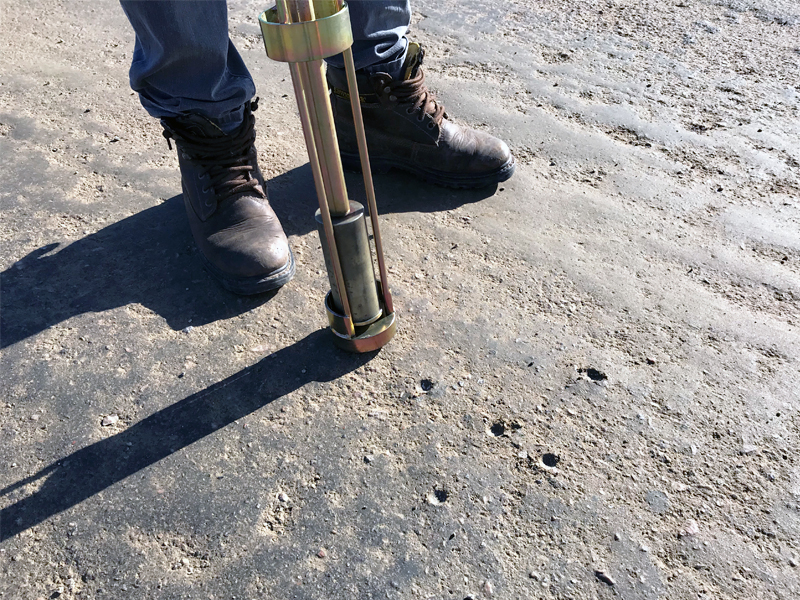
En este frío mes de Agosto, junto con Lucio Borelli de CVC, pusimos a prueba este equipo de medición en diversas superficies: bases granulares no ligadas, bases estabilizadas con ligantes (cemento Portland y asfalto espumado) y mezclas asfálticas. A continuación se ilustran algunas de las conclusiones, acompañadas de fotos de la experiencia.

In the initial treatments (surface treatments on bases), the subsidence of the aggregate on the surface always occurs, to a greater or lesser extent. The degree of penetration will depend on the base material, its humidity, compaction and the traffic to which it will be subjected. Not taking these parameters into account results in exudate in the short term, becoming particularly evident in the tracks. The explanation for this phenomenon is intuitive: the tire pressure sinks the stone into a base that allows it and the voids that correspond to the asphalt and the air (to achieve the macrotexture of the wearing course) are occupied by the material of base, causing the asphalt to surface through the stone, which results in exudation in the tracks.

El ensayo que se propone es muy sencillo y de fácil aplicación: consiste en la penetración de una bola de 19 mm de diámetro que es golpeada por un martillo normalizado lanzado de una altura conocida (Australian Standards: AG-PT/T251 – Ball Penetration Test). El valor de penetración queda registrado en el aparato, ya sea en un indicador electrónico o en una regla graduada (que viene incorporada).

Los resultados de este ensayo se utilizan para ajustar la cantidad de ligante a regar o para seleccionar un tratamiento correctivo previo al definitivo. Su uso más importante es quizá el de establecer el límite en el que no se pueden realizar gravillados sin antes recompactar o estabilizar la base, dado que su riesgo de falla es muy elevado.

La primera y más importante de las conclusiones es que la preparación de la base es un factor determinante en los resultados. Un problema común es que las bases presentan un exceso de finos en la parte superior que genera que la bola penetre con facilidad. Aunque parecen estar lisas y homogéneas inicialmente, tan pronto como se barren, una gran cantidad de este material fino se dispersa, dejando una superficie áspera e inconsistente que es problemática para ejecutar un tratamiento.

Another issue to consider is the humidity at the time of the test: if the surface is visibly wet, the penetration gives higher values. We could corroborate this by testing the same surface early in the morning and close to noon. In some cases, the conditions of the base at the time of the test are good, but when a primer is applied, due to capillarity and temperature differences, humidity begins to increase in the first 5 cm, affecting the penetration result.

Developing

BITAFAL present in the Circulars Opportunities Program

BITAFAL present in the Circulars Opportunities Program

On Wednesday morning, August 8, 2018 the Teatro La Colmena opened its doors to welcome the fifth, and final, meeting dedicated to BUILDING OPPORTUNITIES PROGRAM CIRCULARES.

This is an initiative coordinated by ANDE and biovalue (together with MIEM, MVOTMA, MGAP, UNIDO, GEF and supported by Transforma Uruguay and ANII) to promote joint actions and thus promote the creation and implementation of sustainable productive projects, the framework of circular economy.

We had the pleasure to share a morning full of information and where BITAFAL presented the progress in the use of modified asphalt powder neumátuco out of use for road construction in Uruguay.

At the beginning the basics and regional and international examples of circular economy by the Coordinator of the Environmental Engineer biovalue María José González were presented. Then the Coordinator of associativity area and Integration of the National Development Agency (ANDE) Economist Paula Cobas presented the convocation of Circulars Opportunities Program.

In the second instance it opened a "Living" questions of the problems and opportunities in the construction sector in the transition to Circulate Economy, moderated by Giselle Della Mea (3 Vectors - Innodriven). With Architect Eduardo Siuciak (FARQ- UdelaR) and Ing. Jorge Pazos, Executive Director of the Construction Chamber of Uruguay.

Finally, a panel of businessmen and entrepreneurs with national and regional experience was convened to make a "double click" with examples of application of circular principles in their respective businesses and areas. The exhibition began with Robert Pacheco (Argentina), founding partner of EWAR, a company that since 2008 began to venture into the production of biosynthetic wood boards. The Qco Santiago Kröger (Uruguay) continued presenting the benefits, development, application and prospects of incorporating disused tire dust into asphalt cement. Next, Eng. Nelson Siqueira Nieto (Brazil) from the company RNV Residuos, presented on recycled aggregates, as a sustainable and cheaper solution than the use of non-recycled aggregates. To close the day, Arch. Eliseo Cabrera presented "La Casa Uruguaya", a winning project of the National Prize for Energy Efficiency - Cat. Buildings 2016.

From BITAFAL Group we appreciate the invitation as exhibitors to count the work we have done after collaborating with the environment and society. We welcome these instances of exchange opportunities to further develop new ways of doing things, with a more systemic vision that includes all parties are generated.

In the next LINK We share the presentations made on that day. ()

On the website CIRCULARES OPPORTUNITIESThey may elaborate on the call and the different activities and workshops that have been made under the program.

Podes relive the day ON HERE

BITAFAL enters the world of rheometry

BITAFAL enters the world of rheometry

New Reómetro Anton Paar SmartPave 102 at sion It will allow a big step in the performance of asphalt products in Uruguay.

As we announced in an earlier issue of our newsletterThis month installed a Court Dynamic Rheometer (DSR for its acronym in Ingés). This sophisticated equipment allows to know the performance of asphalts much of its viscoelastic range. Mainly we are concerned in these latitudes, that is at medium and high temperatures.

With this tool we can improve the modified asphalts and emulsions to suit the conditions of our country and know within minutes the quality of asphalts used as raw material.

With the addition of equipment, a course of rheology and use of equipment with an expert from the supplier was performed. The course was held on 27 and 28 August in the CITEVI and we have the participation of technical staff of our company, the MTOP and LATU.

This new machine is equipped with accessories for measurements from -20 to 150 ° C both conventional asphalts, as well as some modified properties of emulsions. Typically it used to determine the degree of asphalt (PG) but can be used for other properties of the binders.

Within the novel assays we can discuss the possibility of making master curves where temperatures and voltages applied to see the performance of the binders are varied. It is also possible to test highly accurate adhesion or cohesion at different temperatures, essential for the performance of emulsions for surface treatment tool.

Not so new but convenient is the possibility of viscosities "brookfield" within minutes both 60 ° C to the viscosity curves at the desired temperature range.

These are some of the many tests that can be performed but the team is extremely versatile and has many accessories that allow analyzing from food to paint smoothly.

In the course they made the basics of fluid mechanics, equipment operation and its application to the asphalts were given. It had a practical module to understand the operation of equipment and advanced software that controls and processes data.

Much remains to explore and contribute to our road with this team. We will keep you informed of progress.

Day VIII Asphalt

Day VIII Asphalt

The Uruguayan Association of Roads He organized the eighth edition with a large turnout of audience.

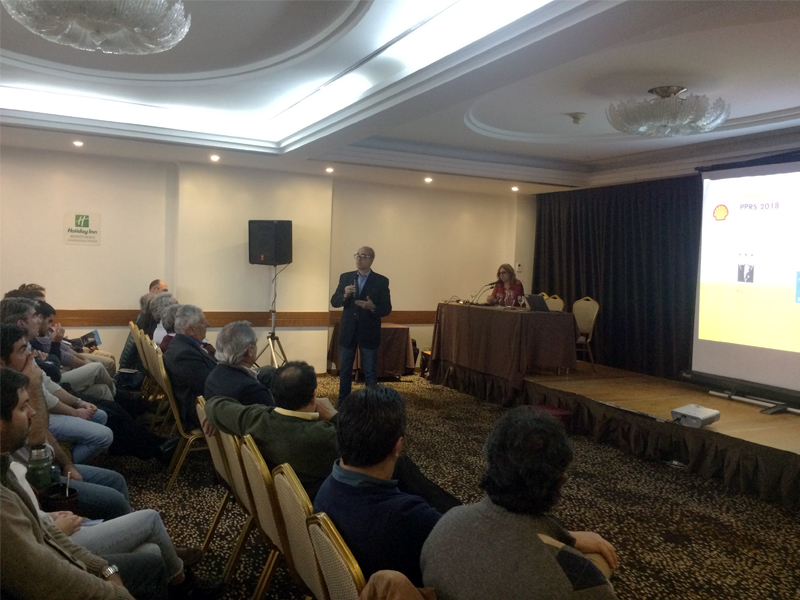
A new edition was held at the Holiday Inn Hotel on August 13 Asphalt Technical Seminar, Event held biannually in our country.

The Permanent Commission of Asphalt (CPA) of Argentina actively participated, as usual, with three technical presentations area recognized the road as Ing. Hugo Bianchetto, Ing. Adrian Nosetti and Ing. Mario Jair. Of Uruguay they presented the Ing. Faustina Keuliyan on modified asphalts and Qco. Santiago Kröger presenting the new practical technical "Gravillados in Uruguay" manual.

En esta edición se hizo bastante hincapié sobre el control de los áridos usados en mezclas asfálticas así como otros temas de interés para el sector. La sala elegida estuvo colmada durante toda el día ya que participaron mas de 150 técnicos vinculados a la vialidad nacional y de Argentina. Esperamos seguir teniendo una participación activa en próximas ediciones y en los demás eventos que se organizan en nuestro país. Los invitamos a conocer los temas tratados en el siguiente enlace.

Day VIII Asphalt - Group Bitafal

BITAFAL group He was present at the conference with the presentation of the book "Gravillados in Uruguay - Practical Technical Manual" through Qco. Santiago Kröger. . To close the day Mr. Mario Jair (Argentina) made a summary of Congress Preservation and Pavement Recycling held in March this year with the talk "PPRS 2018: Trends and conclusions".

VIII Asphalt Technical Seminar. Uruguayan Association of Roads

ROADS newsletter by 2018

ROADS newsletter by 2018

We use own and third party cookies to help us optimize your visit to our website and also to improve service delivery and thus adapt to their most relevant and useful to better their experience needs. When you click OK to continue with navigation and thus confirm that you have read the information and accept the activation of cookies.

You can allow or reject use at any time can change the Configuration Options Privacy - Cookies Policy -

Privacy settings

When you visit a website, you can store or retrieve information in your browser, mainly in the form of cookies. Check your personal services cookies here.


We track anonymous user information to improve our website.
.
  • _ga
  • _gid
  • _gat

Decline all Services
Accept all Services