PERIODIC ROAD CONSERVATION TECHNIQUES COURSE

PERIODIC ROAD CONSERVATION TECHNIQUES COURSE

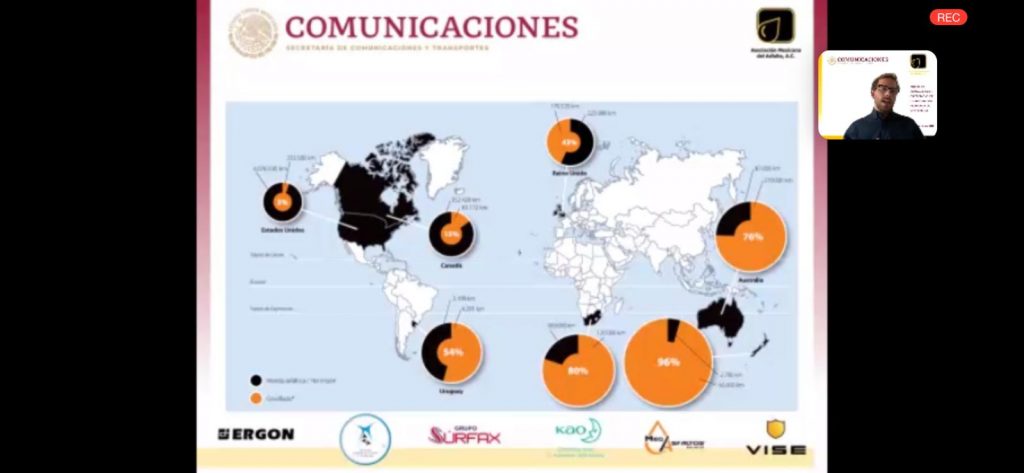
Bitafal was a keynote speaker in the virtual course of the Ministry of Communications and Transportation (SCT) of Mexico and the Mexican Asphalt Association (AMAAC).

Grupo Bitafal held the inaugural conference of the "Refresher Course in Periodic Road Maintenance Techniques", a Mexican event with more than 500 participants. Below we delve into the content of the course and a free tool for the selection of surface treatments.

Organized by the SCT of Mexico and AMAAC, the course on conservation techniques aimed to update the knowledge of Mexican administration professionals. The event took place over three days, each covering a particular theme. The first day the theme was "Periodic Conservation Techniques" and Bitafal gave the first lecture by Ing. Ignacio Kröger, who dealt with the detection of opportunities and limitations in the evaluation of pavements as well as the correct selection of surface treatments. The first day was completed by important exhibitors, such as Eng. Salvador Fernández Ayala, General Director of Highway Conservation of the SCT and Dr. Adriana Vargas, researcher of the North American National Center for Asphalt Technology (NCAT).

The session on the second day dealt with the theme of "Good practices in conservation treatments" with presentations on gravel, microagglomerates, sealing and caulking of cracks. The presentation by Ing. Jorge Alarcón on his experience in the reuse of milled material (RAP), the different recovery techniques and the configurations of asphalt plants for a greater incorporation of RAP was highlighted on that day.

On the third day, “Asphalt mixes as conservation techniques” were studied in depth, commenting on the good practices of milling, patching and discontinuous mixes. Eng. Francisco Ramos commented on the guide on "Road Conservation Procedures and Techniques" developed by the SCT and detailed the highly recommended "Conservation Treatment Selection Tool" available for free at .

We thank the SCT and AMAAC for the invitation and for having the initiative to share crucial issues for the sustainable development of Latin American roads. Follow us on social networks to find out when the videos of the course are published.

Linkedin: https://www.linkedin.com/company/grupo-bitafal/
Twitter: https://twitter.com/BITAFAL
USE OF THE RHEOMETER TO EVALUATE FOOTPRINT AND FISSURES

USE OF THE RHEOMETER TO EVALUATE FOOTPRINT AND FISSURES

We reviewed some agile tests to estimate performance of asphalt mixes with the DSR.

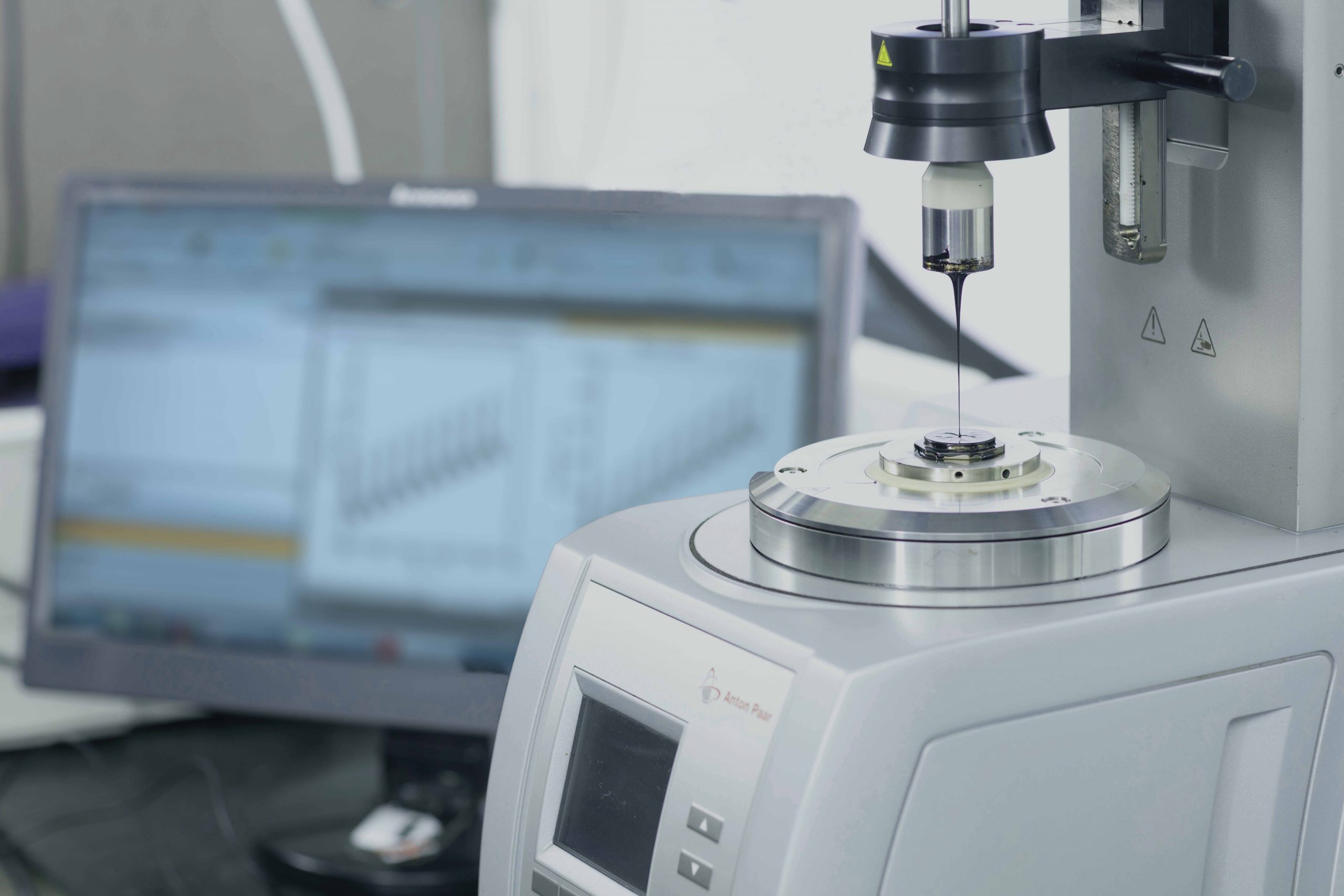
New paving technologies require modern equipment to evaluate the behavior of asphalt. The Dynamic Cut Rheometer (DSR) has positioned itself as the international reference equipment for measuring the viscoelastic properties of asphalt. In addition to amazing measurement accuracy, one of its biggest advantages is optimizing time in the laboratory.

We invite you to read the note where we summarize some of the results of the research presented at the XX CILA where we study the behavior of asphalt against rutting and cracking through agile tests in the DSR.

In 2018, one of the country's first dynamic cutting rheometers (DSR) was acquired to study the rheological behavior of asphalt. https://bitafal.com.uy/novedades/bitafal-entra-al-mundo-de-la-reologia/.

Using transient (creep, stress / strain at constant rate) and dynamic (oscillatory) methods, the team determines the viscoelastic properties of asphalts in very short times.

Globally, road researchers have made numerous efforts to correlate the behavior of the asphalt binder in the laboratory with its performance in the field, mainly to identify the causes of the most common pavement failures, such as fatigue cracking and rutting.

In recent years, the test called Multiple Stress Creep and Recovery (MSCR) has become popular, which allows evaluating the behavior of the binder against rutting. The test is carried out in a few minutes and its result, through the non-recoverable "creep compliance" parameter (Jnr), can be correlated with its resistance to permanent deformation in a rolling test. As a general rule, the lower Jnr, the better its behavior against rutting.

On the other hand, to address the problem of fatigue cracking, a variation to the LAS (Linear Amplitude Sweep) test has very recently been proposed to determine fatigue laws of binders in reduced times, which could be correlated with prolonged fatigue tests at asphalt mixtures, such as the four-point beam, to determine the influence of the binder on this behavior.

At CITEVI we use this test to compare a conventional AC-30 asphalt, an asphalt modified with 3.5% SBS and a highly modified asphalt (HIMA) with 7.5% SBS. The results were correlated with Wheel Tracking tests (EN 12697-22) and four-point beam fatigue (EN 12697-24). If the results of each of the tests are compared, it can be seen that there is a clear tendency towards greater resistance to permanent deformation for lower Jnr values. There is an acceptable correlation between the Jnr parameter and rutting depth (R=0.85) as stated by several authors At CITEVI we use this test to compare a conventional AC-30 asphalt, an asphalt modified with 3.5% SBS and a highly modified asphalt (HIMA) with 7.5% SBS. The results were correlated with Wheel Tracking tests (EN 12697-22) and four-point beam fatigue (EN 12697-24). If the results of each of the tests are compared, it can be seen that there is a clear tendency towards greater resistance to permanent deformation for lower Jnr values. There is an acceptable correlation between the Jnr parameter and rutting depth (R=0.85) as stated by several authors. However, the highest correlation was found between the rutting slope and the Jnr at 0.1kPa, as can be seen in Figure 1.

. However, the highest correlation was found between the rutting slope and the Jnr at 0.1kPa, as can be seen in Figure 1.

. However, the highest correlation was found between the rutting slope and the Jnr at 0.1kPa, as can be seen in Figure 1.

. However, the highest correlation was found between the rutting slope and the Jnr at 0.1kPa, as can be seen in Figure 1.

INTERNATIONAL SEMINAR ON ASPHALT MIXTURES

INTERNATIONAL SEMINAR ON ASPHALT MIXTURES

BITAFAL GROUP present at the International Seminar "Asphaltic mixtures and their relevance in the durability of pavements"

The seminar organized by the Peruvian company Ing. Nestor Huamán y Asociados was held last 11th of June via online, both on the Zoom platform, where about 100 people listened to us and exchanged, as well as on Facebook Live, where there were about 1,200 connected participants. The subsequent numbers of the day are more impressive since the video of it has more than 9000 reproductions at the moment.

The event began with a talk on "Asphaltic mixtures as wearing course" by Ing. Adrián Nosetti from Argentina, then Qco. Santiago Kröger presented on the "Importance of asphalt irrigation with emulsions" and at the end Eng. Nestor Huamán presented on "Asphalt rheology".
We invite you to watch the video of the seminar in the link below.
Evaluation of penetration of the aggregate in the bases for surface treatments

Evaluation of penetration of the aggregate in the bases for surface treatments

Using the penetrometer ball as quality control element base treatment.

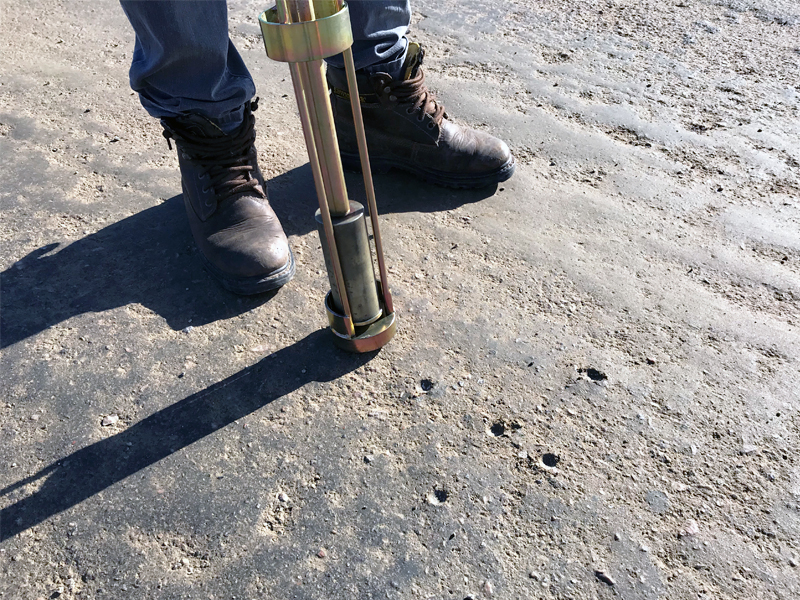
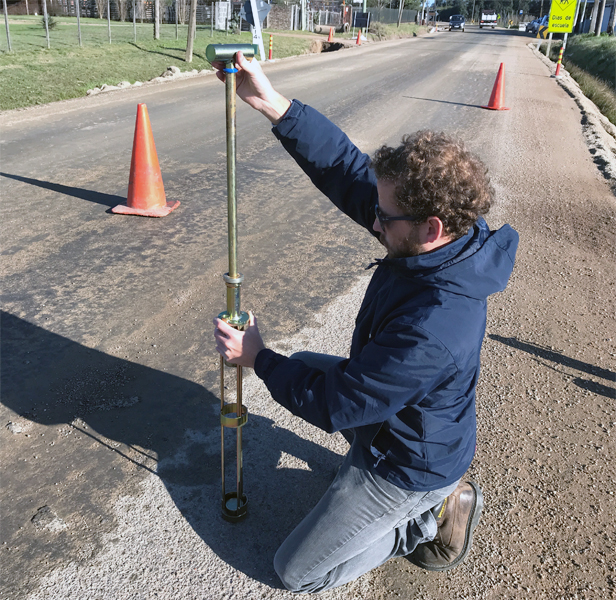
In the path that is being traced at the national level to standardize design criteria for surface treatments, we believe the inclusion of the ball penetrometer test is of utmost importance. It determines if the base is in proper condition to receive initial treatment, or if it requires additional work. It is also an indicator of the degree of compaction that has been achieved and the moisture contained in the base. The test was originally developed by South Africans and is also used in Australia and New Zealand to quantitatively measure the penetration potential of aggregate into the base.

En este frío mes de Agosto, junto con Lucio Borelli de CVC, pusimos a prueba este equipo de medición en diversas superficies: bases granulares no ligadas, bases estabilizadas con ligantes (cemento Portland y asfalto espumado) y mezclas asfálticas. A continuación se ilustran algunas de las conclusiones, acompañadas de fotos de la experiencia.

In the initial treatments (surface treatments on bases), the subsidence of the aggregate on the surface always occurs, to a greater or lesser extent. The degree of penetration will depend on the base material, its humidity, compaction and the traffic to which it will be subjected. Not taking these parameters into account results in exudate in the short term, becoming particularly evident in the tracks. The explanation for this phenomenon is intuitive: the tire pressure sinks the stone into a base that allows it and the voids that correspond to the asphalt and the air (to achieve the macrotexture of the wearing course) are occupied by the material of base, causing the asphalt to surface through the stone, which results in exudation in the tracks.

El ensayo que se propone es muy sencillo y de fácil aplicación: consiste en la penetración de una bola de 19 mm de diámetro que es golpeada por un martillo normalizado lanzado de una altura conocida (Australian Standards: AG-PT/T251 – Ball Penetration Test). El valor de penetración queda registrado en el aparato, ya sea en un indicador electrónico o en una regla graduada (que viene incorporada).

Los resultados de este ensayo se utilizan para ajustar la cantidad de ligante a regar o para seleccionar un tratamiento correctivo previo al definitivo. Su uso más importante es quizá el de establecer el límite en el que no se pueden realizar gravillados sin antes recompactar o estabilizar la base, dado que su riesgo de falla es muy elevado.

La primera y más importante de las conclusiones es que la preparación de la base es un factor determinante en los resultados. Un problema común es que las bases presentan un exceso de finos en la parte superior que genera que la bola penetre con facilidad. Aunque parecen estar lisas y homogéneas inicialmente, tan pronto como se barren, una gran cantidad de este material fino se dispersa, dejando una superficie áspera e inconsistente que es problemática para ejecutar un tratamiento.

Another issue to consider is the humidity at the time of the test: if the surface is visibly wet, the penetration gives higher values. We could corroborate this by testing the same surface early in the morning and close to noon. In some cases, the conditions of the base at the time of the test are good, but when a primer is applied, due to capillarity and temperature differences, humidity begins to increase in the first 5 cm, affecting the penetration result.

Developing

VISIT TO THE UNIVERSITY OF MONTEVIDEO CITEVI

For the third consecutive year we visit students of Civil Engineering at the University of Montevideo in our facilities. The activity is part of the course of Civil Laboratory III specifically on aggregates, binders and asphalt mixtures.

In the same an approach is given to building materials pavement comprising an asphalt mixture, testing quality control thereof, the design criteria of the mix, an evaluation of its mechanical properties and details of the activity laboratory practice compared to those who represent its future activity, such as road builders.
The activity is focused on the design of an asphalt mixture according to the Marshall method. In principle, a theoretical review of the method and national regulations was carried out. Subsequently, asphalt mixtures with different asphalt contents were made in the laboratory and test methods were evaluated to determine the characteristics of the mixture and of the aggregates that were being used. Once the capabilities of each of the systems were determined, the students processed the information and interpreted the results.
In addition to performing conventional tests, as wear LA or mixtures dosing by the Marshall method, seek to bring students to new technologies and assays as Microdeval comment on other methodologies existing dosage.
During the day also made visits to industrial plant Bitafal Special Asfaltos and other technologies are discussed road maintenance to complement seen in the laboratory.

All of the photos ON HERE

TECHNICAL CONFERENCE Asphalt Mixtures - COARCO -

The BITAFAL Group was present at the R & D Technical Conference on new asphalt mixtures by the company COARCO from Argentina. It was held at the plant in Moreno, Province of Buenos Aires, on 25 April. Uruguay took part members of MTOP and LATU and Argentina participated leaders of National and Provincial Roads Authority, representatives from various dealers and other suppliers from the nearby shore.


During the conference the latest equipment were both laboratory mix design and workmanship, laying and compaction. mixtures of high RAP, colored mixtures, mixtures of batching and until a new asphalt scented low level of VOC emissions used were developed.

The sessions began with a visit to the company's state-of-the-art laboratory, where they have invested in high-level equipment for research and development. To list some of the equipment, they have an ignition oven to determine asphalt content, a gyratory compactor for mix design, a Wheel Tracking Test according to the new European regulations with a plate compactor, a unit to determine the dynamic modulus of mixes and a 4 point fatigue team.


Privacy Center


As for the laying and compaction equipment they have Vögele pavers and compactors next generation Hamm oscillatory system with GPS compaction optimization.

More photos HERE

Watch the Video HERE


We use own and third party cookies to help us optimize your visit to our website and also to improve service delivery and thus adapt to their most relevant and useful to better their experience needs. When you click OK to continue with navigation and thus confirm that you have read the information and accept the activation of cookies.

You can allow or reject use at any time can change the Configuration Options Privacy - Cookies Policy -

Privacy settings

When you visit a website, you can store or retrieve information in your browser, mainly in the form of cookies. Check your personal services cookies here.


We track anonymous user information to improve our website.
.
  • _ga
  • _gid
  • _gat

Decline all Services
Accept all Services