USE OF THE RHEOMETER TO EVALUATE FOOTPRINT AND FISSURES
We reviewed some agile tests to estimate performance of asphalt mixes with the DSR.
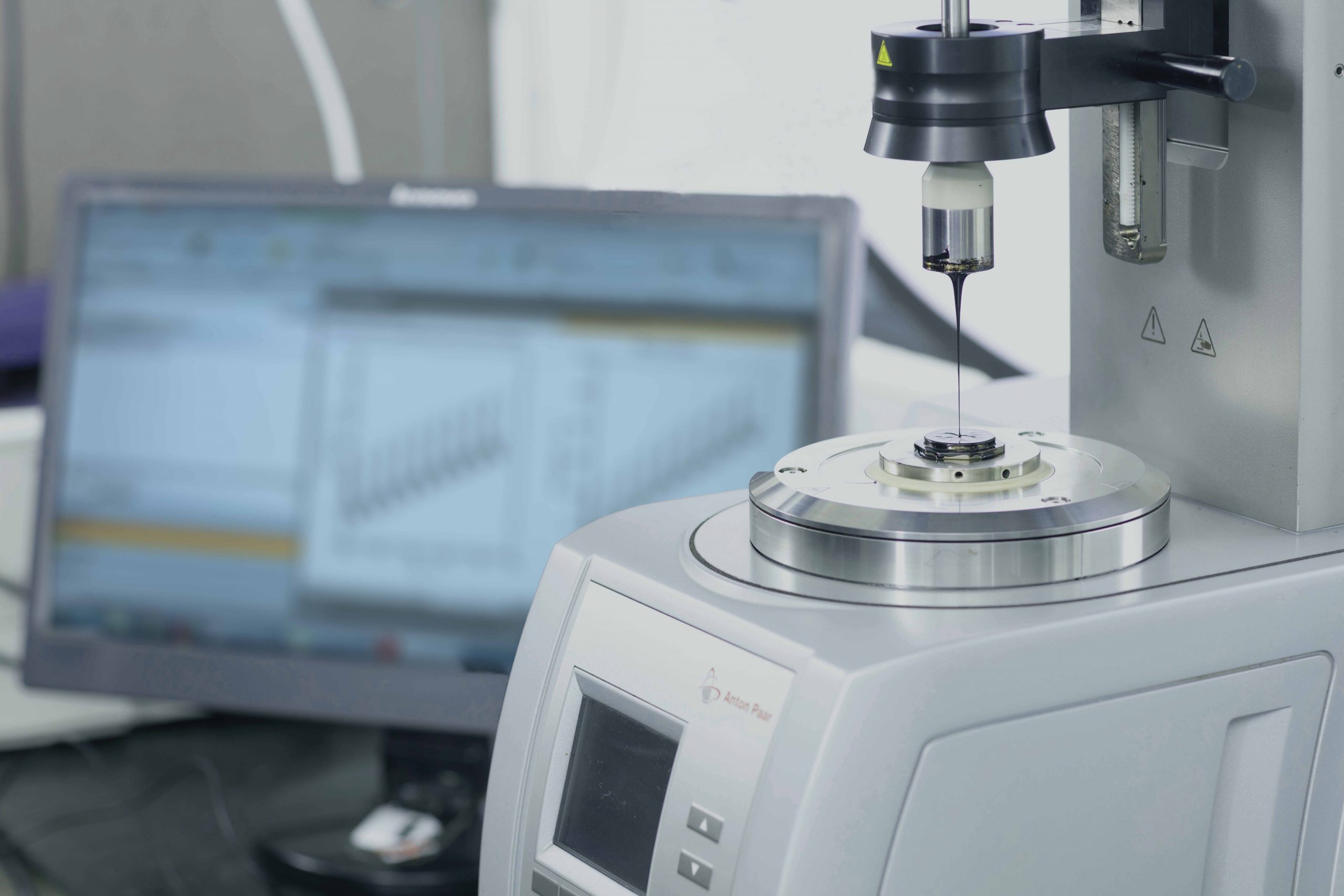
New paving technologies require modern equipment to evaluate the behavior of asphalt. The Dynamic Cut Rheometer (DSR) has positioned itself as the international reference equipment for measuring the viscoelastic properties of asphalt. In addition to amazing measurement accuracy, one of its biggest advantages is optimizing time in the laboratory.
We invite you to read the note where we summarize some of the results of the research presented at the XX CILA where we study the behavior of asphalt against rutting and cracking through agile tests in the DSR.
In 2018, one of the country's first dynamic cutting rheometers (DSR) was acquired to study the rheological behavior of asphalt. https://bitafal.com.uy/novedades/bitafal-entra-al-mundo-de-la-reologia/.
Using transient (creep, stress / strain at constant rate) and dynamic (oscillatory) methods, the team determines the viscoelastic properties of asphalts in very short times.
Globally, road researchers have made numerous efforts to correlate the behavior of the asphalt binder in the laboratory with its performance in the field, mainly to identify the causes of the most common pavement failures, such as fatigue cracking and rutting.
In recent years, the test called Multiple Stress Creep and Recovery (MSCR) has become popular, which allows evaluating the behavior of the binder against rutting. The test is carried out in a few minutes and its result, through the non-recoverable "creep compliance" parameter (Jnr), can be correlated with its resistance to permanent deformation in a rolling test. As a general rule, the lower Jnr, the better its behavior against rutting.
On the other hand, to address the problem of fatigue cracking, a variation to the LAS (Linear Amplitude Sweep) test has very recently been proposed to determine fatigue laws of binders in reduced times, which could be correlated with prolonged fatigue tests at asphalt mixtures, such as the four-point beam, to determine the influence of the binder on this behavior.
At CITEVI we use this test to compare a conventional AC-30 asphalt, an asphalt modified with 3.5% SBS and a highly modified asphalt (HIMA) with 7.5% SBS. The results were correlated with Wheel Tracking tests (EN 12697-22) and four-point beam fatigue (EN 12697-24). If the results of each of the tests are compared, it can be seen that there is a clear tendency towards greater resistance to permanent deformation for lower Jnr values. There is an acceptable correlation between the Jnr parameter and rutting depth (R=0.85) as stated by several authors At CITEVI we use this test to compare a conventional AC-30 asphalt, an asphalt modified with 3.5% SBS and a highly modified asphalt (HIMA) with 7.5% SBS. The results were correlated with Wheel Tracking tests (EN 12697-22) and four-point beam fatigue (EN 12697-24). If the results of each of the tests are compared, it can be seen that there is a clear tendency towards greater resistance to permanent deformation for lower Jnr values. There is an acceptable correlation between the Jnr parameter and rutting depth (R=0.85) as stated by several authors. However, the highest correlation was found between the rutting slope and the Jnr at 0.1kPa, as can be seen in Figure 1.

. However, the highest correlation was found between the rutting slope and the Jnr at 0.1kPa, as can be seen in Figure 1.
. However, the highest correlation was found between the rutting slope and the Jnr at 0.1kPa, as can be seen in Figure 1.