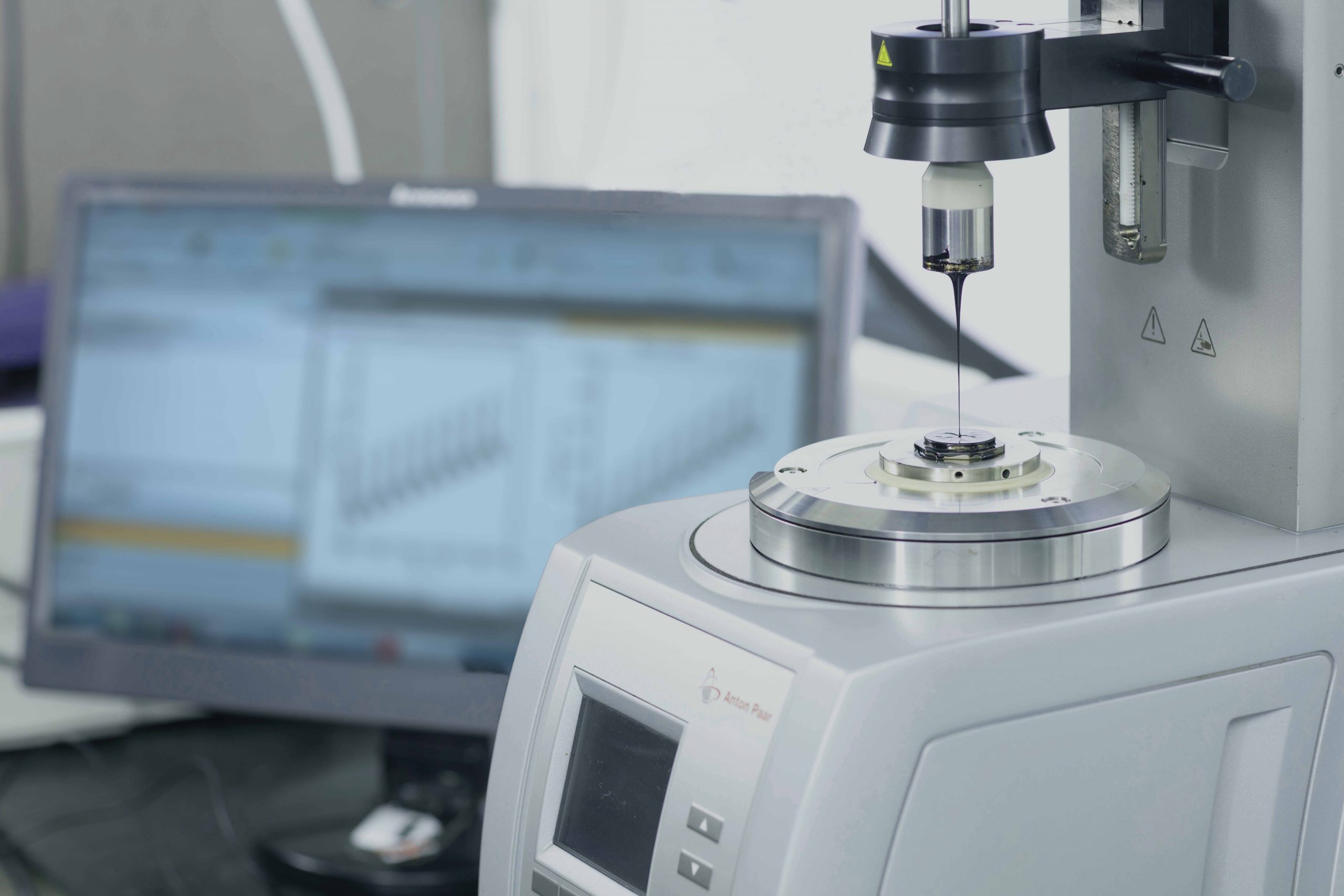
USE OF THE RHEOMETER TO EVALUATE FOOTPRINT AND FISSURES

USE OF THE RHEOMETER TO EVALUATE FOOTPRINT AND FISSURES

We reviewed some agile tests to estimate performance of asphalt mixes with the DSR.

New paving technologies require modern equipment to evaluate the behavior of asphalt. The Dynamic Cut Rheometer (DSR) has positioned itself as the international reference equipment for measuring the viscoelastic properties of asphalt. In addition to amazing measurement accuracy, one of its biggest advantages is optimizing time in the laboratory.

We invite you to read the note where we summarize some of the results of the research presented at the XX CILA where we study the behavior of asphalt against rutting and cracking through agile tests in the DSR.

In 2018, one of the country's first dynamic cutting rheometers (DSR) was acquired to study the rheological behavior of asphalt. https://bitafal.com.uy/novedades/bitafal-entra-al-mundo-de-la-reologia/.

Using transient (creep, stress / strain at constant rate) and dynamic (oscillatory) methods, the team determines the viscoelastic properties of asphalts in very short times.

Globally, road researchers have made numerous efforts to correlate the behavior of the asphalt binder in the laboratory with its performance in the field, mainly to identify the causes of the most common pavement failures, such as fatigue cracking and rutting.

In recent years, the test called Multiple Stress Creep and Recovery (MSCR) has become popular, which allows evaluating the behavior of the binder against rutting. The test is carried out in a few minutes and its result, through the non-recoverable "creep compliance" parameter (Jnr), can be correlated with its resistance to permanent deformation in a rolling test. As a general rule, the lower Jnr, the better its behavior against rutting.

On the other hand, to address the problem of fatigue cracking, a variation to the LAS (Linear Amplitude Sweep) test has very recently been proposed to determine fatigue laws of binders in reduced times, which could be correlated with prolonged fatigue tests at asphalt mixtures, such as the four-point beam, to determine the influence of the binder on this behavior.

At CITEVI we use this test to compare a conventional AC-30 asphalt, an asphalt modified with 3.5% SBS and a highly modified asphalt (HIMA) with 7.5% SBS. The results were correlated with Wheel Tracking tests (EN 12697-22) and four-point beam fatigue (EN 12697-24). If the results of each of the tests are compared, it can be seen that there is a clear tendency towards greater resistance to permanent deformation for lower Jnr values. There is an acceptable correlation between the Jnr parameter and rutting depth (R=0.85) as stated by several authors At CITEVI we use this test to compare a conventional AC-30 asphalt, an asphalt modified with 3.5% SBS and a highly modified asphalt (HIMA) with 7.5% SBS. The results were correlated with Wheel Tracking tests (EN 12697-22) and four-point beam fatigue (EN 12697-24). If the results of each of the tests are compared, it can be seen that there is a clear tendency towards greater resistance to permanent deformation for lower Jnr values. There is an acceptable correlation between the Jnr parameter and rutting depth (R=0.85) as stated by several authors. However, the highest correlation was found between the rutting slope and the Jnr at 0.1kPa, as can be seen in Figure 1.

. However, the highest correlation was found between the rutting slope and the Jnr at 0.1kPa, as can be seen in Figure 1.

. However, the highest correlation was found between the rutting slope and the Jnr at 0.1kPa, as can be seen in Figure 1.

. However, the highest correlation was found between the rutting slope and the Jnr at 0.1kPa, as can be seen in Figure 1.

INTERNATIONAL SEMINAR ON ASPHALT MIXTURES

INTERNATIONAL SEMINAR ON ASPHALT MIXTURES

BITAFAL GROUP present at the International Seminar "Asphaltic mixtures and their relevance in the durability of pavements"

The seminar organized by the Peruvian company Ing. Nestor Huamán y Asociados was held last 11th of June via online, both on the Zoom platform, where about 100 people listened to us and exchanged, as well as on Facebook Live, where there were about 1,200 connected participants. The subsequent numbers of the day are more impressive since the video of it has more than 9000 reproductions at the moment.

The event began with a talk on "Asphaltic mixtures as wearing course" by Ing. Adrián Nosetti from Argentina, then Qco. Santiago Kröger presented on the "Importance of asphalt irrigation with emulsions" and at the end Eng. Nestor Huamán presented on "Asphalt rheology".
We invite you to watch the video of the seminar in the link below.
9TH TECHNICAL DAY OF ASPHALT

9TH TECHNICAL DAY OF ASPHALT

The biannual event of the Uruguayan Association of Roads was held in online format

The virtual activity co-organized with the Permanent Asphalt Commission (CPA) and the Argentine Highway Association (AAC) had a great attendance of almost 450 people from all over the world.

In this edition, emphasis was placed on modified asphalts for asphalt mixtures such as the new highly modified asphalt (HiMA), which we have already delved into in previous editions (Nota HiMA) and novel experiences with AM3 such as the recapping of Route 1 carried out by Tracoviax (Note route 1).
We hope to continue having such an active participation in person as well as virtually in future editions.
The conferences were held on the 22nd and June 23 through the AAC platform. They began with a conference of the Ings. Rafael Lopes Martins and Gary Fitts from the Kraton company doing an "Introduction to high performance modified asphalt (HiMA)", technology introduced in Uruguay by GRUPO BITAFAL with the support of the Kraton company in the development and Colier in the execution of the section test. This technology has been extensively studied at CITEVI and is part of the degree thesis of BITAFAL Engineers, Carlos Pfeiff and Ignacio Kröger (Thesis Note: https://bitafal.com.uy/novedades/desempeno-de-asfaltos-altamente-modificados/).
Then for the CPA, Eng. Alejandro Bisio, who until a few months ago was in charge of the Research and Development Quality Management of the National Highway in Argentina, made an excellent overview of the “Asphalt mix design methods”.
He Tuesday June 23 opened the day the Ings. Diego Larsen and Lisandro Daguerre with “Solutions for high performance pavements” where they detailed the 200 km project with HiMA asphalt carried out in Argentina on Route 9 (Rosario-Campana) and other sections with high modulus asphalt.
For the closing, Eng. Marcelo Borrelli detailed what the Tracoviax company had done in the "Rehabilitation in asphalt mixture of Route 1 double track between accesses to Montevideo and Santiago Vázquez" where modified asphalt was used BITAFLEX AM3 for the three layers of the overcoat, an asphalt sand to delay the reflection of cracks, a semi-dense one for leveling and an F10 for rolling. For more information about this work you can see in our BLOG (https://bitafal.com.uy/novedades/arena-asfalto-con-am3-en-ruta-1/) or in the presentation of the day.
The presentations are available on the AUC and AAC websites (http://www.aacarreteras.org.ar/noticia-jornada-asfalto.php).

We use own and third party cookies to help us optimize your visit to our website and also to improve service delivery and thus adapt to their most relevant and useful to better their experience needs. When you click OK to continue with navigation and thus confirm that you have read the information and accept the activation of cookies.

You can allow or reject use at any time can change the Configuration Options Privacy - Cookies Policy -

Privacy settings

When you visit a website, you can store or retrieve information in your browser, mainly in the form of cookies. Check your personal services cookies here.


We track anonymous user information to improve our website.
.
  • _ga
  • _gid
  • _gat

Decline all Services
Accept all Services