USE OF THE RHEOMETER TO EVALUATE FOOTPRINT AND FISSURES

USE OF THE RHEOMETER TO EVALUATE FOOTPRINT AND FISSURES

We reviewed some agile tests to estimate performance of asphalt mixes with the DSR.

New paving technologies require modern equipment to evaluate the behavior of asphalt. The Dynamic Cut Rheometer (DSR) has positioned itself as the international reference equipment for measuring the viscoelastic properties of asphalt. In addition to amazing measurement accuracy, one of its biggest advantages is optimizing time in the laboratory.

We invite you to read the note where we summarize some of the results of the research presented at the XX CILA where we study the behavior of asphalt against rutting and cracking through agile tests in the DSR.

In 2018, one of the country's first dynamic cutting rheometers (DSR) was acquired to study the rheological behavior of asphalt. https://bitafal.com.uy/novedades/bitafal-entra-al-mundo-de-la-reologia/.

Using transient (creep, stress / strain at constant rate) and dynamic (oscillatory) methods, the team determines the viscoelastic properties of asphalts in very short times.

Globally, road researchers have made numerous efforts to correlate the behavior of the asphalt binder in the laboratory with its performance in the field, mainly to identify the causes of the most common pavement failures, such as fatigue cracking and rutting.

In recent years, the test called Multiple Stress Creep and Recovery (MSCR) has become popular, which allows evaluating the behavior of the binder against rutting. The test is carried out in a few minutes and its result, through the non-recoverable "creep compliance" parameter (Jnr), can be correlated with its resistance to permanent deformation in a rolling test. As a general rule, the lower Jnr, the better its behavior against rutting.

On the other hand, to address the problem of fatigue cracking, a variation to the LAS (Linear Amplitude Sweep) test has very recently been proposed to determine fatigue laws of binders in reduced times, which could be correlated with prolonged fatigue tests at asphalt mixtures, such as the four-point beam, to determine the influence of the binder on this behavior.

At CITEVI we use this test to compare a conventional AC-30 asphalt, an asphalt modified with 3.5% SBS and a highly modified asphalt (HIMA) with 7.5% SBS. The results were correlated with Wheel Tracking tests (EN 12697-22) and four-point beam fatigue (EN 12697-24). If the results of each of the tests are compared, it can be seen that there is a clear tendency towards greater resistance to permanent deformation for lower Jnr values. There is an acceptable correlation between the Jnr parameter and rutting depth (R=0.85) as stated by several authors At CITEVI we use this test to compare a conventional AC-30 asphalt, an asphalt modified with 3.5% SBS and a highly modified asphalt (HIMA) with 7.5% SBS. The results were correlated with Wheel Tracking tests (EN 12697-22) and four-point beam fatigue (EN 12697-24). If the results of each of the tests are compared, it can be seen that there is a clear tendency towards greater resistance to permanent deformation for lower Jnr values. There is an acceptable correlation between the Jnr parameter and rutting depth (R=0.85) as stated by several authors. However, the highest correlation was found between the rutting slope and the Jnr at 0.1kPa, as can be seen in Figure 1.

. However, the highest correlation was found between the rutting slope and the Jnr at 0.1kPa, as can be seen in Figure 1.

. However, the highest correlation was found between the rutting slope and the Jnr at 0.1kPa, as can be seen in Figure 1.
. However, the highest correlation was found between the rutting slope and the Jnr at 0.1kPa, as can be seen in Figure 1.

ASPHALT RHEOLOGY

ASPHALT RHEOLOGY

Rheology is the science that studies the internal response of materials when they deform as a result of an applied stress. To learn about the rheological properties of any material, one must measure the deformation resulting from an applied stress or the force required to produce a given deformation (1).

1 Dynamic Cutoff Rheometer (DSR)

Dynamic shear rheometers are used to study the rheological behavior of various materials, including asphalt. The two most common methods used by the team to determine the viscoelastic properties of asphalts are transient (constant rate stress/strain) and dynamic (oscillatory) methods (2). The typical configuration of these equipments consists of a fixed lower plate and a mobile upper plate, between which an asphalt sample is placed, to which a shear stress is applied.

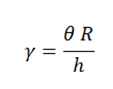
Dynamic or oscillatory tests cover a wide range of stresses in relatively short times, offering very valuable results (3). The operation of the equipment can be by controlled tension or by controlled deformation. In a tension controlled arrangement, a fixed torque is applied to the top plate to generate the oscillating motion. Because the applied stress level is fixed, the distance the plate moves in its oscillatory path can vary between cycles. When the strain-controlled test is defined, the upper platen is accurately moved between the amplitude extremities at the specified frequency and the torque required to maintain oscillation is measured. Since the DSR only takes three measurements; torque, angular rotation and time, all results are calculated from these variables. The following equations are used to calculate the strain () and stress () in the equipment:

( 1 )

Where:

g is the deformation of the sample, dimensionless or expressed in%.

q is the angular rotation, in radians (rad).

R is the radius of the plate, in millimeters (mm).

h is the space between the plates, in mm.

( 2 )

Where:

t is the shear stress, in Pa.

T is the recorded torque, in Newton meter (Nm).

From these definitions the absolute complex cut modulus is derived, whose expression is the following:

( 3 )

Where:

G * (ω) is the complex shear modulus, expressed in Pa.

ω is the angular frequency, in radians per second (rad / s).

Note: in this work the angular velocity will be referred to as angular frequency or simply frequency, therefore the frequency variable may present units of rad/s or Hertz (Hz). Both are related as .

Note: in this work the angular velocity will be referred to as angular frequency or simply frequency, therefore the frequency variable may present units of rad/s or Hertz (Hz). Both are related as .

For viscoelastic materials such as asphalt, the shear modulus is composed of a loss modulus (viscous component, G'') and a storage modulus (elastic component, G'), the relative magnitude of which determines how the material responds to loads. applied. The two components are linked to the complex modulus by the phase angle in a vector sum as shown in Figure 1. Therefore, the different components can be related using equation 4:

For viscoelastic materials such as asphalt, the shear modulus is composed of a loss modulus (viscous component, G'') and a storage modulus (elastic component, G'), the relative magnitude of which determines how the material responds to loads. applied. The two components are linked to the complex modulus by the phase angle in a vector sum as shown in Figure 1. Therefore, the different components can be related using equation 4:

Where:

For viscoelastic materials such as asphalt, the shear modulus is composed of a loss modulus (viscous component, G'') and a storage modulus (elastic component, G'), the relative magnitude of which determines how the material responds to loads. applied. The two components are linked to the complex modulus by the phase angle in a vector sum as shown in Figure 1. Therefore, the different components can be related using equation 4:

G ’’ (ω) is the loss modulus, in Pa.

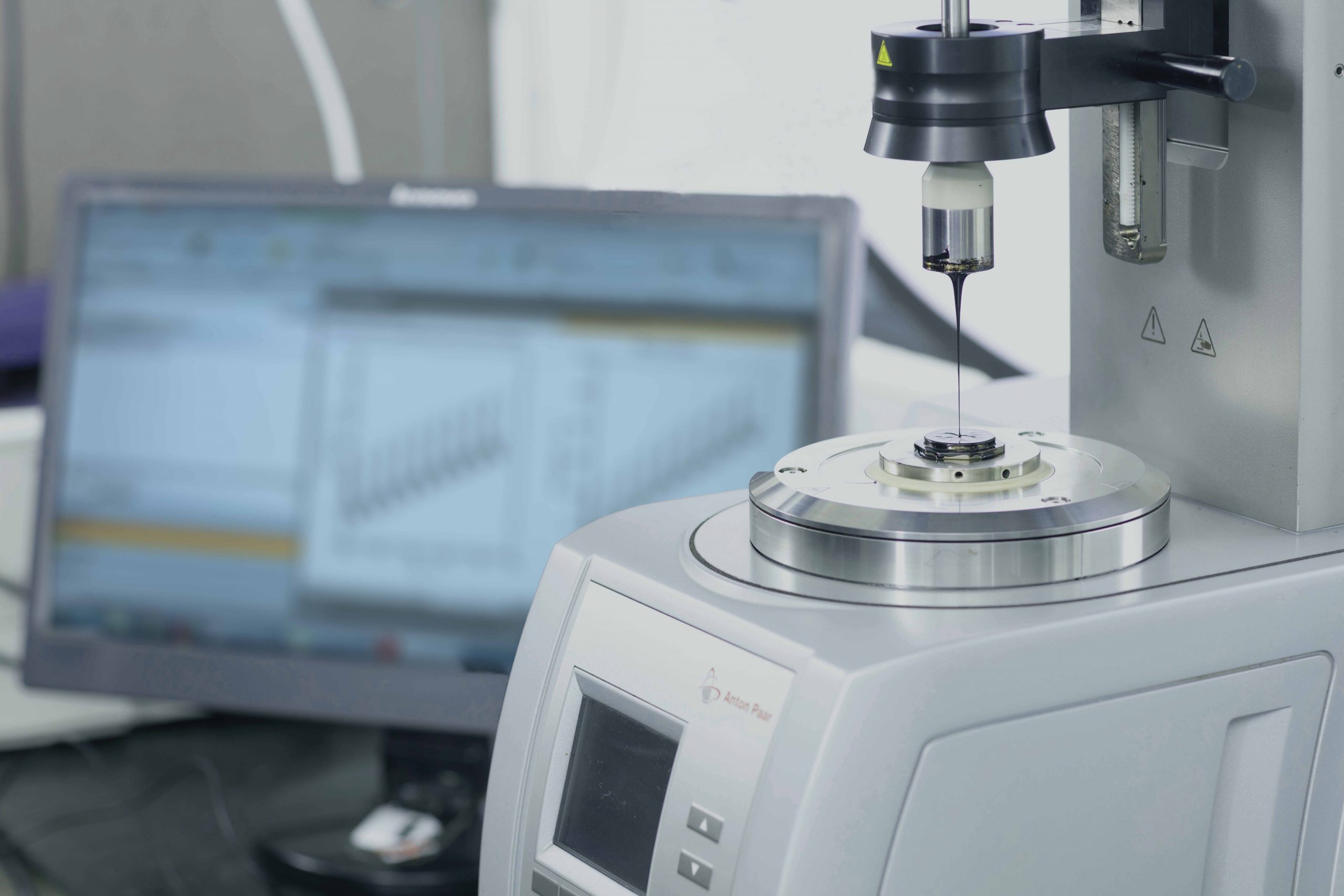
CITEVI has an Anton Para DSR SmartPave 102 shown in Figure 2. Due to the high stiffness of asphalt cements at room temperature, high shear stresses are required to reach a certain level of deformation, which can be limited by the minimum torque recordable by the equipment (2). To overcome this, the 8 mm diameter geometry is used to perform tests at temperatures below 35 °C and the 25 mm diameter geometry is used for tests where the temperature is equal to or greater than 35 °C. To maintain the specified temperature for each test, the equipment has a Peltier temperature control device and a water circulator to cool the pieces. In addition, an air compressor is used to help the rotation of the frictionless geometry in what is called an air bearing, allowing for high levels of precision. The operation of the rheometer and temperature control unit, along with data acquisition and analysis, are controlled by a computer.

Figure 2. SmartPave 102 dynamic shear rheometer. Taken from Anton Paar's website (4)

2 Linear viscoelastic region

The relationship between stress and strain in asphalt can be approximated as linear to small strains. Within this region, the relationship between stress and strain is influenced only by temperature and load time (frequency) and not by the magnitude of stress or strain. By increasing the amplitude of the stresses, the relationship is no longer linear and a decrease in the modulus of rigidity is caused (2).

There are three important reasons why the linear viscoelastic region of asphalt should be defined. First of all, it is advisable to limit the characterization of asphalt to its linear viscoelastic response to simplify the mathematical modeling of the material, since the nonlinear response, particularly for viscoelastic materials, is extremely difficult to characterize and model in the laboratory. Second, the rheological measurements and analysis methods are defined under the linear viscoelastic region. Finally, in the field of pavement design, it is necessary to study the asphalt and the asphalt mixture in the same domain in order to define the applicability limits of the linear viscoelastic theory (2).

BITAFAL enters the world of rheometry

BITAFAL enters the world of rheometry

New Reómetro Anton Paar SmartPave 102 at sion It will allow a big step in the performance of asphalt products in Uruguay.

As we announced in an earlier issue of our newsletterThis month installed a Court Dynamic Rheometer (DSR for its acronym in Ingés). This sophisticated equipment allows to know the performance of asphalts much of its viscoelastic range. Mainly we are concerned in these latitudes, that is at medium and high temperatures.

With this tool we can improve the modified asphalts and emulsions to suit the conditions of our country and know within minutes the quality of asphalts used as raw material.

With the addition of equipment, a course of rheology and use of equipment with an expert from the supplier was performed. The course was held on 27 and 28 August in the CITEVI and we have the participation of technical staff of our company, the MTOP and LATU.

This new machine is equipped with accessories for measurements from -20 to 150 ° C both conventional asphalts, as well as some modified properties of emulsions. Typically it used to determine the degree of asphalt (PG) but can be used for other properties of the binders.

Within the novel assays we can discuss the possibility of making master curves where temperatures and voltages applied to see the performance of the binders are varied. It is also possible to test highly accurate adhesion or cohesion at different temperatures, essential for the performance of emulsions for surface treatment tool.

Not so new but convenient is the possibility of viscosities "brookfield" within minutes both 60 ° C to the viscosity curves at the desired temperature range.

These are some of the many tests that can be performed but the team is extremely versatile and has many accessories that allow analyzing from food to paint smoothly.

In the course they made the basics of fluid mechanics, equipment operation and its application to the asphalts were given. It had a practical module to understand the operation of equipment and advanced software that controls and processes data.

Much remains to explore and contribute to our road with this team. We will keep you informed of progress.

CITEVI gives a great step incorporates a Rheometer (DSR)

CITEVI gives a great step incorporates a Rheometer (DSR)

We are pleased to inform our readers that we are adding to our Research Center (CITEVI) Court Dynamic Rheometer (DSR for its acronym in English).

In a natural evolution of a company committed to the development of national road company, it's time to incorporate a computer that involves a before and after in the knowledge of the binders we handle.

This sophisticated equipment allows to know the performance of asphalts much of its viscoelastic range. Mainly we are concerned in these latitudes, that is at medium and high temperatures.

The team selected after several months of visits to research centers in the region and the US, is a Anton Paar SmartPave 102 with all accessories to perform the usual tests standardized by AASHTO and other agencies both America and Europe.

It is expected to be operational by August so we'll have more news on this in future editions of this Newsletter.

We use own and third party cookies to help us optimize your visit to our website and also to improve service delivery and thus adapt to their most relevant and useful to better their experience needs. When you click OK to continue with navigation and thus confirm that you have read the information and accept the activation of cookies.

You can allow or reject use at any time can change the Configuration Options Privacy - Cookies Policy -

Privacy settings

When you visit a website, you can store or retrieve information in your browser, mainly in the form of cookies. Check your personal services cookies here.


We track anonymous user information to improve our website.
.
  • _ga
  • _gid
  • _gat

Decline all Services
Accept all Services