ASPHALT RHEOLOGY

ASPHALT RHEOLOGY

Rheology is the science that studies the internal response of materials when they deform as a result of an applied stress. To learn about the rheological properties of any material, one must measure the deformation resulting from an applied stress or the force required to produce a given deformation (1).

1 Dynamic Cutoff Rheometer (DSR)

Dynamic shear rheometers are used to study the rheological behavior of various materials, including asphalt. The two most common methods used by the team to determine the viscoelastic properties of asphalts are transient (constant rate stress/strain) and dynamic (oscillatory) methods (2). The typical configuration of these equipments consists of a fixed lower plate and a mobile upper plate, between which an asphalt sample is placed, to which a shear stress is applied.

Dynamic or oscillatory tests cover a wide range of stresses in relatively short times, offering very valuable results (3). The operation of the equipment can be by controlled tension or by controlled deformation. In a tension controlled arrangement, a fixed torque is applied to the top plate to generate the oscillating motion. Because the applied stress level is fixed, the distance the plate moves in its oscillatory path can vary between cycles. When the strain-controlled test is defined, the upper platen is accurately moved between the amplitude extremities at the specified frequency and the torque required to maintain oscillation is measured. Since the DSR only takes three measurements; torque, angular rotation and time, all results are calculated from these variables. The following equations are used to calculate the strain () and stress () in the equipment:
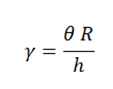
( 1 )

Where:

g is the deformation of the sample, dimensionless or expressed in%.

q is the angular rotation, in radians (rad).

R is the radius of the plate, in millimeters (mm).

h is the space between the plates, in mm.

( 2 )

Where:

t is the shear stress, in Pa.

T is the recorded torque, in Newton meter (Nm).

From these definitions the absolute complex cut modulus is derived, whose expression is the following:

( 3 )

Where:

G * (ω) is the complex shear modulus, expressed in Pa.

ω is the angular frequency, in radians per second (rad / s).

Note: in this work the angular velocity will be referred to as angular frequency or simply frequency, therefore the frequency variable may present units of rad/s or Hertz (Hz). Both are related as .

Note: in this work the angular velocity will be referred to as angular frequency or simply frequency, therefore the frequency variable may present units of rad/s or Hertz (Hz). Both are related as .

For viscoelastic materials such as asphalt, the shear modulus is composed of a loss modulus (viscous component, G'') and a storage modulus (elastic component, G'), the relative magnitude of which determines how the material responds to loads. applied. The two components are linked to the complex modulus by the phase angle in a vector sum as shown in Figure 1. Therefore, the different components can be related using equation 4:

For viscoelastic materials such as asphalt, the shear modulus is composed of a loss modulus (viscous component, G'') and a storage modulus (elastic component, G'), the relative magnitude of which determines how the material responds to loads. applied. The two components are linked to the complex modulus by the phase angle in a vector sum as shown in Figure 1. Therefore, the different components can be related using equation 4:

Where:

For viscoelastic materials such as asphalt, the shear modulus is composed of a loss modulus (viscous component, G'') and a storage modulus (elastic component, G'), the relative magnitude of which determines how the material responds to loads. applied. The two components are linked to the complex modulus by the phase angle in a vector sum as shown in Figure 1. Therefore, the different components can be related using equation 4:

G ’’ (ω) is the loss modulus, in Pa.

CITEVI has an Anton Para DSR SmartPave 102 shown in Figure 2. Due to the high stiffness of asphalt cements at room temperature, high shear stresses are required to reach a certain level of deformation, which can be limited by the minimum torque recordable by the equipment (2). To overcome this, the 8 mm diameter geometry is used to perform tests at temperatures below 35 °C and the 25 mm diameter geometry is used for tests where the temperature is equal to or greater than 35 °C. To maintain the specified temperature for each test, the equipment has a Peltier temperature control device and a water circulator to cool the pieces. In addition, an air compressor is used to help the rotation of the frictionless geometry in what is called an air bearing, allowing for high levels of precision. The operation of the rheometer and temperature control unit, along with data acquisition and analysis, are controlled by a computer.

Figure 2. SmartPave 102 dynamic shear rheometer. Taken from Anton Paar's website (4)

2 Linear viscoelastic region

The relationship between stress and strain in asphalt can be approximated as linear to small strains. Within this region, the relationship between stress and strain is influenced only by temperature and load time (frequency) and not by the magnitude of stress or strain. By increasing the amplitude of the stresses, the relationship is no longer linear and a decrease in the modulus of rigidity is caused (2).

There are three important reasons why the linear viscoelastic region of asphalt should be defined. First of all, it is advisable to limit the characterization of asphalt to its linear viscoelastic response to simplify the mathematical modeling of the material, since the nonlinear response, particularly for viscoelastic materials, is extremely difficult to characterize and model in the laboratory. Second, the rheological measurements and analysis methods are defined under the linear viscoelastic region. Finally, in the field of pavement design, it is necessary to study the asphalt and the asphalt mixture in the same domain in order to define the applicability limits of the linear viscoelastic theory (2).

ASPHALT

ASPHALT

Continue read: ASFALTO

Among its main characteristics, it stands out that it is a non-volatile material at room temperature and atmospheric pressure, it is an excellent waterproofing and adhesive, and it has a relatively stable chemical structure. All these factors, added to its low cost, have positioned it as the material par excellence for road construction (2).

1 History of asphalt

Asphalt, or bitumen, is well known and used since ancient times. The extensive deposits of crude oil in the Middle East have been seeping to the surface in the form of "natural" bitumen for thousands of years. The ancient inhabitants of these parts quickly appreciated the excellent waterproofing, adhesive and preservative properties of the material and quickly made it available to them (2).

The first recorded use was by the Sumerians whose empire existed from around 3500 BC. until about 2000 BC, and they used to use it in ship building (2). Later, the Babylonians used it as a binder in the construction of castles, such as the Tower of Babel. Asphalt was also used by the Egyptians both to mummify corpses and to waterproof reservoirs of water (3).

The Greek word asphaltos it was used during Homeric times to mean stable or solid substance. Later, it was adopted by the Romans who used the material to waterproof their baths, reservoirs and aqueducts (3).

The earliest uses of asphalt as a road construction material date back to around 615 BC. in Babylon, in the reign of King Nabopolassar. It is believed that this character was a skilled exponent of the use of bitumen because there is evidence that he used the product to waterproof the masonry of his palace and as a grout for stone paths. This record is inscribed on a brick, where it is detailed that the paving of the street that linked the palace to the north wall of the city had been made "with asphalt and burnt brick" (4).

2 Obtaining and production

Natural asphalt is extracted from the ground and can be associated with other mineral matter (sand, clay, rocks). The most common way to find natural asphalt is in surface deposits or lakes, mainly in Venezuela (Lake Bermúdez) and in Trinidad and Tobago (Lake La Brea or Trinidad) (1).

Asphalt can also be found naturally in the form of asphaltite or gilsonite (its correct name is uintaite) in deposits that are mainly found in the United States, Cuba and Argentina. Additionally, asphalt can be found naturally, impregnated in concentrations of up to 12%, within limestone or sandstone rocks that are extracted from mines or quarries depending on the deposit (1).

On the other hand, asphalt is obtained artificially from the distillation of petroleum. There are mainly four oil extraction areas in the world: North America, the Caribbean, Russia and the Middle East. According to these zones, the physical and chemical characteristics of the crude vary considerably. Of the 1,500 types of crude produced in the world, only a few are suitable for the production of asphalt.

In refineries, the crude oil is heated to 350 °C and enters distillation towers. Distillation is a physical separation process, based on the difference in boiling points between components in the same liquid mixture. As the boiling points of hydrocarbons increase with their molecular masses, the first vaporization of volatile compounds and then the fractional distillation of the rest of the components becomes possible (5). The lighter fractions (propane, butane, naphtha, kerosene, gas oil) are extracted and the residue, also called "tower bottom", passes to a vacuum distillation tower that separates the asphalt from the other distillates still present in the crude. (6).

3 Conventional asphalt

3 Conventional asphalt

3 Conventional asphalt

The chemical composition of asphalt varies according to the crude oil and its refining process. However, broadly speaking, the content can be separated into two groups called asphaltenes and maltenes, which in turn are subdivided into saturates, aromatics and resins. These four groups are not strictly defined and there is some overlap between them. The structure of asphalt is considered as a colloidal system made up of micelles of high molecular weight asphaltenes dispersed or dissolved in an oily medium (maltenes) of low molecular weight (2).

3.2 Viscoelastic behavior

Viscoelastic materials are those that exhibit elastic and viscous behavior simultaneously (7). Several factors affect the behavior of viscoelastic materials, with temperature being the most critical parameter. The mechanical response of asphalt varies from that of an elastic solid to that of a Newtonian fluid in the temperature range from −20 to 150 °C. In the working temperature range of the pavement, knowing the exact nature of the response is essential, since it has a significant influence on the magnitude of the damage due to permanent deformation and fatigue (8).

The other parameter that has a marked effect on viscoelastic materials is the loading time or loading speed (frequency). Asphalt behaves as an elastic solid at high load speeds, exhibiting high stiffness and eventually brittleness; while it behaves like a viscous liquid in prolonged loading times, presenting high ductility and low rigidity (9).

Figure 7 shows the response of an asphalt sample in the creep test or creep. The stress resulting from the applied load shows an instantaneous elastic response followed by a gradual increase in stress over time until the load is removed. The change in stress over time is caused by the viscous behavior of the material. When the load is removed, the elastic stress recovers instantly and additional recovery occurs over time, known as "delayed elasticity." Ultimately, a permanent residual deformation remains, which is irrecoverable and is caused directly by the viscous behavior (2).

Figure 1. Asphalt response in the creep test. Adapted from The Shell Bitumen Handbook (2)

The modulus of stiffness of asphalt, by analogy with the modulus (E) of elastic solids, is the relationship between stress (σ) and strain (ε). However, the modulus of rigidity of a viscoelastic material depends on the loading time (t) and the temperature (T) (3). Therefore, the modulus of stiffness of asphalt can be determined by Equation 1:

( 1 )

Where:

is the asphalt's modulus of stiffness at a given temperature and with a given load application time (frequency), in Pascals (Pa).

σ is the applied stress or load, in Pa.

is the deformation relative to the original dimensions due to the application of the load, for a given temperature and time (frequency). It is usually measured in percentage (%).

It is difficult to experimentally demarcate a viscoelastic solid from a viscoelastic fluid at a defined temperature, since the precise nature of the response depends on the loading rate (8). For very short load application times, the modulus of rigidity is practically constant and asymptotic towards 3 × 10⁹ Pa, regardless of temperature. In these cases the asphalt behaves as an elastic solid. On the contrary, when the load application time is high or the temperature increases, the stiffness modulus decreases considerably, reflecting the viscous behavior of the asphalt. At the usual pavement service temperatures and under the usual traffic loads, the behavior can be generalized as viscoelastic (2).

The fact that a material exhibits viscoelastic fluid behavior at a given temperature and frequency, and simultaneously that same sample can exhibit viscoelastic solid behavior at the same temperature and at a much higher frequency is known as the principle of time-temperature superposition. and it is a fundamental property of viscoelastic materials. This rule is very useful because it allows us to study the nature of asphalt at frequencies that cannot be experimentally achievable and will be explored in greater depth later.

The fact that a material exhibits viscoelastic fluid behavior at a given temperature and frequency, and simultaneously that same sample can exhibit viscoelastic solid behavior at the same temperature and at a much higher frequency is known as the principle of time-temperature superposition. and it is a fundamental property of viscoelastic materials. This rule is very useful because it allows us to study the nature of asphalt at frequencies that cannot be experimentally achievable and will be explored in greater depth later.

Viscosity is a fundamental characteristic property of asphalt as it determines how it will behave at a specific temperature or range of temperatures. Viscosity is defined as a measure of the resistance to flow (shear or tensile stresses) due to internal friction between molecules (10). In asphalt, viscosity is affected inversely to temperature; the higher the temperature, the lower the viscosity.

In the fundamental way of measuring viscosity, the space between two planes movable relative to each other (straight as in parallel plates or curved as in concentric cylinders) is filled with asphalt. The force that opposes the movement of one of the planes due to the applied shear stress is developed solely due to the presence of the material. This force is proportional to the area and the relative speed of movement from one plane to another and inversely proportional to the distance between the plates. The constant that relates the variables is the viscosity, as shown in equation 2.

( 2 )

Where:

FIn the fundamental way of measuring viscosity, the space between two planes movable relative to each other (straight as in parallel plates or curved as in concentric cylinders) is filled with asphalt. The force that opposes the movement of one of the planes due to the applied shear stress is developed solely due to the presence of the material. This force is proportional to the area and the relative speed of movement from one plane to another and inversely proportional to the distance between the plates. The constant that relates the variables is the viscosity, as shown in equation 2. In the fundamental way of measuring viscosity, the space between two planes movable relative to each other (straight as in parallel plates or curved as in concentric cylinders) is filled with asphalt. The force that opposes the movement of one of the planes due to the applied shear stress is developed solely due to the presence of the material. This force is proportional to the area and the relative speed of movement from one plane to another and inversely proportional to the distance between the plates. The constant that relates the variables is the viscosity, as shown in equation 2.

A is the surface between both planes that contains the fluid, in square meters (m2).

A is the surface between both planes that contains the fluid, in square meters (mA is the surface between both planes that contains the fluid, in square meters (mA is the surface between both planes that contains the fluid, in square meters (m

A is the surface between both planes that contains the fluid, in square meters (mA is the surface between both planes that contains the fluid, in square meters (m

A is the surface between both planes that contains the fluid, in square meters (m

( 3 )

Where:

A is the surface between both planes that contains the fluid, in square meters (m

A is the surface between both planes that contains the fluid, in square meters (m

For viscoelastic materials such as asphalt, the shear modulus is composed of a loss modulus (viscous component, G'') and a storage modulus (elastic component, G'), the relative magnitude of which determines how the material responds to loads. applied. The two components are linked to the complex modulus by the phase angle in a vector sum as shown in Figure 1. Therefore, the different components can be related using equation 4:

Bibliography

  1. A is the surface between both planes that contains the fluid, in square meters (m A is the surface between both planes that contains the fluid, in square meters (m A is the surface between both planes that contains the fluid, in square meters (m
  2. Read, John y Whiteoak, David. Read, John y Whiteoak, David. Read, John y Whiteoak, David.
  3. Nikolaides, Athanassios. Highway Engineering: Pavements, Materials and Control of Quality. EUA : Taylor & Francis Group, 2015.
  4. Read, John y Whiteoak, David. Read, John y Whiteoak, David. Read, John y Whiteoak, David.
  5. Read, John y Whiteoak, David. Read, John y Whiteoak, David. Read, John y Whiteoak, David.
  6. Read, John y Whiteoak, David. Read, John y Whiteoak, David.
  7. Read, John y Whiteoak, David. Read, John y Whiteoak, David. Read, John y Whiteoak, David.
  8. Read, John y Whiteoak, David. Read, John y Whiteoak, David. s.l. : INTERNATIONAL JOURNAL OF PAVEMENT ENGINEERING, 2018, International Journal of Pavement Engineering.
  9. s.l. : INTERNATIONAL JOURNAL OF PAVEMENT ENGINEERING, 2018, International Journal of Pavement Engineering. s.l. : INTERNATIONAL JOURNAL OF PAVEMENT ENGINEERING, 2018, International Journal of Pavement Engineering. s.l. : INTERNATIONAL JOURNAL OF PAVEMENT ENGINEERING, 2018, International Journal of Pavement Engineering.
  10. s.l. : INTERNATIONAL JOURNAL OF PAVEMENT ENGINEERING, 2018, International Journal of Pavement Engineering. s.l. : INTERNATIONAL JOURNAL OF PAVEMENT ENGINEERING, 2018, International Journal of Pavement Engineering. s.l. : INTERNATIONAL JOURNAL OF PAVEMENT ENGINEERING, 2018, International Journal of Pavement Engineering.
  11. s.l. : INTERNATIONAL JOURNAL OF PAVEMENT ENGINEERING, 2018, International Journal of Pavement Engineering. s.l. : INTERNATIONAL JOURNAL OF PAVEMENT ENGINEERING, 2018, International Journal of Pavement Engineering. s.l. : INTERNATIONAL JOURNAL OF PAVEMENT ENGINEERING, 2018, International Journal of Pavement Engineering.
  12. s.l. : INTERNATIONAL JOURNAL OF PAVEMENT ENGINEERING, 2018, International Journal of Pavement Engineering. s.l. : INTERNATIONAL JOURNAL OF PAVEMENT ENGINEERING, 2018, International Journal of Pavement Engineering. s.l. : INTERNATIONAL JOURNAL OF PAVEMENT ENGINEERING, 2018, International Journal of Pavement Engineering.
  13. s.l. : INTERNATIONAL JOURNAL OF PAVEMENT ENGINEERING, 2018, International Journal of Pavement Engineering. s.l. : INTERNATIONAL JOURNAL OF PAVEMENT ENGINEERING, 2018, International Journal of Pavement Engineering.

We use own and third party cookies to help us optimize your visit to our website and also to improve service delivery and thus adapt to their most relevant and useful to better their experience needs. When you click OK to continue with navigation and thus confirm that you have read the information and accept the activation of cookies.

You can allow or reject use at any time can change the Configuration Options Privacy - Cookies Policy -

Privacy settings

When you visit a website, you can store or retrieve information in your browser, mainly in the form of cookies. Check your personal services cookies here.


We track anonymous user information to improve our website.
.
  • _ga
  • _gid
  • _gat

Decline all Services
Accept all Services