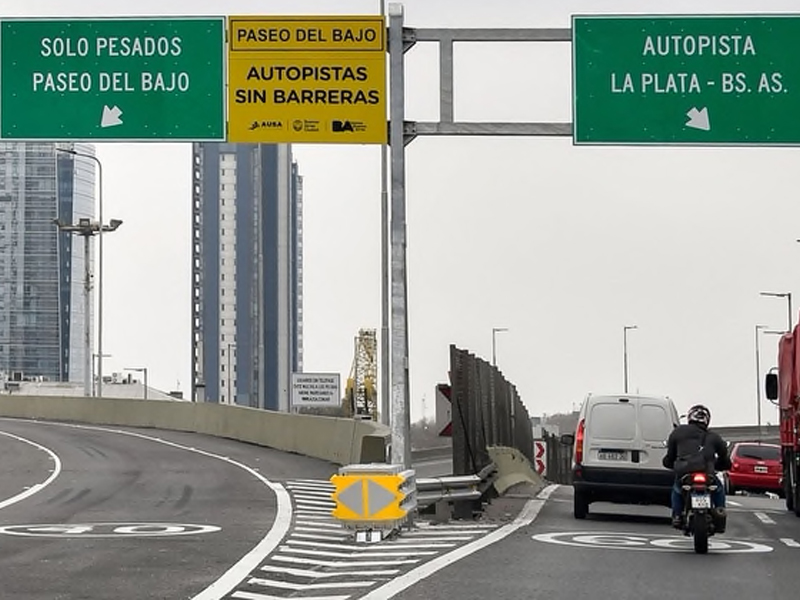
Under the Walk is a 7.1 kilometer road corridor connecting the Illia and Buenos Aires-La Plata highway.
We had the opportunity to tour the recently opened Paseo del Bajo works, construction facilitating cross the city of Buenos Aires in just ten minutes already benefit some 12 thousand vehicles per day, between heavy and light. We invite you to read the note to know the details of the various stages where we were present and see pictures of such a work of engineering.
At the junction of the 25 de Mayo and Ricardo Balbín highways (Buenos Aires-La Plata), this work begins, which, although it had been planned since the 1980s, had never been carried out. The project consisted of about 7,300 meters in total length, in viaduct typologies, level sections, semi-covered trenches and open pit. The work was built in three sections (A, B and C) by 4 construction companies, IECSA, COARCO, GREEN and CEOSA. Section A consists of a viaduct and in particular was divided into two sections: A-South, which connects with the Buenos Aires-La Plata and 25 de Mayo highways, and A-Norte with the Illia highway. Sections B and C are mostly low level. Transversal crossings between Microcentro and Puerto Madero were also installed through several streets, and together with the 60,000 m² of new green spaces of squares and parks, the historical barriers that separated Buenos Aires from the Río de la Plata were eliminated. The terms of the work were 17 months for section A and 28 months for sections B and C, at an approximate cost of US$650 million.
The configuration of the highway is two lanes in each direction of traffic, each lane approximately 11 meters wide, with New Jersey TL5 concrete guardrails. The rolling course in the viaduct sections consisted of a fine leveling layer of asphalt sand with modified asphalt type AM3, about 3 cm, followed by a 7 cm layer of SMA 19. In the low-level sections, a 7 cm layer of conventional asphalt added to another 7 cm of SMA 19. Some 832 beams were placed in the viaduct sections, of which 796 were manufactured in the plant, with a double T section and lengths between 21 and 26 meters, in all alleged cases. Then there were 36 special beams which break down as follows:
- nine beams 36 meters long, 1.90 high and 120 tons, manufactured in situ, post-tensioned and mounted on spans of 36 meters above the Illia highway.
- two beams 42 meters, 1.90 tall, made in situ post-tensioned and mounted on a branch access.
- 25 beams 42 meters, height 2.5, 180 tons of which 6 were manufactured in situ, post-tensioned, and 19 which were prefabricated segments (7 segments per beam) to be assembled and tesaron in the trace. These beams were mounted on the main boards where will the lower rail level.
All the special beams were assembled by means of two frames that ran along tracks perpendicular to the layout. The beams were moved to the assembly site with an innovative traction buggy system, where they were raised and mounted above the spans. Placing the beams for the viaduct presented great challenges. We had the immense pleasure of witnessing the placement of the monumental piece of 42 meters and 180 tons, as can be seen in the photos.
Like any project of this magnitude, the work on Paseo del Bajo had other challenges, which had to be resolved with fair schedules. Among other factors, they had to work in very confined spaces, always allowing (although with difficulties) traffic at all times. In addition, when working in the vicinity of the Río de la Plata, it was also important to take into account the water table when excavating for the trenches, and also to consider sanitation services with large pipes that had to be avoided. Despite these complications, the work was completed in a timely manner, being inaugurated on the 27th of last month.
We congratulate all the professionals responsible for carrying out this magnificent work of engineering and we appreciate the kind invitation to witness a project of this nature.
More photos and note INFOBAE