VEDA IN Surface treatments

VEDA IN Surface treatments

With the imminent entry of autumn, we should take the necessary precautions in the execution of surface treatments.

The ban begins in a few days and the most suitable for our summer climate emulsions begin to generate low yields in the execution by the cold and the few hours of insolation that we are already living.

Asphalts specifications based emulsions remain unchanged throughout the year. If the manufacturer wants a change in specifications to continue the work, we do get an email with the desired specification.

We recall that in remitos load the batch number corresponding detailed, and which can enter our website to have the Quality report and to corroborate with the requested specifications.

To maintain the quality of the works must run less meters per day before releasing traffic with some specific recommendations always looking to reduce the amount of water in the system.

We invite you to know in detail the recommendations on the following link "SEVEN RECOMMENDATIONS FOR USE OF EMULSIONS IN WINTER"

surface treatments:

1) heating the emulsion to be used above 70 ° C to promote evaporation of water from the emulsion itself.

2) Do not wet aggregates and try to use the top in the collection that are drier and drained, not load the gathering at the bottom.

3) Start the task early in the morning, regardless of the prevailing temperature, for that tranche has executed the most hours of exposure to air, wind and sun.

4) Apply TMT technologiesThat favor locking of aggregates applied, achieving superior quality and finish.

5) Have properly calibrated equipment graveled and irrigation to the quality objective is sought to be achieved.

Irrigations primer:

In these autumn and winter periods irrigation primer they are affected by the high rate of humidity in the foundations.

It must be respected as well as primers with dilute MC 1, optimum moisture application for the purpose of achieving a successful work.

By the above, it is normal for a primer in summer takes less than 1 hour in winter takes more than 24 hours to get to be acceptable.

Soil stabilization:

It is best suited to perform soil stabilization with cement or lime period.

Water needs hydration are very basic and profiling work, compaction and sealing are unmatched.

Here the sealing emulsion IRRIGATION BITAFAL 65 at 1 per square meter lt should be complemented with a sealed with quarry dust good quality.

These bases have such successful results supporting several months before recommencing graveled tasks in appropriate months.

SUCCESS STORIES IN WINTER GRAVILLADOS

SUCCESS STORIES IN WINTER GRAVILLADOS

The use of the technique TDT (Double Treatment Trabado) graveled in various works that have recently implemented show that emulsions may be used during the winter successfully without risk of landslides and significant material savings.

Such is the case of the work done by NECKLACE Ruta 19, executed by the banquinas BITAFAL RENTALS for SERVIAM in Route 5 and TECHINT in Route 9 and Route 16.

All these works were done with modified emulsions Bitaflex P40 or P25 Riego 65 using the technique TDT (Note: "Innovative technologies for surface treatments in winter") Without any detachment.

This is due to the combination of good materials and implementing ways appropriate to the era. The key is to run two risks in the day achieving total mechanical interlock and to even make irrigation fog on the same day to ensure adherence of the entire stone and a superior aesthetic finish. Moreover it is essential dosing intelligently materials to have the optimal amounts in each irrigation and save on the materials used.

We invite you to know the procedure used in our blog:INNOVATIVE SURFACE TREATMENT TECHNOLOGIES IN WINTER

Strength studies ductility performed on the binders for surface treatments show that the modified emulsions Bitaflex Riego 65 P25 and P40 have a cohesive energy far superior to any common emulsion and not to mention the asphalt diluted, which contributes to the durability of the matrix achieved in the implementation of DTT.

As the images of the enclosed work COLIER in Route 19 can be seen that achieved is homogeneous matrix, containing suitable gaps for expansion of the bitumen in summer and very little excess stone in the shoulders.

We invite you to contact if considered necessary to deepen the dosage form and implementation of a TDT or the selection of suitable materials: bitafal@bitafal.com.uy

GRAVILLADOS HOT IN WINTER

GRAVILLADOS HOT IN WINTER

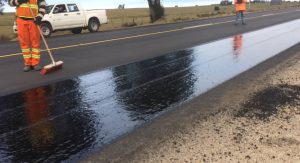
Last week with the company H & G successful tests gravillados hot in the shoulders of Route 3 were performed.

Because of the ban at this time governing a special binder it was developed to achieve full adherence of the aggregate used avoiding disadvantages of premature landslides and excess binder that can lead to exudates with the first warm days.

The developed binder BITAFLEX TERMOSEAL has various modifying additives to achieve immediate adhesion of stone (even when it contains dust) while maintaining a high viscosity to prevent exudates in warm periods.

This technology is used in Australia and New Zealand in winter periods with lower temperatures at local performing well and avoiding closures work both delay the execution of the works.
For implementing the binder is preheated and irrigated with sprinkler truck about 110 ° C noting that the range of irrigation fully open. There are no contraindications if it is cooled before the gravel is applied. In the video of the execution pe can be observed that the asphalt after application reaches 14 ° C and gravel applied almost 20 minutes after adhered smoothly.
In case of dirty stone, it must be dried by passing it through the asphalt plant until it reaches a temperature higher than 105ºC. In this way, the separation of the possible dust adhering to the stone is guaranteed (which once released, will not interfere during the irrigation as can be seen in the video). The graveling was carried out taking all the precautions corresponding to a work with hot binder and with ambient temperatures below 14 ° C. Once the binder and the gravel had been applied, it was compacted with a pneumatic compactor, making about 5 passes at 8 km / h.

The results were more than satisfactory in the first section executed, releasing the traffic immediately after compacting. To demonstrate the high adhesion between the BITAFLEX TERMOSEAL and gravel, it was circulated by the roadside traffic route without receiving any detachment. This technology can be applied even with cold gravels prewrapped with special asphalts or suitable emulsions prepared in times of good weather during the winter and apply automatic double spacing.


These tests were conducted in the presence of Ing. Jorge Galusso and MTOP assistants for the purpose of studying in situ the performance of technology.

VIDEO: https://youtu.be/WboY2CqnIKw

We use own and third party cookies to help us optimize your visit to our website and also to improve service delivery and thus adapt to their most relevant and useful to better their experience needs. When you click OK to continue with navigation and thus confirm that you have read the information and accept the activation of cookies.

You can allow or reject use at any time can change the Configuration Options Privacy - Cookies Policy -

Privacy settings

When you visit a website, you can store or retrieve information in your browser, mainly in the form of cookies. Check your personal services cookies here.


We track anonymous user information to improve our website.
.
  • _ga
  • _gid
  • _gat

Decline all Services
Accept all Services