What are the treatments Multiple Trabados®?
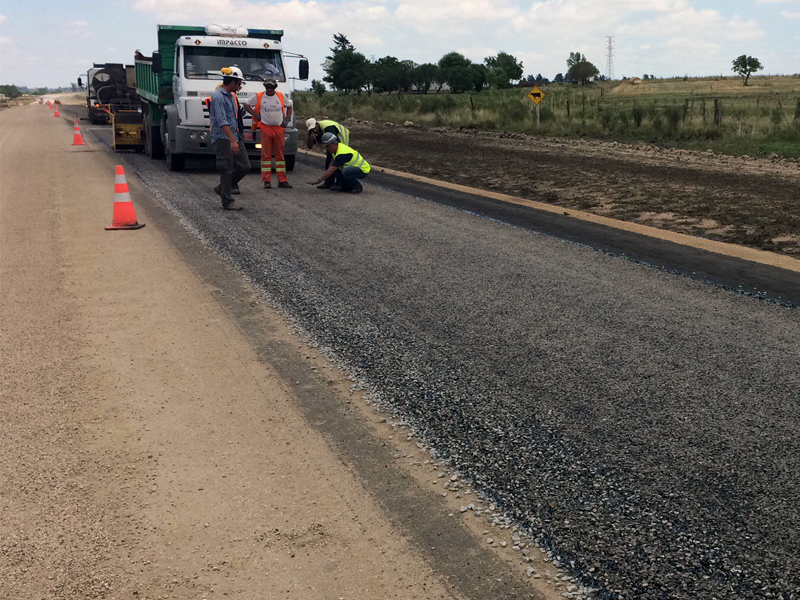
The TMT® are an innovative way to run single and double treatments, which improves the mechanical interlocking of aggregates and minimizes risks of landslides.
Its development is linked to the use of emulsions it allows full coverage of aggregates and which differs from the conventional methods as applicable.
They can be run at any time of the year and on any surface, allowing traffic early release with conventional methods than aesthetics. Success depends on the type and quality of materials in conjunction with the proper technique. It is ideal for initial treatment of stabilized bases technique.
The TMT® They are the product of several years of observation and continuous improvement of construction procedures with laboratory research, new product development, development plan and implementation on site.
HOW DOES IT WORK?
- It involves placing the right amount of binder and aggregate at the appropriate time and place, saving up to 20% of materials.
- optimum mechanical and chemical resistance is achieved by the way it is run, accelerating the curing process and accommodating the stone to ensure detachment almost zero.
- The method includes a number of key intermediate steps substantially increase the adhesion between the aggregates.
- aeration of the emulsion is favored, allowing further exposure to external agents which accelerate curing.
- Find your best performance with the use of modified emulsions.
SOLVE WHAT?
- Gravillados building permits at any time of year.
- Accelerates the speed of work, allowing progress without risks.
- Minimizes landslides and prevents excess aggregate causing damage to the windshield and risks to users.
- It requires fewer passes fracture mitigating Compactor aggregates and prevents its removal from the use of this equipment.
- It does not require subsequent scan, nor tire compactors to settle the stone.
- It allows controlled traffic before the system has completely healed rating.
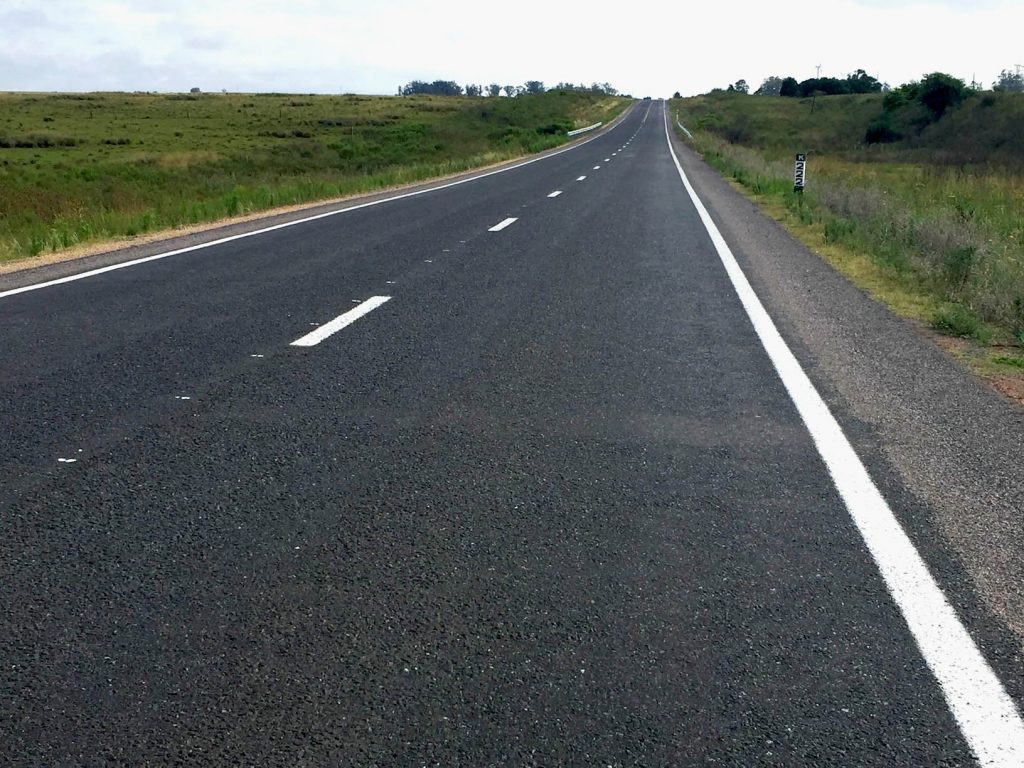
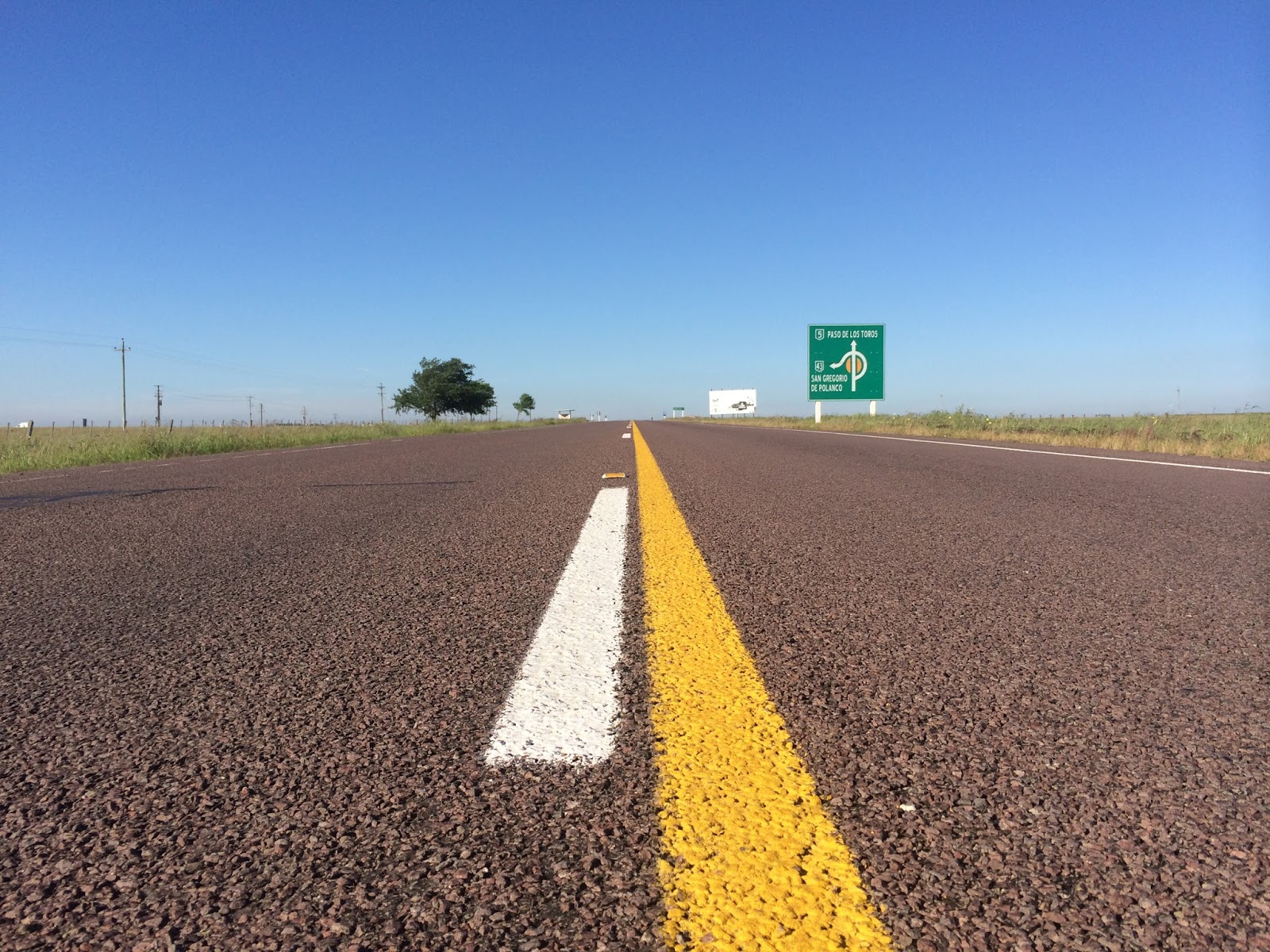
- The final quality of the surface obtained is smooth and silent, with better contrast for roadway marking.
- All jobs are completed in a single workday, allowing high yields.
What are the treatments Multiple Trabados®?
The TMT® are an innovative way to run single and double treatments, which improves the mechanical interlocking of aggregates and minimizes risks of landslides.
Its development is linked to the use of emulsions it allows full coverage of aggregates and which differs from the conventional methods as applicable.
They can be run at any time of the year and on any surface, allowing traffic early release with conventional methods than aesthetics. Success depends on the type and quality of materials in conjunction with the proper technique. It is ideal for initial treatment of stabilized bases technique.
The TMT® They are the product of several years of observation and continuous improvement of construction procedures with laboratory research, new product development, development plan and implementation on site.
HOW DOES IT WORK?
- It involves placing the right amount of binder and aggregate at the appropriate time and place, saving up to 20% of materials.
- optimum mechanical and chemical resistance is achieved by the way it is run, accelerating the curing process and accommodating the stone to ensure detachment almost zero.
- The method includes a number of key intermediate steps substantially increase the adhesion between the aggregates.
- aeration of the emulsion is favored, allowing further exposure to external agents which accelerate curing.
- Find your best performance with the use of modified emulsions.
SOLVE WHAT?
- Gravillados building permits at any time of year.
- Accelerates the speed of work, allowing progress without risks.
- Minimizes landslides and prevents excess aggregate causing damage to the windshield and risks to users.
- It requires fewer passes fracture mitigating Compactor aggregates and prevents its removal from the use of this equipment.
- It does not require subsequent scan, nor tire compactors to settle the stone.
- It allows controlled traffic before the system has completely healed rating.
- The final quality of the surface obtained is smooth and silent, with better contrast for roadway marking.
- All jobs are completed in a single workday, allowing high yields.
Capeseal technology tendered by MTOP on routes 12 and 108.
Capeseal technology takes hold in Uruguay with the first project awarded in this mode by the MTOP.
The company Emilio Alvarez Diaz S.A. it's found rehabbing a stretch of 32 km of Routes 108 and 12 in the Department of Canelones. The work consists of a charge in some areas and then performing a site recycling in 20 cm depth with 3% Portland cement and subsequent Capeseal treatment involving the execution of a simple treatment and bituminous cold microsurfacing above.
In this case the application of simple treatment is performed with emulsion IRRIGATION BITAFAL 65 at between 1.2 and 1.4 L / m2 and a gravel 14-20 mm applied between 13 and 15 L / m2. Once cured, the treatment is swept and the company R & K Engineers applies a cold emulsion microsurfacing BITAFLEX MICRO 62 P25 at a rate of about 14 kg / m2. The aesthetic completion of the work resembles an asphalt binder and provides an excellent Macrotexture giving greater security to the pavement.
There are several sections already implemented this technology as Route 55 or Route 69 successfully suggesting that the development of the same in the coming years will grow. So soon in the coming months the company Served S.A. You will be running a section of Route 60 Route 12 and in the Minas with Capeseal.
We believe that it is essential to make a good stable base for the Capeseal will play as a surface treatment lasting many years both in function and waterproofing in adherence with the tire without losing the aesthetic quality.
The use of modified emulsions for both simple treatment as for microsurfacing use should be binding as the adhesion achieved with much higher aggregate in respect to unmodified emusiones. In turn the selection of aggregates for both treatments should be carefully performed for an appropriate duration.
We hope to inform them about future works Capeseal in the coming months and leave you with some pictures of the work done.
HIGH PERFORMANCE EMULSION -BITAFLEX IRRIGATION 65 P40 -
Already there are several companies committed to quality work using the emulsion IRRIGATION BITAFLEX 65 P40 ensuring the life of bituminous treatment.
This product is being usad in various works in the country with excellent performance and in the first summer of use without detachments or risks rising by tires.
It is formulated with a high content of polymers that provide high cohesion and flexibility to the binder. During the summer and especially to the north, the emulsion P40 is being developed with hard asphalts which ensure suitable consistency and avoid potential exudates (with subsequent lifting) Excess binder.
We invite you to view photos of applications work
EMULSIONES BITAFAL IN WORK
emulsions IRRIGATION BITAFLEX 65 polymer modified P12, P25 and P40 and the 50 PRINT BITAFAL They are having a great performance in all works of surface treatment that is using the different areas in the country both in their application and end use.
They have good viscosity to prevent runoff and once in contact with the aggregate achieve high cohesion within minutes. The asphalt binder, adjusted penetration according to the time of year when we are working and the area of the country where the work is executed, is further modified with elastomeric polymers that provide excellent resistance to traffic and weather.
The hundreds of km of works in major routes as 10, 13, 15, 19, 20, 23, 26, 45, 57, among others, are witness to the above and shown BITAFAL engagement with Uruguay road.
We invite you to view images of some of the newly built surface treatments.
SUCCESS STORIES IN WINTER GRAVILLADOS
The use of the technique TDT (Double Treatment Trabado) graveled in various works that have recently implemented show that emulsions may be used during the winter successfully without risk of landslides and significant material savings.
Such is the case of the work done by NECKLACE Ruta 19, executed by the banquinas BITAFAL RENTALS for SERVIAM in Route 5 and TECHINT in Route 9 and Route 16.
All these works were done with modified emulsions Bitaflex P40 or P25 Riego 65 using the technique TDT (Note: "Innovative technologies for surface treatments in winter") Without any detachment.
This is due to the combination of good materials and implementing ways appropriate to the era. The key is to run two risks in the day achieving total mechanical interlock and to even make irrigation fog on the same day to ensure adherence of the entire stone and a superior aesthetic finish. Moreover it is essential dosing intelligently materials to have the optimal amounts in each irrigation and save on the materials used.
We invite you to know the procedure used in our blog: “INNOVATIVE SURFACE TREATMENT TECHNOLOGIES IN WINTER“
Strength studies ductility performed on the binders for surface treatments show that the modified emulsions Bitaflex Riego 65 P25 and P40 have a cohesive energy far superior to any common emulsion and not to mention the asphalt diluted, which contributes to the durability of the matrix achieved in the implementation of DTT.
As the images of the enclosed work COLIER in Route 19 can be seen that achieved is homogeneous matrix, containing suitable gaps for expansion of the bitumen in summer and very little excess stone in the shoulders.
We invite you to contact if considered necessary to deepen the dosage form and implementation of a TDT or the selection of suitable materials: bitafal@bitafal.com.uy
SEVEN RECOMMENDATIONS FOR USE OF EMULSIONS IN WINTER
When they start to shorten the days and appear the first cold start problems with the use of emulsions. This situation is repeated year after year and often turns into a spiral of construction problems that last for months if the corresponding precautions are not taken.
Being a recurring theme which we have learned to solve these years, we bring our 7 recommendations regarding the selection of products and ways of implementation to work in cold weather conditions.
While asphaltic emulsions have minimal restrictions on use in winter, since moisture of the aggregate is not counterproductive, if it is imperative that the embodiment in winter is different from the traditional, to avoid problems of detachment during execution and prevent exudates which cause in the first warm days of spring and every year we complained.
Las emulsiones catiónicas cortan por desbalance de cargas eléctricas y no es selectivo de verano o invierno, así que SIEMPRE cortan. Luego del corte existen diversos procesos dentro de la emulsión como coalescencia y curado, en el cual el agua de la emulsión debe evaporar para lograr la cohesión necesaria del asfalto residual con la piedra y así evitar desprendimientos prematuros.
Said above it is evident that the moisture retained in the system due to the low evaporation during winter, the aggregate / asphalt affinity is less. Subject usually solved from the viewpoint of performance as long as the maximum temperatures are above 10 ° C, otherwise it is not advisable to use emulsions until maximal exceed that temperature.
1) IMPROVE THE RESISTANCE OF THE MATRIX OF ARIDAchieve the stone is held in place by mechanical locking means.
When working on granular bases, use a heavy cylinder for driving the aggregate in the base and thus prevent detachment traffic. These solutions have drawbacks because if the stone is not large enough gaps may be affected and when summer comes the binder has nowhere to expand and asphalt appears on the surface. But if you plan to make a second irrigation or sealed future.
* If simple treatment, can be made the same in two passes with half the components in each pass, making the initial half containing emulsion below and above and the second irrigation achieved get into the gaps of the first giving a stone matrix closed using a heavy compactor.
* In case of a double treatment, perform the two executions on the same day to achieve the same closed die from the outset.
2) START very early: You must run risks in the winter mornings, once that blunts the sun. Recall that the emulsions cut by decompensation loads and we need all available hours of evaporation.
3) terminate PAST PERFORMANCE NOON: Watering must be discontinued after noon for a time sufficient evaporation in the last application so that when night came, the system achieves sufficient to withstand uncontrolled traffic cohesion.
4) heat more EMULSIONS: Si el problema es el agua retenida en el sistema luego del corte, podemos ayudar al proceso de curado si calentamos la emulsión entre 80 y 95°C para que el agua evapore mas rápidamente. Con las actuales emulsiones de RIEGO de BITAFAL no hay inconvenientes de escurrimiento debido a las altas viscosidades de las mismas incluso a temperaturas de 95°C. Además al ser en base a agua no existen riegos de incendio o explosión como si existe con el uso de diluidos.
5) AVOID AGGREGATES DIRTY: This recommendation is for all types of surface treatment but when the weather is good, you can moisten a dirty arid for the emulsion works well. That is not the case in winter where we seek to reduce the amount of water in the middle. With a dirty arid the emulsion will only adhere to dust causing peeling even if it is fully cured. (Especially if it is very hot)
6) ENABLE TRAFFICKING AND CONTROLLED EARLY FORM: Controllably release traffic (maximum speed 30 km / h) once finished the compaction in the early hours of the afternoon. There if we need the air traffic for the purpose of purging the system drops of water released from the residual asphalt and aggregates collaborate to lock each watering done.
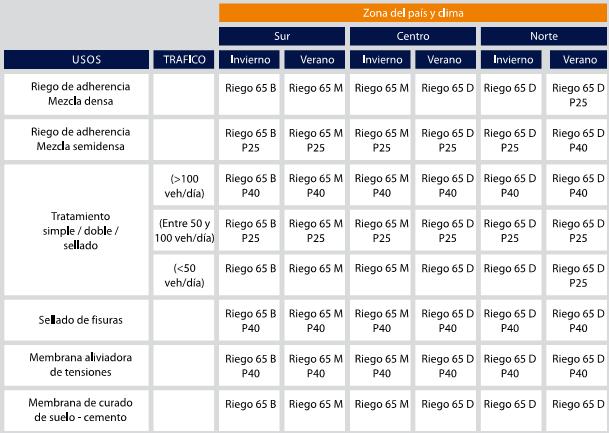
7) USE OF EMULSIONS SUITABLE TO SITUATION: SPECIAL BITAFAL ASFALTOS emulsions prepared with different hardnesses of the waste and with different degrees of modification. Please find attached our table recommendations by type of work to be done, the area of the country and the time of year.
LIMITATIONS these recommendations:
Although it is possible to work during cold periods we not recommend performing work during the winter if:
1) highest temperatures all day do not exceed 10 ° C.
2) monogranular Treatments applied on hard surfaces such as concrete or asphalt layers and where traffic speed is greater than 75 km / h.
3) Surface treatments applied on very soft bases without adequate granulometry, as silts the coast, where a burial arid irrigation A occurs, reducing gaps and subsequent exudation.
Emulsions for high demands (65 IRRIGATION BITAFLEX P40)
Since 2011, SPECIAL BITAFAL ASFALTOS, It has expanded its line emulsions seeking to adapt to climatic conditions, use and traffic which are undergoing different technologies.
The specification used in our country for modified emulsions is the IRAM 6698 standard: Modified cationic asphalt emulsions. In it, to determine the degree of modification, the minimum requirement for elastic torsional recovery is 12%, a value that we consider extremely low since a conventional asphalt cement has about 8%. That is why we have specified two ranges of elasticity for all types of modified emulsions manufactured, one with a minimum of 25% and another with 40% elastic torsional recovery and three types of asphalt penetration ranges depending on the application and thermal gradient in the area to execute the work.
Then we attach an indicative table for selection of emulsions Irrigation
The emulsion designed for the highest demands was the emulsion BITAFLEX RIEGO 65 P40 D, Which is manufactured with an asphalt hard penetration of 50 to 80 dmm (and a viscosity above 2000 cP as determined in a study of sections required not presented exudates) and add a high amount of polymer achieve greater torsional elastic recovery 40%.
For inquiries please write to bitafal@bitafal.com.uy or visit our website www.bitafal.com.uy