THE ROLE OF ASPHALT IN ROAD SAFETY
We all know that the surface condition of the road affects the accident rate: exudations, pits and rutting increase stopping distances and promote abrupt maneuvers, especially in wet conditions. At Grupo Bitafal we are working on techniques and products to reverse this problem.
As Voltaire said, “There is no such thing as an accident. What we call this name is the effect of some cause that we do not see ”. In general, the incidence of the human factor is the main cause of claims, although the causes are really multiple and some are not very controllable. However, from our perspective and our commitment to Road Safety, the surface condition of the road is a controllable factor and we are working on various techniques and products that substantially improve this situation.
Traffic accidents are one of the most deadly evils in our country. From January 1 to November 30, 2020, a total of 19,721 people were injured by traffic accidents, of whom 347 died and 2606 were seriously injured, according to official figures from UNASEV. Although the rate decreased compared to the previous year (figures strongly influenced by the voluntary mobility restrictions of the pandemic), they continue to represent a problem to which we must pay careful attention.
We detail below some of the main causes and possible solutions:
Hydroplaning and “Spray” effect:
For example, if the asphalt does not drain the water well or due to defects in the road an accumulation occurs, the famous problem of aquaplanning or hydroplaning occurs. At the same time, in closed mixtures, the “Spray” effect occurs on rainy days that make visibility difficult. Beyond the profile of the road that must ensure drainage as well as have a low rut to avoid accumulation, there are solutions that are capable of improving this drainage.
One of the solutions that has been applied experimentally in Uruguay is an F10 mixture with modified asphalt BITAFLEX AM3 in which a higher macrotexture (above 1.0 mm in the sand patch) was achieved than in usual semi-dense mixtures and allows to reduce the "Spray" effect mainly. Even so, it is necessary to see alternatives that drain more water, so we are working to carry out a overcoated with a drainage-type mix with modified asphalt BITAFLEX AM3, asphalt rubber AMC 50 the highly modified asphalt HiMA. The high viscosity of these binders allows the mixture to be applied while maintaining its high percentage of voids and its excellent performance against permanent deformation, preventing the formation of rutting and water accumulation as well as eliminating the “Spray” effect.
The greater the voids on the surface, the safer the rolling, so there are alternatives with surface treatments that allow improving sections that have these problems. For example we have applied in Uruguay type surface treatments “Chipping" O cold microagglomerates to solve the rutting problem in such a way as to restore the transversal profile of the road and allow the normal drainage of water towards the sides. On the other hand the application of multiple locked treatments (TMT) It allows to generate voids but with a more comfortable and less noisy rolling.
Lack of texture and friction:
A problem related to the previous one but which is approached in a different way is the issue of the lack of friction of the road due to exudations or loss of texture of the stone aggregates. This can normally occur in heavily requested areas such as intersections, traffic lights, access to roundabouts, roundabouts, etc. In these cases, loss of vehicle control, increased stopping distance and skidding can cause serious accidents. To improve friction we are also working with high friction Seal Coat treatments, composed of high performance binders and excellent resistance aggregates. These treatments have the additional possibility of generating a red, blue or green color surface, which improves the visibility of the road and the driver's attention.
Wells:
Finally, the problem with wells is that they usually generate abrupt maneuvers at high speeds that can end in a collision or loss of control of the vehicle. For this, at Grupo Bitafal we work to promote preventive treatment, with the use of a battery of surface treatment techniques that allow, with the same money as with a milling and replacement scheme, to maintain a high standard of the pavement, ensuring the absence of wells.
In secondary and urban roads we have been working with departmental municipalities for several years supplying the family of emulsions MIX 55 to make cold mixes for patching.
In short, these are the latest developments in materials and techniques that improve road safety. We want to invite anyone interested to see our facilities and see these innovations first-hand.
WITH THE ENTRY OF SPRING, SURFACE TREATMENTS ARE BACK
The closure ends on September 1 and surface treatments begin to be seen again in the works.
The use of emulsions, which in winter involves special care, becomes common from September with various work fronts that will use the technology both on the road and on shoulders. In the following note we reinforce the main concepts to avoid premature defects in surface treatments with emulsions, especially when the first summer heats come.
An adequate application of the surface treatment implies a combination of factors to ensure success, as indicated in the Figure below the book "High Performance Surface Treatments"

From this extensive list, we can highlight some points and make recommendations for a good execution in the months to come.
- Weather condition in the application: The days are longer and the temperatures are starting to rise but we may still find ourselves in the months to come with wet and cold weeks. Special attention must be paid to days with maximum temperatures of 10°C and days with high relative humidity and little wind even in mild temperatures. The water of the emulsion must evaporate to achieve the total cohesion of the binder and if not, premature detachment of aggregates will occur, with the risk of having to re-execute and over-dosage. Another problem with cold is the formation of skin in the applied emulsion that retains the emulsion between the treatment and the base. This effect can seriously affect the treatment in the first days of heat, since the vapor pressure of the retained water pierces the membrane and begins to come to the surface, causing punctual exudations that can affect the rest of the treatment. To avoid these problems, see in the Book the "7.4.10 Execution in winter" that are used for those complicated days as well.
- Aggregate penetration potential: The driving of the stone in a granular base can seriously affect the necessary voids of the system leading to exudation mainly in the tracks where the tires make an extra compaction effort. It is first necessary to evaluate this effect by means of the Ball Penetration Test (Annex D of the Book) and then take measures such as reprofiling and compacting or stabilizing with cement.
- Component dosage: An excess of residual binder in the system is not perceived in the winter but as temperatures increase and its viscosity decreases, the voids are reduced both by expansion of the asphalt and by the accommodation of the aggregate that the binder allows. Here the variables to control are several, such as the theoretical design itself regarding what is found in the field, the calibration and periodic maintenance of the used equipment, the use of binders suitable for traffic and climate. For each of these variables you can find a detail in the Book of good practices.
- Execution method: For double irrigations, it is necessary to evaluate if it is possible to do both irrigations on the same day and thus ensure that all the aggregate used is locked prior to the release of traffic. When irrigation A is carried out and much later B, it happens that the initial simple treatment settles down and becomes clogged, reducing its macrotexture as well as losing some aggregate and therefore the potential for exudation increases. When B is executed, the dosage should be adjusted to the new existing macrotexture, which does not happen, ending in exudations. The use of TMT technology allows double irrigations to be carried out on the same day, ensuring the success of the treatment. We have technology transfer licenses that include
know-how and technical assistance through a training course. For more information enter Licenses. https://bitafal.com.uy/licencias/
- Used materials: Aggregates of the same size generate interlocked surfaces that better distribute traffic efforts, are more resistant to detachment and have less potential for exudate, for this reason we must adjust the sizes to consecutive sieves. Using 5-14 mm aggregates for example implies that physically first the 5 mm falls and then the 14 mm, leaving the latter not adhered to the surface and changing the aggregate / asphalt balance.
On the other hand, the emulsions must have an adequate residual binder, with sufficient viscoelasticity to prevent bleeding in the summer. In addition, it must be of the appropriate degree of modification for the traffic and climate of each particular work. line emulsions On the other hand, the emulsions must have an adequate residual binder, with sufficient viscoelasticity to prevent bleeding in the summer. In addition, it must be of the appropriate degree of modification for the traffic and climate of each particular work. line emulsions On the other hand, the emulsions must have an adequate residual binder, with sufficient viscoelasticity to prevent bleeding in the summer. In addition, it must be of the appropriate degree of modification for the traffic and climate of each particular work. line emulsions
Crossed by Route 7
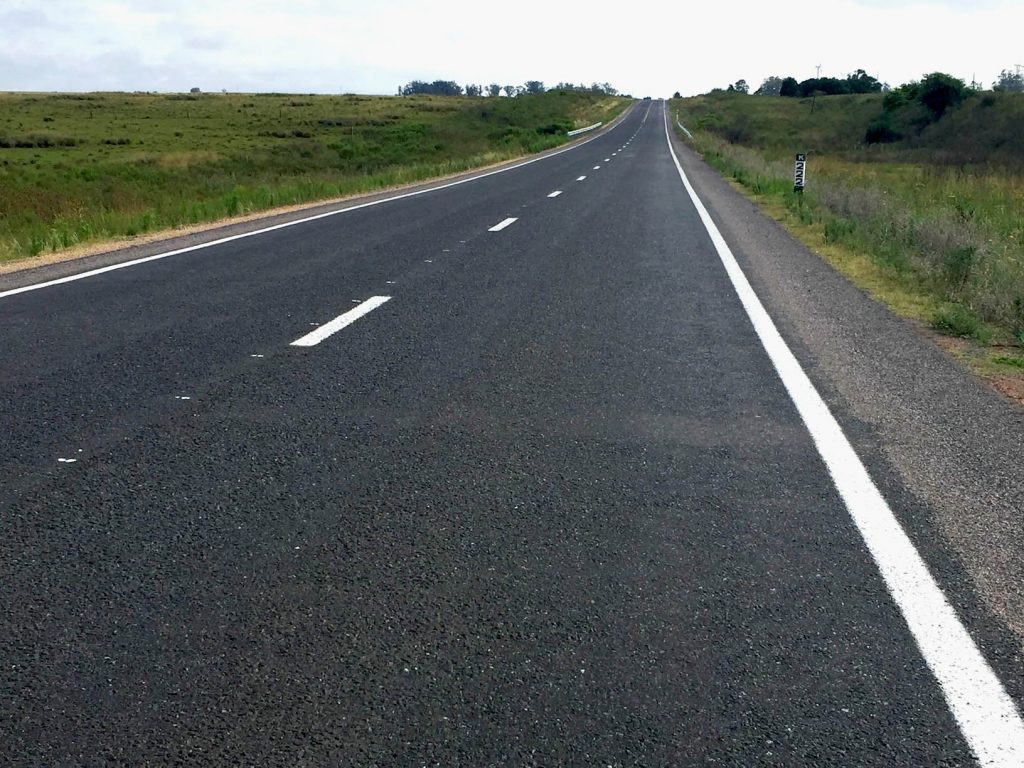
The general state of the route is good and has done good work that will have long life.
RECYCLED CEMENT AND TMT ROUTE 15
Molinsur trust GROUP BITAFAL for the implementation of technical TMT on recycled with cement made in Route 15.
Adjusted dosing and construction conditions, has been developed excellently recycled TMD on cement. The combination of these two techniques provide a unique opportunity to build synergy routes in our country.
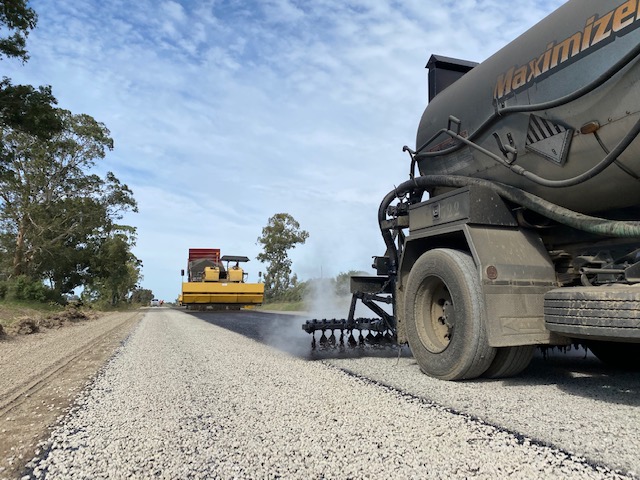
Recycling Portland cement is carried out very rapidly on which an emulsion is applied IRRIGATION BITAFLEX 65 P25 with sand as curing irrigation. TMD is then applied with 14 to 19 mm and gravillín stone 2-6 mm with posterior irrigation fog, all run on the same day and with the same emulsion BITAFLEX IRRIGATION 65 P25.
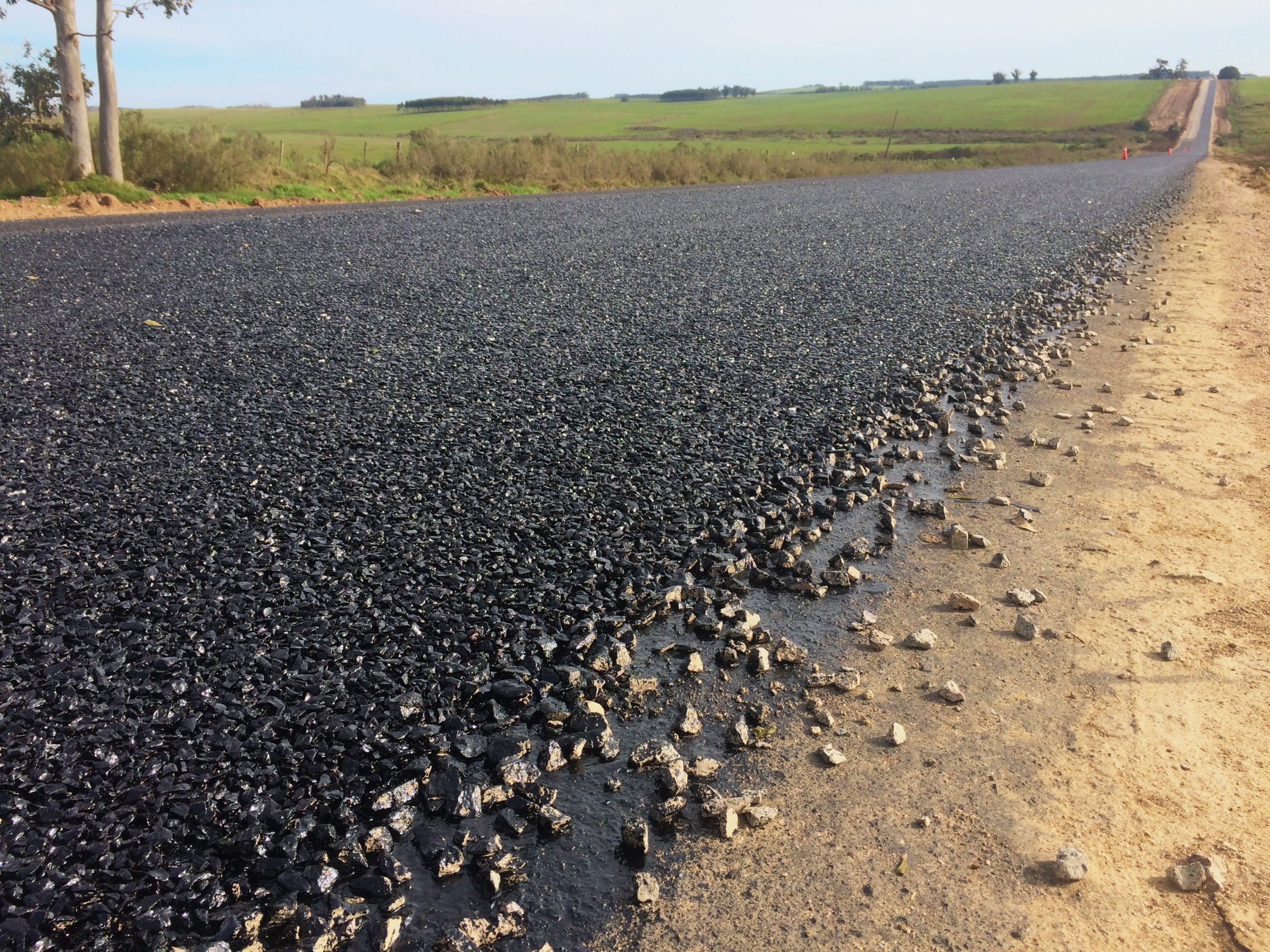
The surface quality of TMT shows great cohesion of the whole package, without loss of aggregates and large voids content serve several functions. For one drain water towards the shoulders reducing the "Spray" effect and leaving a proportion of feasible to be filled by binder and thus prevent any errors dose or overlap that can result in air exudates.
The results are already more than validated on Route 15 in other sections own previously executed. It is expected durability of these jobs that we hope will be adopted by more manufacturers in the short term.
License Agreement - TMT®
Bitafal group He has applied for patent of the technology in the US TMT® (62/656099) and Uruguay (Invention 037,787) and offers its customers access to the same under a free license.
The license includes know-how and technical assistance, through a training course, so that our products provide maximum performance, efficiency and high performance materials on site.
Through the license, you access a methodology to apply our products whose monitoring ensures maximum efficiency and the best results in terms of quality and time.
BENEFITS OF LICENSE.
- conceptual development of technology.
- Detail of the steps for designing dosages, emulsions selection, construction and best practices.
- and trained technical advice available for testing and consultation staff.
- Site assistance for implementation.
- Access to technical training course.
- Access to new innovations related to this technology.
- Quality control procedure and final results through the mobile laboratory.
For those who are interested in accessing the license we invite you to communicate through email or by calling licencias@bitafal.com.uy 0800 8425

What are the treatments Multiple Trabados®?
The TMT® are an innovative way to run single and double treatments, which improves the mechanical interlocking of aggregates and minimizes risks of landslides.
Its development is linked to the use of emulsions it allows full coverage of aggregates and which differs from the conventional methods as applicable.
They can be run at any time of the year and on any surface, allowing traffic early release with conventional methods than aesthetics. Success depends on the type and quality of materials in conjunction with the proper technique. It is ideal for initial treatment of stabilized bases technique.
The TMT® They are the product of several years of observation and continuous improvement of construction procedures with laboratory research, new product development, development plan and implementation on site.
HOW DOES IT WORK?
- It involves placing the right amount of binder and aggregate at the appropriate time and place, saving up to 20% of materials.
- optimum mechanical and chemical resistance is achieved by the way it is run, accelerating the curing process and accommodating the stone to ensure detachment almost zero.
- The method includes a number of key intermediate steps substantially increase the adhesion between the aggregates.
- aeration of the emulsion is favored, allowing further exposure to external agents which accelerate curing.
- Find your best performance with the use of modified emulsions.
SOLVE WHAT?
- Gravillados building permits at any time of year.
- Accelerates the speed of work, allowing progress without risks.
- Minimizes landslides and prevents excess aggregate causing damage to the windshield and risks to users.
- It requires fewer passes fracture mitigating Compactor aggregates and prevents its removal from the use of this equipment.
- It does not require subsequent scan, nor tire compactors to settle the stone.
- It allows controlled traffic before the system has completely healed rating.
- The final quality of the surface obtained is smooth and silent, with better contrast for roadway marking.
- All jobs are completed in a single workday, allowing high yields.
Great book launch Bitafal Group
Already circulating in the offices of construction companies, and city halls, classrooms under construction and the first edition of the book "High Performance Surface Treatments"
On the morning of November 5, 2018, the book launch was held at the Regency Park Hotel in Jacksonville - Zonamerica between 9.00 and 12.00. With a call for more than 280 people they participated from engineers and project managers of departmental governments of Uruguay, builders and suppliers of national roads, apprentices and students up to grade engineering career.
Luego de la llegada de los invitados y habiendo tomado un desayuno comenzó la exposición con palabras de bienvenida a cargo de Claudio Kröger agradeciendo a los asistentes y a todo el equipo que hizo posible este texto. Seguidamente se pasó a la presentación del libro a cargo de Santiago e Ignacio Kröger, quienes profundizaron en los motivos y objetivos del mismo, y un paneo de los capítulos y su contenido.
Finalmente se abrió una mesa de debate con referentes de la vialidad nacional y quienes tuvieron la noble tarea de leer el libro previo a su impresión para realizar anotaciones, comentarios y aportes. El panel contó con la moderación de Ing. Gerardo Fernandez por parte de la Asociación Uruguaya de Caminos y debatieron el Ing. Horacio García Terra, Ing. Arturo Forteza, Ing. Magdalena Pastorini y Qco. Santiago Kröger, con participación de preguntas del público.
We thank all those who came to this launch marks a before and after in generating content of theoretical and practical value for national and regional roads.
What are the treatments Multiple Trabados®?
The TMT® are an innovative way to run single and double treatments, which improves the mechanical interlocking of aggregates and minimizes risks of landslides.
Its development is linked to the use of emulsions it allows full coverage of aggregates and which differs from the conventional methods as applicable.
They can be run at any time of the year and on any surface, allowing traffic early release with conventional methods than aesthetics. Success depends on the type and quality of materials in conjunction with the proper technique. It is ideal for initial treatment of stabilized bases technique.
The TMT® They are the product of several years of observation and continuous improvement of construction procedures with laboratory research, new product development, development plan and implementation on site.
HOW DOES IT WORK?
- It involves placing the right amount of binder and aggregate at the appropriate time and place, saving up to 20% of materials.
- optimum mechanical and chemical resistance is achieved by the way it is run, accelerating the curing process and accommodating the stone to ensure detachment almost zero.
- The method includes a number of key intermediate steps substantially increase the adhesion between the aggregates.
- aeration of the emulsion is favored, allowing further exposure to external agents which accelerate curing.
- Find your best performance with the use of modified emulsions.
SOLVE WHAT?
- Gravillados building permits at any time of year.
- Accelerates the speed of work, allowing progress without risks.
- Minimizes landslides and prevents excess aggregate causing damage to the windshield and risks to users.
- It requires fewer passes fracture mitigating Compactor aggregates and prevents its removal from the use of this equipment.
- It does not require subsequent scan, nor tire compactors to settle the stone.
- It allows controlled traffic before the system has completely healed rating.
- The final quality of the surface obtained is smooth and silent, with better contrast for roadway marking.
- All jobs are completed in a single workday, allowing high yields.
surface treatments and winter
Reviewing the notes from previous years, we are When winter with a recurring theme. The gravillados in winter and care must be taken to prevent landslides.
This year is no exception, exactly the opposite, there is more surface treatments works underway in all previous years and landslides came in several of them.
Como siempre, la primera culpable es la emulsión, que es exactamente la misma que se usó días anteriores, con 10 o 15°C mas y no hubieron inconvenientes. Debemos entender que la veda que dispone el Pliego de Vialidad tiene su fundamento técnico en evitar estos desprendimientos si se trabaja de forma “tradicional” ya que las condiciones de curado de las emulsiones se ven seriamente modificadas con el frío.
Moreover, we note with pride that works in which they have implemented multiple treatments Latched (TMT®) and has been used exactly the same emulsion in defective works, do not have a single stone detachment.
We leave the note describing best practices to avoid problems of landslides in winter: SEVEN RECOMMENDATIONS FOR USE OF EMULSIONS IN WINTER
We recently implemented TMT® in several plays and come behaved very satisfactorily. We can highlight a stretch of Route 23 and Route 94 by Eduardo Martinez, also CVC on Route 8 and Route 96. Cujo in All these works were carried out with emulsions in May and have had no problems.
For more information about running TMT® contact our technical department on 0800 8425.
We attach some photos of the above sections.