RECYCLED CEMENT AND TMT ROUTE 15

RECYCLED CEMENT AND TMT ROUTE 15

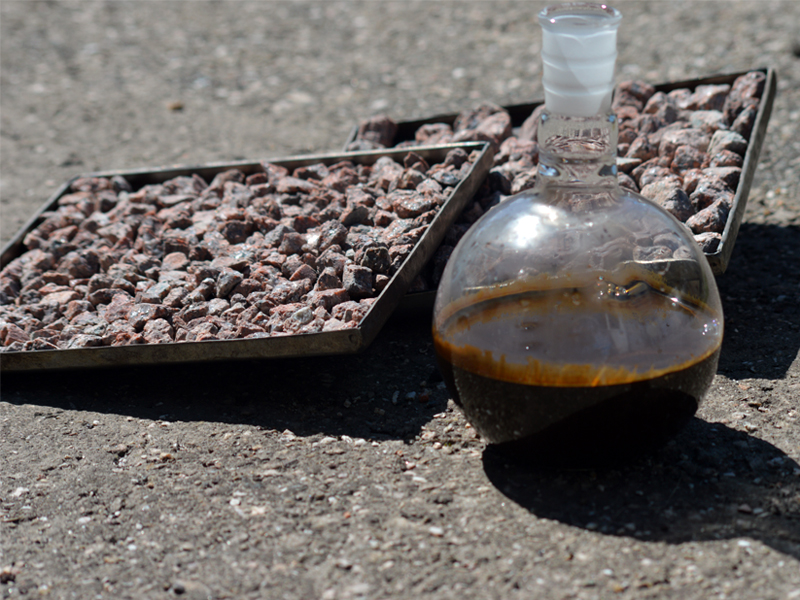
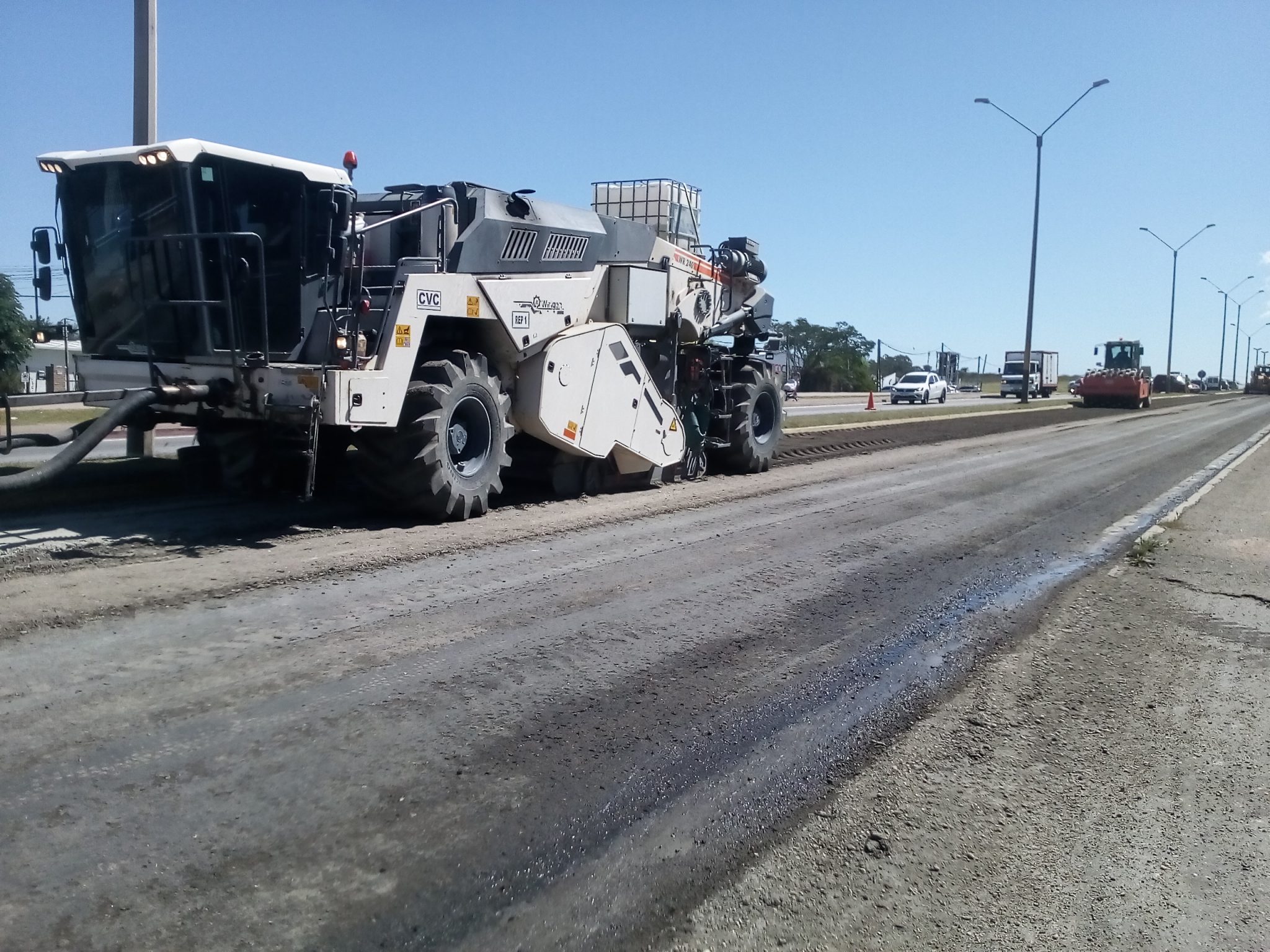
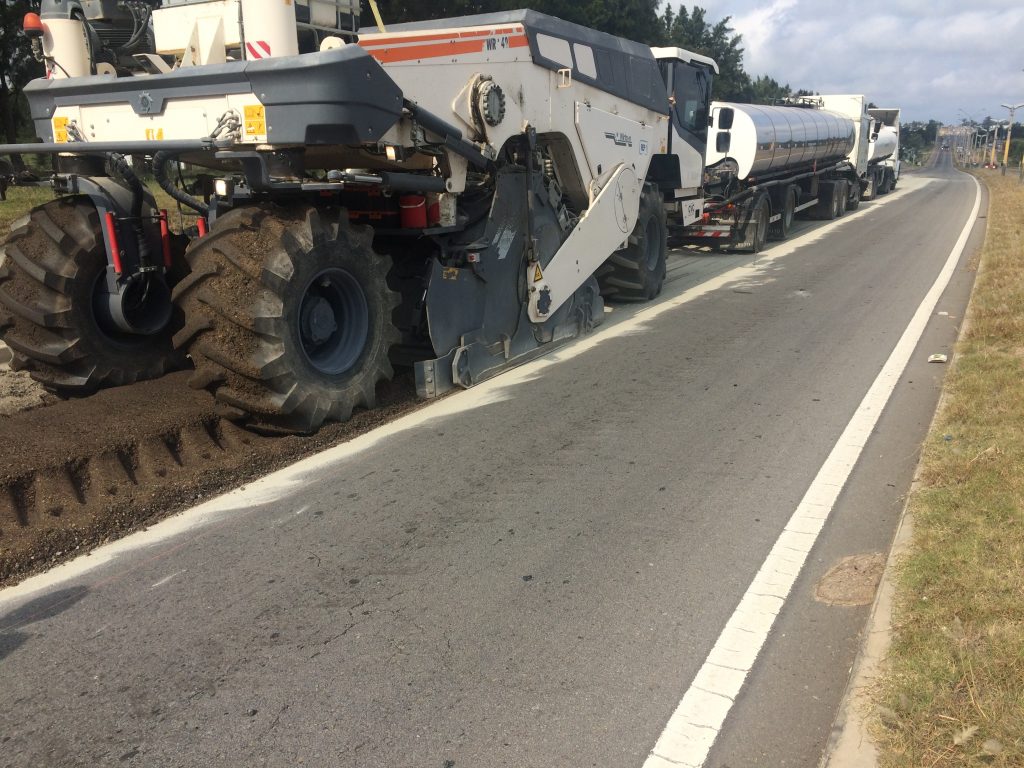
Molinsur trust GROUP BITAFAL for the implementation of technical TMT on recycled with cement made in Route 15.

Adjusted dosing and construction conditions, has been developed excellently recycled TMD on cement. The combination of these two techniques provide a unique opportunity to build synergy routes in our country.

Recycling Portland cement is carried out very rapidly on which an emulsion is applied IRRIGATION BITAFLEX 65 P25 with sand as curing irrigation. TMD is then applied with 14 to 19 mm and gravillín stone 2-6 mm with posterior irrigation fog, all run on the same day and with the same emulsion BITAFLEX IRRIGATION 65 P25.

The surface quality of TMT shows great cohesion of the whole package, without loss of aggregates and large voids content serve several functions. For one drain water towards the shoulders reducing the "Spray" effect and leaving a proportion of feasible to be filled by binder and thus prevent any errors dose or overlap that can result in air exudates.

The results are already more than validated on Route 15 in other sections own previously executed. It is expected durability of these jobs that we hope will be adopted by more manufacturers in the short term.

VEDA IN Surface treatments

VEDA IN Surface treatments

With the imminent entry of autumn, we should take the necessary precautions in the execution of surface treatments.

The ban begins in a few days and the most suitable for our summer climate emulsions begin to generate low yields in the execution by the cold and the few hours of insolation that we are already living.

Asphalts specifications based emulsions remain unchanged throughout the year. If the manufacturer wants a change in specifications to continue the work, we do get an email with the desired specification.

We recall that in remitos load the batch number corresponding detailed, and which can enter our website to have the Quality report and to corroborate with the requested specifications.

To maintain the quality of the works must run less meters per day before releasing traffic with some specific recommendations always looking to reduce the amount of water in the system.

We invite you to know in detail the recommendations on the following link "SEVEN RECOMMENDATIONS FOR USE OF EMULSIONS IN WINTER"

surface treatments:

1) heating the emulsion to be used above 70 ° C to promote evaporation of water from the emulsion itself.

2) Do not wet aggregates and try to use the top in the collection that are drier and drained, not load the gathering at the bottom.

3) Start the task early in the morning, regardless of the prevailing temperature, for that tranche has executed the most hours of exposure to air, wind and sun.

4) Apply TMT technologiesThat favor locking of aggregates applied, achieving superior quality and finish.

5) Have properly calibrated equipment graveled and irrigation to the quality objective is sought to be achieved.

Irrigations primer:

In these autumn and winter periods irrigation primer they are affected by the high rate of humidity in the foundations.

It must be respected as well as primers with dilute MC 1, optimum moisture application for the purpose of achieving a successful work.

By the above, it is normal for a primer in summer takes less than 1 hour in winter takes more than 24 hours to get to be acceptable.

Soil stabilization:

It is best suited to perform soil stabilization with cement or lime period.

Water needs hydration are very basic and profiling work, compaction and sealing are unmatched.

Here the sealing emulsion IRRIGATION BITAFAL 65 at 1 per square meter lt should be complemented with a sealed with quarry dust good quality.

These bases have such successful results supporting several months before recommencing graveled tasks in appropriate months.

What are the treatments Multiple Trabados®?

What are the treatments Multiple Trabados®?

The TMT® are an innovative way to run single and double treatments, which improves the mechanical interlocking of aggregates and minimizes risks of landslides.

Its development is linked to the use of emulsions it allows full coverage of aggregates and which differs from the conventional methods as applicable.

They can be run at any time of the year and on any surface, allowing traffic early release with conventional methods than aesthetics. Success depends on the type and quality of materials in conjunction with the proper technique. It is ideal for initial treatment of stabilized bases technique.

The TMT® They are the product of several years of observation and continuous improvement of construction procedures with laboratory research, new product development, development plan and implementation on site.

HOW DOES IT WORK?

  • It involves placing the right amount of binder and aggregate at the appropriate time and place, saving up to 20% of materials.
  • optimum mechanical and chemical resistance is achieved by the way it is run, accelerating the curing process and accommodating the stone to ensure detachment almost zero.
  • The method includes a number of key intermediate steps substantially increase the adhesion between the aggregates.
  • aeration of the emulsion is favored, allowing further exposure to external agents which accelerate curing.
  • Find your best performance with the use of modified emulsions.

SOLVE WHAT?

  • Gravillados building permits at any time of year.
  • Accelerates the speed of work, allowing progress without risks.
  • Minimizes landslides and prevents excess aggregate causing damage to the windshield and risks to users.
  • It requires fewer passes fracture mitigating Compactor aggregates and prevents its removal from the use of this equipment.
  • It does not require subsequent scan, nor tire compactors to settle the stone.
  • It allows controlled traffic before the system has completely healed rating.
  • The final quality of the surface obtained is smooth and silent, with better contrast for roadway marking.
  • All jobs are completed in a single workday, allowing high yields.
What are the treatments Multiple Trabados®?

What are the treatments Multiple Trabados®?

The TMT® are an innovative way to run single and double treatments, which improves the mechanical interlocking of aggregates and minimizes risks of landslides.

Its development is linked to the use of emulsions it allows full coverage of aggregates and which differs from the conventional methods as applicable.

They can be run at any time of the year and on any surface, allowing traffic early release with conventional methods than aesthetics. Success depends on the type and quality of materials in conjunction with the proper technique. It is ideal for initial treatment of stabilized bases technique.

The TMT® They are the product of several years of observation and continuous improvement of construction procedures with laboratory research, new product development, development plan and implementation on site.

HOW DOES IT WORK?

  • It involves placing the right amount of binder and aggregate at the appropriate time and place, saving up to 20% of materials.
  • optimum mechanical and chemical resistance is achieved by the way it is run, accelerating the curing process and accommodating the stone to ensure detachment almost zero.
  • The method includes a number of key intermediate steps substantially increase the adhesion between the aggregates.
  • aeration of the emulsion is favored, allowing further exposure to external agents which accelerate curing.
  • Find your best performance with the use of modified emulsions.

SOLVE WHAT?

  • Gravillados building permits at any time of year.
  • Accelerates the speed of work, allowing progress without risks.
  • Minimizes landslides and prevents excess aggregate causing damage to the windshield and risks to users.
  • It requires fewer passes fracture mitigating Compactor aggregates and prevents its removal from the use of this equipment.
  • It does not require subsequent scan, nor tire compactors to settle the stone.
  • It allows controlled traffic before the system has completely healed rating.
  • The final quality of the surface obtained is smooth and silent, with better contrast for roadway marking.
  • All jobs are completed in a single workday, allowing high yields.
Capeseal technology tendered by MTOP on routes 12 and 108.

Capeseal technology tendered by MTOP on routes 12 and 108.

Capeseal technology takes hold in Uruguay with the first project awarded in this mode by the MTOP.

The company Emilio Alvarez Diaz S.A. it's found rehabbing a stretch of 32 km of Routes 108 and 12 in the Department of Canelones. The work consists of a charge in some areas and then performing a site recycling in 20 cm depth with 3% Portland cement and subsequent Capeseal treatment involving the execution of a simple treatment and bituminous cold microsurfacing above.

In this case the application of simple treatment is performed with emulsion IRRIGATION BITAFAL 65 at between 1.2 and 1.4 L / m2 and a gravel 14-20 mm applied between 13 and 15 L / m2. Once cured, the treatment is swept and the company R & K Engineers applies a cold emulsion microsurfacing BITAFLEX MICRO 62 P25 at a rate of about 14 kg / m2. The aesthetic completion of the work resembles an asphalt binder and provides an excellent Macrotexture giving greater security to the pavement.

There are several sections already implemented this technology as Route 55 or Route 69 successfully suggesting that the development of the same in the coming years will grow. So soon in the coming months the company Served S.A. You will be running a section of Route 60 Route 12 and in the Minas with Capeseal.

We believe that it is essential to make a good stable base for the Capeseal will play as a surface treatment lasting many years both in function and waterproofing in adherence with the tire without losing the aesthetic quality.

The use of modified emulsions for both simple treatment as for microsurfacing use should be binding as the adhesion achieved with much higher aggregate in respect to unmodified emusiones. In turn the selection of aggregates for both treatments should be carefully performed for an appropriate duration.

We hope to inform them about future works Capeseal in the coming months and leave you with some pictures of the work done.

RECYCLED foamed bitumen - ROUTE 102

RECYCLED foamed bitumen - ROUTE 102

The CVC recently started with recycling Route 102 using recycling technology in situ foamed bitumen. Thanks to the high yields of the technique is expected to have completed the tasks leaving a strong and flexible for future interventions take place only in the surface layer basis in about a month.

BITAFAL group HIGH PERFORMANCE EMULSION -BITAFLEX IRRIGATION 65 P40 -

The work consists of milling the previous route, due to the large cracking had the same block, the application of cement, recycled asphalt with added foaming and water, compaction and final grade. Then applying a curing irrigation awaiting a thin asphalt with conventional asphalt.

On the one hand, this intervention makes it clear the maintenance backlog that had this route of great importance for heavy vehicle traffic at the entrances of Montevideo and to the port. We must become conscious that interventions at the right time require less investment in maintenance.

De todas maneras, esta experiencia en conjunto con varias a nivel nacional, demuestran una vez más la importancia de estos equipos de reciclado en el aprovechamiento de nuestro patrimonio vial. La reutilización de materiales de calidad aplicados con maquinarias de alta tecnología abre nuevas fronteras en la construcción de nuestros caminos y carreteras.

Share photos of the work in progress.

INAUGURATION WITH STRETCH STABILIZATION TECHNOLOGIES ROADS

INAUGURATION WITH STRETCH STABILIZATION TECHNOLOGIES ROADS

TComparative experimental bouquet stabilizing products in the Constancy Paysandú.

On 27 September the official opening of the section was performed in which Bitafal group He participated applying technology soil stabilization with Portland cement as reported in the Bulletin # 83 Making Roads of April.

En el mismo, 6 diferentes productos estabilizantes de suelos van a ser evaluados en su desempeño en el tiempo respecto a un par de tramos testigo sin aplicación de ningún producto. La Facultad de Ingeniería está haciendo una evaluación mensual del tramo para ver su evolución.

The inauguration was attended by representatives of OPP, the Mayor of Paysandu, the Director of Works of the Government of Paysandu (IDP), representatives of the Faculty of Engineering and applied products. The Telégrafo_28 / 09 / 2017_VER - for the same conditions of application of the products with the IDP, the commitment of all suppliers and adverse weather conditions that have plagued the section (over 650 mm of rain) highlighted LINK

Assessment being conducted by the Faculty consists of a measurement by laser Profilograph IRI, counting potholes and regularity of the transverse profile.

The IDP will intervene only in sections witnesses until one of the applied products fail more than acceptable, at what will be the end of their useful life. At the end of this experiment you will have a comparison between durability of each type of stabilizer along with its estimated cost and about not implement anything.

Hopefully excellent performance of cement stabilized as road engineering has proven worldwide for decades and thankfully is being applied in our country regularly.

We will keep you informed of developments thereof.

EXPERIMENTAL SECTION: DIFFERENT BASES ON CEMENTED taxiways.

EXPERIMENTAL SECTION: DIFFERENT BASES ON CEMENTED taxiways.

An experiment carried out 18 months ago shows how the use of bituminous treatments reduce the reflection surface cracks.

C.V.C held in Route 69 in Montevideo in early 2016 an interesting experimental section of Portland cement stabilized base which they were applied different layers of rolling to see its evolution:

1. Hot asphalt layer of asphalt AC20 3cm

2.- Bituminous treatment Simple -TBS- fog irrigation (14-20mm arid emulsion IRRIGATION BITAFAL 65 )

3. Cape seal (TBS with aggregate and emulsion 14-20mm IRRIGATION BITAFAL 65 + Micro Type II TMN 5mm emulsion BITAFLEX MICRO 62 P25)

4.- microsurfacing Type III (TMN 10mm emulsion BITAFLEX MICRO 62 P25)

After 18 months in service you can determine that all taxiways are used in very good condition overall and are alternatives to consider when protecting a stabilized with cement.

As reflection of shrinkage cracks in the cemented basis substantial differences exist between each of the layers used that detail below.

STABILIZED BASE:

The cement stabilized performed looking for a simple compressive strength of between 15 and 20 Kg / cm2. He was executed in place with a cold recycler and no crazing was performed. Irrigation curing was performed with emulsion IRRIGATION BITAFAL 65 and gravillín.

Wearing courses:

After 18 months of service shows that:

1. Hot asphalt layer of asphalt AC20 3cm. The cracks in this case are transverse to the roadway between 3 and 5 m. Also it is shown in much of the length of the longitudinal crack in the shaft which corresponds to the overlapping of the execution of the cement base.

2. Treatment Bituminous Simple irrigation fog (14-20mm arid emulsion IRRIGATION BITAFAL 65 ). Fissures surface but are difficult to identify the observed are between 9 and 18 m and no longitudinal crack is identified. In some identified fissure could be seen a slight loosening of aggregate.

3. Cape seal (TBS with aggregate and emulsion 14-20mm IRRIGATION BITAFAL 65 + Micro Type II TMN 5mm emulsion BITAFLEX MICRO 62 P25). In this case the cracks are clearly visible because the smooth surface which achieves the Micro Type II. They are transverse between 5 and 12 m apart. Nor longitudinal fissure of the overlap of the base shown.

4.- microsurfacing Type III (TMN 10mm emulsion BITAFLEX MICRO 62 P25). In this section transverse cracks between 2 and 3 m apart and longitudinal cracks of overlap almost the whole section are identified.

PRIMARY CONCLUSIONS (First 18 months)

• Bituminous simple treatment is the wearing at the time shows better performance in the reflection of cracking, not so much so in the comfort of the user (and neighbors) because it is quite noisy. (Patch initial sand: 3.75 mm). Something that could easily be solved with a finer stone or a sealing treatment.

• Then follow the Cape Seal with a very good performance against the reflection of cracks which obviously is contributed by the Bituminous simple treatment. In this case the sealed surface gives quiet and safe running. (Patch initial arena: 0.95 mm)

• The folder has a good asphalt performance but still has more Cracking the Cape Seal for security and is thinner than the rest of the taxiways (Patch initial arena: 0.45 mm) Macrotexture. In turn it would have to make an economic comparison against the cold techniques, but at the same cost would be reasonable to use treatments or Cape Seal.

• The Micro Type III had the worst performance against reflection even crack your Macrotexture is suitable (Patch initial arena: 1.10 mm)

For future tranches of these features we suggest:

Perform 1_ TBS with modified emulsion BITAFLEX P25 or P40 65 IRRIGATION to further reduce the reflection of cracks and have more cohesion in the asphalt to prevent premature detachment.

2_ Test with TBS with a little fine stone (10 to 14 mm) and made in Australia and New Zealand, to have good resistance to cracks without neglecting the noise generated.

3_ Perform a double treatment Trabado (TDT) with modified emulsion BITAFLEX P25 or P40 65 IRRIGATION to contemplate the above as well as high yields of work and minimal waste of materials.

IMPROVEMENTS IN ROUTE 81

IMPROVEMENTS IN ROUTE 81

INCOCI RENTALS BITAFAL trust for the execution of a stretch of cold recycling on site.

They are making improvements to Route 81 in the section that connects the new bridge over the St. Lucia. Once the works are completed there will be a corridor between Route 11 and Route 5 giving it the importance it deserves the new bridge and bypaseando St. Lucia and Canelones substantially improving travel times.

The work done by INCOCI includes an expansion platform, recycling of the existing macadam, performing an offset Portland cement stabilized layer and a concrete floor 21 cm.

For the implementation of recycling and stabilized base, BITAFAL RENTALS He collaborated in the dosage of Portland cement, recycled walkway and initial compaction.

For widening of the platform teeth on both sides of the existing roadway is made with successive layers of granular materials CBR 10, 40 and 60. A cement stabilized granular layer remaining flush with the existing roadway is then executed for have similar rigidities.

Across the width of the new roadway a regularizing layer was made. To do recharged with crude which was then stabilized in place by adjusting the dosages of cement according to the thickness profile. At this stage of the existing recycled macadam. For thick thicknesses were made was fundamentally a heavy compaction equipment kickstand to achieve densification.

Currently running the concrete pavement 21 cm thick is achieving very good resistance values ​​and excellent surface finish.

INCOCI thank the confidence provided BITAFAL group.

We use own and third party cookies to help us optimize your visit to our website and also to improve service delivery and thus adapt to their most relevant and useful to better their experience needs. When you click OK to continue with navigation and thus confirm that you have read the information and accept the activation of cookies.

You can allow or reject use at any time can change the Configuration Options Privacy - Cookies Policy -

Privacy settings

When you visit a website, you can store or retrieve information in your browser, mainly in the form of cookies. Check your personal services cookies here.


We track anonymous user information to improve our website.
.
  • _ga
  • _gid
  • _gat

Decline all Services
Accept all Services