EFFICIENCY IN TREATMENTS BITUMINOSOS

EFFICIENCY IN TREATMENTS BITUMINOSOS

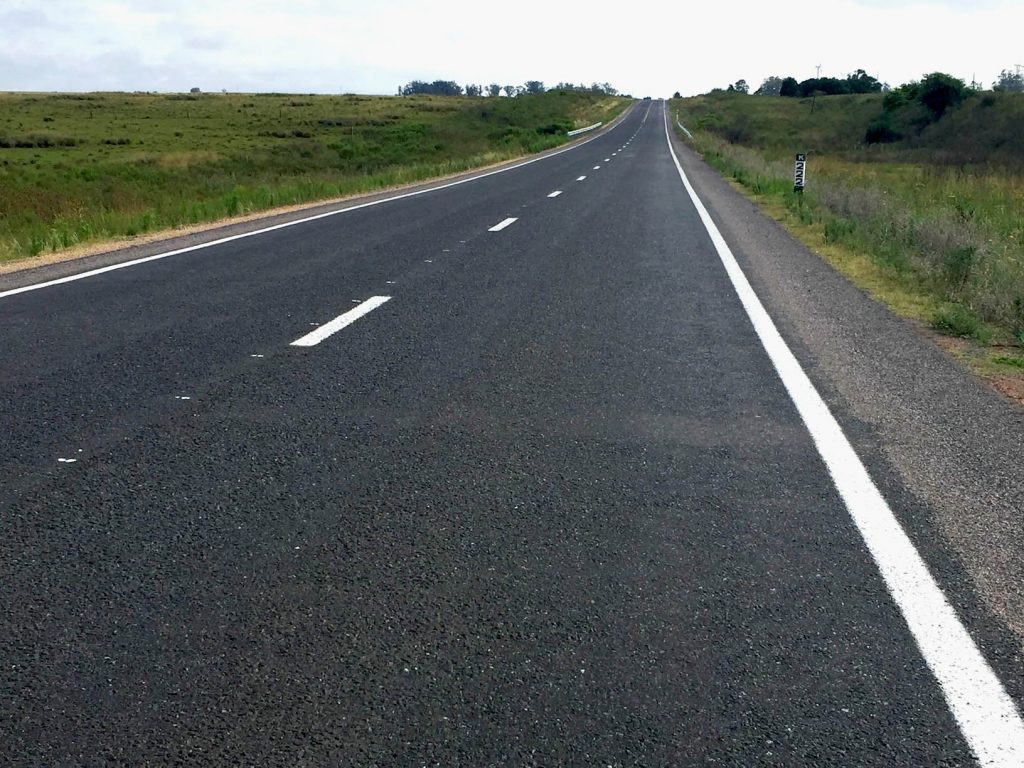
Once again, the Colier company entrusted us to collaborate in the surface treatments that are being carried out on Route 7 at the height of Santa Clara de Olimar

Bitafal Rentals made available to the company a double ACMAR spreader of French origin that has the characteristic of being a graveller with telescopic rollers, which allows a perfect dosage of the calibrated aggregates as well as the necessary emulsion in a fair and precise way.
Through this technology, the company went from having a crew for the execution of the treatment of about 8 people to only 3. In addition, the advantage that the same equipment doses emulsion and aggregate allows greater control of the dosage and better results in the treatment built.
We present ourselves on site and agree, using a calibrating drawer, the appropriate dose of aggregate and after defining this characteristic, the necessary emulsion. The results are eloquent and the doses and emulsion / aggregate ratio are behaving in a superior way without the risks of overdosing so harmful for subsequent exudations.

Bitafal is already in the operational phase of track tests of a series of new asphalts for winter use that are applied hot and with automatic release to traffic. This project is linked to a new generation of developments that we have been working on for 3 years in order to ensure that our market does not see its productivity altered during closed seasons.

Our companies are going through a very difficult time economically linked to the low productivity of execution of works. When Bitafal incorporated the first recycling train, it achieved a great leap in productivity on the road and now we are preparing for this new generation of very high performance elastomeric asphalts that will complement this innovation.

Crossed by Route 7

Crossed by Route 7

The general state of the route is good and has done good work that will have long life.

In recent years, a great effort has been made on Route 7 to improve its structural capacity and bring it to a primary route standard. To this end, a widening of the road has been carried out in almost its entire extension to reach a total width of 11 m and double bituminous treatments have been carried out on the 7.2 m road and simple treatments on the shoulders. Cement has been recycled over more than 100 km and granulometric stabilized sections have been carried out to increase the bearing capacity of the pavement.
Structural results speak for themselves, there are no potholes or sinkholes despite the tremendous growth that had heavy route, but we still have way to go to achieve double bituminous treatment resistant and durable from day one.
Exudation treatments presented in several sections of the works recently opened but have been remedied by the construction companies time and no risk for rising or severe bleeding now. It is clear that the sections carried out during the winter are most affected but there are still sections executed in good time they had exudation.
On the other hand those made from October 2019 to date show a very good performance and have not submitted exudates and has been achieved adequate dosing and has been made in good time.
Irrigations A are always in very good condition and this is because the appropriate proportions of aggregate and asphalt are used (because if there are landslides, the base is visible and it is necessary to redo the section), which allows having the necessary voids in the system to prevent exudation. On the other hand, when there are landslides in aggregate B, not much attention is paid to it, since aggregate A “hides” the problem, but that is where the necessary voids are lost, since the asphalt of both irrigations is there, but only to adhere the aggregate. A. This is verifiable in the field since the most compromised sections have a cushion of aggregate B in the ditch and the sections in better condition do not.
In this regard we insist on the following points to prevent premature exudates:
1) Respect the ban
2) Incorporating ball penetration test for the ramming potential at the base arid
3) Make dosing based on rational method Austroads where in addition to the characteristics of the aggregates are incorporated concepts based and traffic
4) In the selection of aggregates, narrow strips search granulometric aridos for irrigation A and B that do not overlap in their belts or are contiguous
5) Executing processing B should be next to or immediately after the A cure system for simultaneously minimizing loss arid B as proposed in multiple treatments locked
6) Use highly modified emulsions (P40 or P60) for those sections which have a high traffic and are in thermal Mediterranean area
7) Making only the risks A
We need to rethink the usefulness of double treatments as new work. Today Today we are making almost all stabilized bases, so a simple treatment that provides impermeability and an adequate macrotexture is more than enough. Irrigation A already cured and in service have a very good mechanical resistance and are capable of withstanding high traffic without problems, there are plenty of examples in Uruguay and in the world. In New Zealand and Australia, only simple irrigation is done in new construction and they are maintained frequently to maintain the necessary safety and functionality characteristics.
January 2020 - Bitafal Group
OPENING OF ROUTE 7

OPENING OF ROUTE 7

They rehabilitated three sections to complete more than 82 km of Route 7 between Reboledo and Jose Batlle y Ordonez.

Tracoviax, Meliter and Colier were in charge of the rehabilitation and widening of carriageway to reach a total width of 11 meters. where recycling was performed with cement to increase the bearing capacity. As for the surface layer double bituminous treatment was conducted with watering fog in the driveway of 7.2 meters. and then banquinas simple bituminous treatment. Contractors trusted BITAFAL supplying the modified emulsions BITAFLEX P25 and P40 IRRIGATION 65.

In addition to work on the route they were made extensions and reinforcements of bridges over streams and Mansavillagra El Potrero and a layout correction in Reboledo making a bypass to such people.

The opening last September 19 was held and attended by Transport Minister Victor Rossi, the Director of Roads Leonardo Cola, elected officials and representatives of the Municipality of Florida and Lavalleja and several colleagues from other road companies of the MTOP and suppliers.

It was carried out in 4 stages: First in Cerro Colorado (Alejandro Gallinal) the Tracoviax company made the ribbon cutting of its section, then a toast was made at the San Pedro del Timote farm, then the opening of the Meliter section was held along with the inauguration of the two bridges mentioned above. Finally, late in the afternoon, the inauguration of the Colier section was held, with the presence of the Mayor of Lavalleja, Adriana Peña.

The work done in this particular stretch, which involved an investment of 530 million pesos, in addition to the sections already opened in Fraile Muerto (along with a new bridge) and between Casupá and Reboledo few years ago. On the other hand these same companies are working in two tranches more to the north of the newly opened. It is estimated that by the end of this year Route 7 will find 80% in very good condition.

We use own and third party cookies to help us optimize your visit to our website and also to improve service delivery and thus adapt to their most relevant and useful to better their experience needs. When you click OK to continue with navigation and thus confirm that you have read the information and accept the activation of cookies.

You can allow or reject use at any time can change the Configuration Options Privacy - Cookies Policy -

Privacy settings

When you visit a website, you can store or retrieve information in your browser, mainly in the form of cookies. Check your personal services cookies here.


We track anonymous user information to improve our website.
.
  • _ga
  • _gid
  • _gat

Decline all Services
Accept all Services