BITAFAL GROUP RESPONSIBLE CARE AND ENVIRONMENT

BITAFAL GROUP RESPONSIBLE CARE AND ENVIRONMENT

He December 3 We welcome the representative of the Responsible Care Program Environment and an external auditor of the LSQA, to conduct the audit on compliance with the requirements of this program, which the company is attached.

Was one more instance verification and enrichment of management, the positive result of it, stimulates continue working in this direction.

The purpose of the Program of Responsible Care Environment, is to manage the risks they are exposed the different actors involved in the management of chemicals, looking for continuous improvement and excellence in their interaction with the environment, occupational health and safety of employees and the community.

PRINT 50 AN ALLY FOR THE ENVIRONMENT

PRINT 50 AN ALLY FOR THE ENVIRONMENT

Since the introduction of the emulsion 50 in Uruguay PRINT form base priming it has changed considerably because of the technical and economic advantages

We have made little emphasis on the environmental benefits of its use to the detriment of asphalt diluted for priming as in the case of the MC1. Diluted contains 30% volatile solvents evaporating end to the atmosphere photochemical smog impact on the greenhouse effect and the reduction of the ozone layer while PRINT 50 only emits water in curing.
Also, temperatures of handling and application of different types of primers lead to significant fuel economy as the PRINT 50 It is fully liquid at room temperature and water it is possible at temperatures as low as 40 to 50 ° C while the MC1 must be heated to 90 ° C or 80 to be applied correctly.
In recent years the use of PRINT 50 in Uruguay achieved:
- Reduce by 3000 tons of solvents emitted into the atmosphere
- Reducing CO2 emitted to the atmosphere because of its lower temperature manufacturing, handling and application
- Improving safety and health of workers by lower operating temperatures and avoid inhaling solvents
- Eliminate the risk of explosion in regadores trucks.
As for flammability and explosion hazard we should worry seriously and only in 2019 there were 2 accidents which fortunately had no fatal casualties but substantial material losses.
March 14 2019: Explosion of a tank RC2 in Maldonado http://www.maldonado.gub.uy/?n=38251&mm=Obras
In many countries of the world the use of diluted asphalt is prohibited, as is the case of Argentina and Spain, or at the least there are state policies that tend to reduce these products. In the US and Canada have guidelines for not using dilute solvent regulate their content or used out only from the time of ozone generation (usually summer).
It has recently been proposed that can not manufacture or market any diluted containing more than 0.5% by volume of volatile solvents evaporated at 260 ° C or less as determined by ASTM D402.
Uruguay should consider this path if we want to be an environmentally responsible country and protect the lives of workers.
For further information on the technical advantages we approached them a paper presented at the 9th Congress of the Road Uruguaya: https://bitafal.com.uy/wp-content/uploads/2017/10/9%c2%ba-CVU-Trabajo-Imprimaci%c3%b3n-con-emulsiones-mejoras-t%c3%a9cnicas-y-ambientales.pdf
Crossed by Route 7

Crossed by Route 7

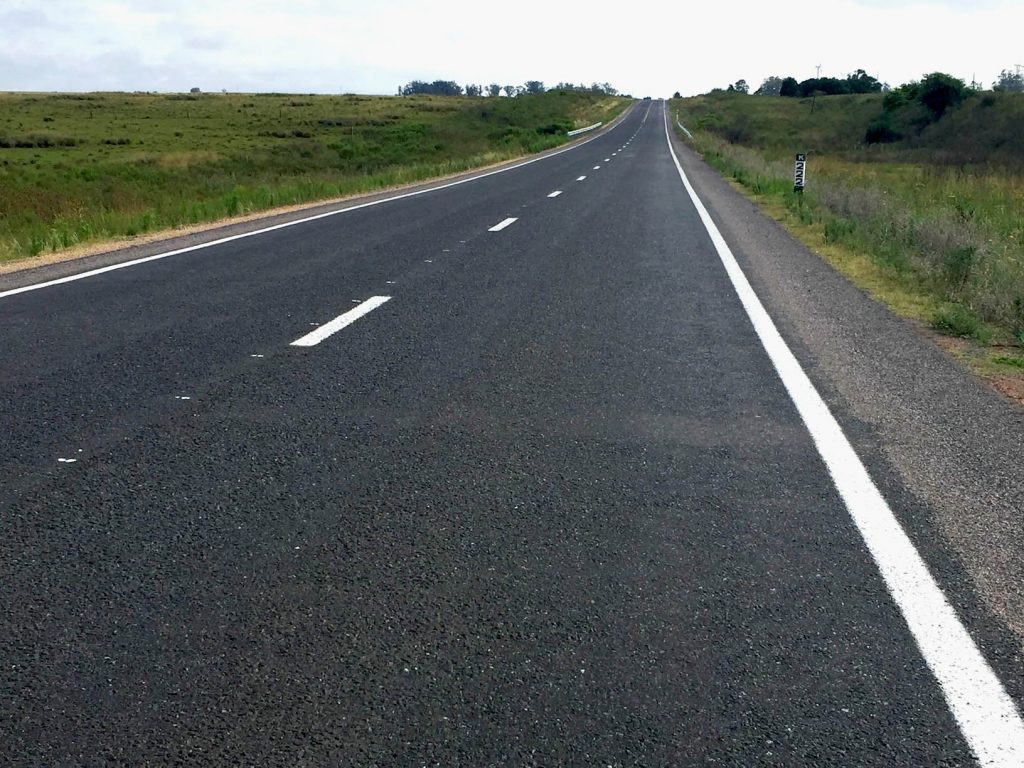
The general state of the route is good and has done good work that will have long life.

In recent years, a great effort has been made on Route 7 to improve its structural capacity and bring it to a primary route standard. To this end, a widening of the road has been carried out in almost its entire extension to reach a total width of 11 m and double bituminous treatments have been carried out on the 7.2 m road and simple treatments on the shoulders. Cement has been recycled over more than 100 km and granulometric stabilized sections have been carried out to increase the bearing capacity of the pavement.
Structural results speak for themselves, there are no potholes or sinkholes despite the tremendous growth that had heavy route, but we still have way to go to achieve double bituminous treatment resistant and durable from day one.
Exudation treatments presented in several sections of the works recently opened but have been remedied by the construction companies time and no risk for rising or severe bleeding now. It is clear that the sections carried out during the winter are most affected but there are still sections executed in good time they had exudation.
On the other hand those made from October 2019 to date show a very good performance and have not submitted exudates and has been achieved adequate dosing and has been made in good time.
Irrigations A are always in very good condition and this is because the appropriate proportions of aggregate and asphalt are used (because if there are landslides, the base is visible and it is necessary to redo the section), which allows having the necessary voids in the system to prevent exudation. On the other hand, when there are landslides in aggregate B, not much attention is paid to it, since aggregate A “hides” the problem, but that is where the necessary voids are lost, since the asphalt of both irrigations is there, but only to adhere the aggregate. A. This is verifiable in the field since the most compromised sections have a cushion of aggregate B in the ditch and the sections in better condition do not.
In this regard we insist on the following points to prevent premature exudates:
1) Respect the ban
2) Incorporating ball penetration test for the ramming potential at the base arid
3) Make dosing based on rational method Austroads where in addition to the characteristics of the aggregates are incorporated concepts based and traffic
4) In the selection of aggregates, narrow strips search granulometric aridos for irrigation A and B that do not overlap in their belts or are contiguous
5) Executing processing B should be next to or immediately after the A cure system for simultaneously minimizing loss arid B as proposed in multiple treatments locked
6) Use highly modified emulsions (P40 or P60) for those sections which have a high traffic and are in thermal Mediterranean area
7) Making only the risks A
We need to rethink the usefulness of double treatments as new work. Today Today we are making almost all stabilized bases, so a simple treatment that provides impermeability and an adequate macrotexture is more than enough. Irrigation A already cured and in service have a very good mechanical resistance and are capable of withstanding high traffic without problems, there are plenty of examples in Uruguay and in the world. In New Zealand and Australia, only simple irrigation is done in new construction and they are maintained frequently to maintain the necessary safety and functionality characteristics.
January 2020 - Bitafal Group

We use own and third party cookies to help us optimize your visit to our website and also to improve service delivery and thus adapt to their most relevant and useful to better their experience needs. When you click OK to continue with navigation and thus confirm that you have read the information and accept the activation of cookies.

You can allow or reject use at any time can change the Configuration Options Privacy - Cookies Policy -

Privacy settings

When you visit a website, you can store or retrieve information in your browser, mainly in the form of cookies. Check your personal services cookies here.


We track anonymous user information to improve our website.
.
  • _ga
  • _gid
  • _gat

Decline all Services
Accept all Services