2 - Design
The objective of pavement design is to produce a structure that distributes traffic loads efficiently and minimizes the lifetime cost of the pavement. The term "useful life" refers to the estimated duration that a structure can have, fulfilling the function for which it has been created. The costs incurred in this period include: works costs (construction, maintenance and residual value) and user costs (traffic delays, accidents, fuel consumption, tire wear, etc.). Pavement design is essentially a structural evaluation process, necessary to ensure that traffic loads are distributed in such a way that the stresses developed in each layer are within the allowable for that material. It also involves the selection of materials for the different layers, the calculation of the required thickness and the determination of its stiffness. Consequently, the mechanical properties of the materials that constitute each of the layers in a pavement are important to design the structure (7).
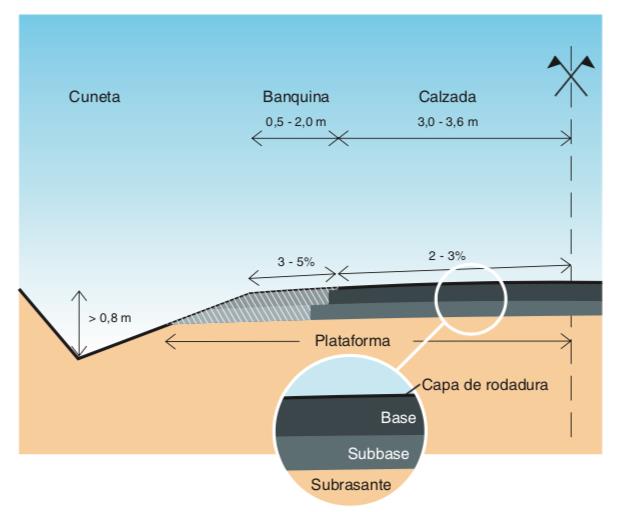
A pavement is then a complex structure that must fulfill several different functions. In general, the flexible pavement structure consists of two characteristic sets of layers with different mechanical properties: the “loose” aggregate layers sitting on the subgrade and the “asphalt-bound” layers sitting on top of the former. This separation of the structure is based on the different mechanical behavior of each layer and constitutes the basis for the development of any flexible pavement design methodology (1).
One of the first empirical methodologies consisted of an immense field test, carried out from 1958 to 1962, by AASHO (American Association of State Highway Officials) in the state of Illinois called the “AASHO Road Test”. The results were used to develop a pavement design guide, first issued in 1961 as the "AASHO Interim Guide for the Design of Rigid and Flexible Pavements," with major updates published in 1972, 1986, and 1993. In the latter , AASHTO (transportation officials are added to the nomenclature) takes the data that the test produced and posits a series of empirical structural behavior equations that remain the basis for pavement design procedures today. Although the investigation was limited to one set of soil and climatic conditions, the test results are usually extrapolated to fit other design conditions (8). The method proposes that the serviceability drop function (a measure of driving quality) with the number of reiterations of reference axes depends on a combination of thicknesses and qualities of the materials that make up the structure. The quality is defined by means of the structural contribution coefficient “ai”, by using the rigidity modulus together with the type of layer (2).
The AASHTO 93 'method has been used in Uruguay in the past, although currently the National Highway Administration uses mechanistic empirical methods, where it not only focuses on serviceability, but also on the prediction of the most common pavement deterioration. The mechanistic part calculates the pavement responses (stresses, deformations and deflections) and the damage that the pavement will accumulate over time, while the empirical section relates the damage over time with typical pavement deteriorations (9).