Emulsions for high demands (65 IRRIGATION BITAFLEX P40)

Emulsions for high demands (65 IRRIGATION BITAFLEX P40)

Since 2011, SPECIAL BITAFAL ASFALTOS, It has expanded its line emulsions seeking to adapt to climatic conditions, use and traffic which are undergoing different technologies.

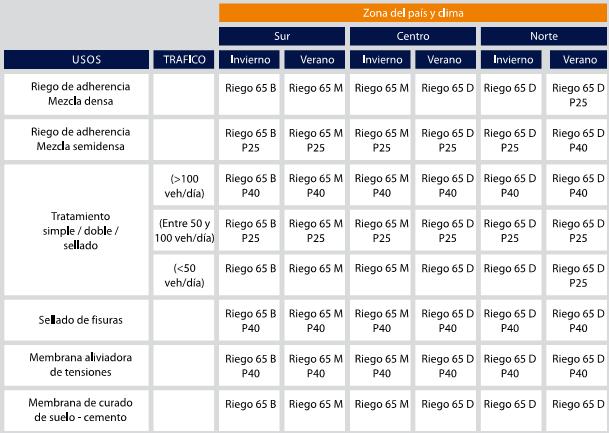
The specification used in our country for modified emulsions is the IRAM 6698 standard: Modified cationic asphalt emulsions. In it, to determine the degree of modification, the minimum requirement for elastic torsional recovery is 12%, a value that we consider extremely low since a conventional asphalt cement has about 8%. That is why we have specified two ranges of elasticity for all types of modified emulsions manufactured, one with a minimum of 25% and another with 40% elastic torsional recovery and three types of asphalt penetration ranges depending on the application and thermal gradient in the area to execute the work.

Then we attach an indicative table for selection of emulsions Irrigation

The emulsion designed for the highest demands was the emulsion BITAFLEX RIEGO 65 P40 D, Which is manufactured with an asphalt hard penetration of 50 to 80 dmm (and a viscosity above 2000 cP as determined in a study of sections required not presented exudates) and add a high amount of polymer achieve greater torsional elastic recovery 40%.

Already there are several sections that have used this emulsion on domestic routes (Route 26, Route 15, Route 8, Route 5, etc.) and their use is becoming more common because of the noticeable advantages of their use. On the one hand, it ensures good performance of works even when not run in optimal temperature conditions or performance and moreover withstand high traffic demands and climatic giving high durability to sections executed.

this emuslión was recently applied in the Chipping performed by Served en Route 8 with excellent performance, withstanding high temperatures and traffic, with minimal detachments.

For inquiries please write to bitafal@bitafal.com.uy or visit our website www.bitafal.com.uy

TIBIAN BLENDS: 50 ° C less in mixing and compaction

Following the way of introducing new technology in road construction in the country, Group BITAFAL made a successful stretch of warm mixtures with Techint SACI Route 9. This time was used on CCS S12 mixture envisaged for section a double innovation and a binder modified crumb rubber was used (BITAFLEX AMC 50) with a reducing surfactant additive mixing temperatures and compaction.

Fue posible bajar ambas temperaturas en 50°C, mejorando los promedios de densidad del tramo respecto al realizado sin aditivo a pesar que durante la jornada de prueba la temperatura máxima ambiente fue de 12°C. Por otra parte se lograron aumentos de productividad de la planta y ahorros verificados de Fuel Oil de un 27% con los cuales prácticamente se repaga el uso del aditivo.
the first tire recycling plant is disused Opens - GreenUr
They accompanying the development of technical research of both companies, the MTOP and an engineer of the supplier of the additive which conducted an extensive temperature control and final compaction work by an electromagnetic hydrometer.

The density values ​​were never below 97%, reaching values ​​of 99.5% in some points, quite superior to those evaluated in the section made without additive. Lubricity the surfactant imparts to the binder as well as an improvement in the adhesiveness between the aggregate and the binder contribute to the economy and efficiency during production and paving mixtures.

The following are some of the advantages of incorporating technology tibias mixtures:

  • Lower operating cost in factory production due to fuel savings
  • Increased productivity at the plant, due to mix optimization and ease of mixing the aggregate and binder
  • Greater workability and compactability of the mixture during its extended
  • Lower emissions of harmful pollutants into the air, to be applied at lower temperatures
  • More time between the production of the mixture and its application in the field, which can be translated within reach for longer trucks, and the ability to still compact with 6-8 hours between manufacture and compaction field mixture
  • The possibility of producing asphalt mixtures during cold weather (below 8 ° C)
  • The possibility of eliminating other bonding agents such as lime or an adhesion improver, and that the additive is an adhesion promoter
  • More safety and comfort for workers in the plant and in the field, due to the reduction of emissions and harmful particles in the air
  • The possibility of constructing a pavement with longer lifetime, less oxidized from the beginning, and lower thermal segregation at the time of its spread.
SUCCESS STORIES IN WINTER GRAVILLADOS

SUCCESS STORIES IN WINTER GRAVILLADOS

The use of the technique TDT (Double Treatment Trabado) graveled in various works that have recently implemented show that emulsions may be used during the winter successfully without risk of landslides and significant material savings.

Such is the case of the work done by NECKLACE Ruta 19, executed by the banquinas BITAFAL RENTALS for SERVIAM in Route 5 and TECHINT in Route 9 and Route 16.

All these works were done with modified emulsions Bitaflex P40 or P25 Riego 65 using the technique TDT (Note: "Innovative technologies for surface treatments in winter") Without any detachment.

This is due to the combination of good materials and implementing ways appropriate to the era. The key is to run two risks in the day achieving total mechanical interlock and to even make irrigation fog on the same day to ensure adherence of the entire stone and a superior aesthetic finish. Moreover it is essential dosing intelligently materials to have the optimal amounts in each irrigation and save on the materials used.

We invite you to know the procedure used in our blog:INNOVATIVE SURFACE TREATMENT TECHNOLOGIES IN WINTER

Strength studies ductility performed on the binders for surface treatments show that the modified emulsions Bitaflex Riego 65 P25 and P40 have a cohesive energy far superior to any common emulsion and not to mention the asphalt diluted, which contributes to the durability of the matrix achieved in the implementation of DTT.

As the images of the enclosed work COLIER in Route 19 can be seen that achieved is homogeneous matrix, containing suitable gaps for expansion of the bitumen in summer and very little excess stone in the shoulders.

We invite you to contact if considered necessary to deepen the dosage form and implementation of a TDT or the selection of suitable materials: bitafal@bitafal.com.uy

New equipment for slip resistance CITEVI

New equipment for slip resistance CITEVI

Release Pendulum TRRL (British Pendulum Friction) to determine the coefficient of slip resistance in path 102.

Following the course Walkways assessment of the AUC, Measuring the skid resistance on asphalt Route 102 was made recently built by company C.V.C. with the British Pendulum CITEVI.

Slip resistance assesses the non-slip characteristics of a pavement surface and is directly related to the micro-texture of the aggregates used. The test consists of measuring the energy loss experienced by a pendulum fitted at its end with a rubber shoe, once it touches the surface to be tested. This loss of energy is registered by a mark on the graduated plate that contains the equipment.

Citevi Archives - Page 2 of 3 - Grupo Bitafal

With respect to the study section, said coefficient was determined in the new and in the old asphalt layer. In both cases, the test gave a value between 60-65, with a high repeatability in the measurement. Sections of the Carrasco Airport and the Interbalnearia were also tested, exhibiting similar values. Magdalena Pastorini and Nicolás Vaz from the MTOP were present to evaluate and discuss the results obtained.

Teachers consulted the University of Rosario, Marta Pagola and Oscar Giovanon, confirmed that the value found is good. They also clarified that the value tends to decrease with the level of traffic, and if it remains, it may be due to a not very good Los Angeles wear value, to the extent that the particles suffer small detachments (recovering their microtexture) when At the same time they tend to be polished. Finally, Marta comments that as an example, the Olavarría granite in the Province of Buenos Aires, has an initial value before polishing of the order of 65, and after polishing of 40. That final value of 40 is reached in 5 , 10 or 15 years depending on traffic and dirt conditions on the road.

As a final observation we conclude that the pendulum is very sensitive to the texture: if the mixture was kneaded, but still with exposed aggregates can give similar values. Therefore, to fully assess the slip resistance, it is advisable to supplement it with the patch of sand.

We must pay attention to these factors as they influence the behavior of the tire with the pavement, especially in wet conditions. Laboratory sion It has the equipment available to evaluate this parameter.

BITAFAL enters the world of rheometry

BITAFAL enters the world of rheometry

New Reómetro Anton Paar SmartPave 102 at sion It will allow a big step in the performance of asphalt products in Uruguay.

As we announced in an earlier issue of our newsletterThis month installed a Court Dynamic Rheometer (DSR for its acronym in Ingés). This sophisticated equipment allows to know the performance of asphalts much of its viscoelastic range. Mainly we are concerned in these latitudes, that is at medium and high temperatures.

With this tool we can improve the modified asphalts and emulsions to suit the conditions of our country and know within minutes the quality of asphalts used as raw material.

With the addition of equipment, a course of rheology and use of equipment with an expert from the supplier was performed. The course was held on 27 and 28 August in the CITEVI and we have the participation of technical staff of our company, the MTOP and LATU.

This new machine is equipped with accessories for measurements from -20 to 150 ° C both conventional asphalts, as well as some modified properties of emulsions. Typically it used to determine the degree of asphalt (PG) but can be used for other properties of the binders.

Within the novel assays we can discuss the possibility of making master curves where temperatures and voltages applied to see the performance of the binders are varied. It is also possible to test highly accurate adhesion or cohesion at different temperatures, essential for the performance of emulsions for surface treatment tool.

Not so new but convenient is the possibility of viscosities "brookfield" within minutes both 60 ° C to the viscosity curves at the desired temperature range.

These are some of the many tests that can be performed but the team is extremely versatile and has many accessories that allow analyzing from food to paint smoothly.

In the course they made the basics of fluid mechanics, equipment operation and its application to the asphalts were given. It had a practical module to understand the operation of equipment and advanced software that controls and processes data.

Much remains to explore and contribute to our road with this team. We will keep you informed of progress.

Evaluation of penetration of the aggregate in the bases for surface treatments

Evaluation of penetration of the aggregate in the bases for surface treatments

Using the penetrometer ball as quality control element base treatment.

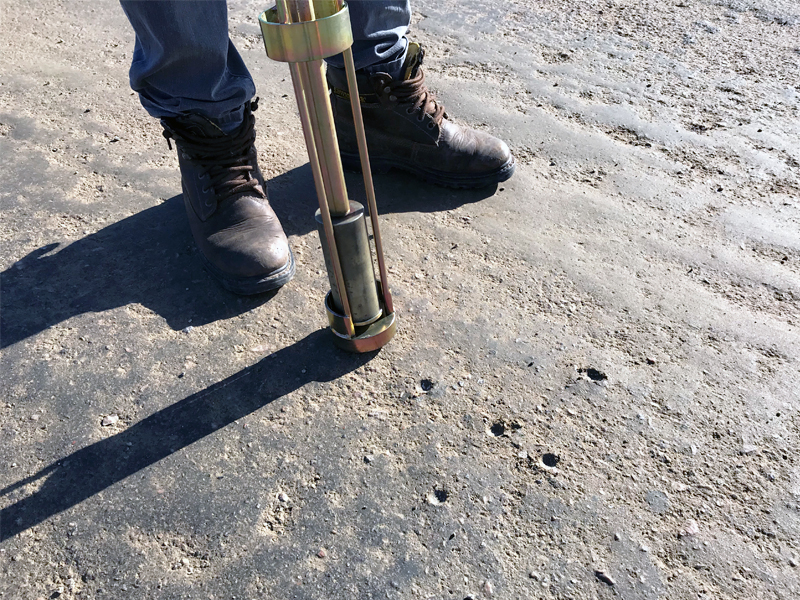
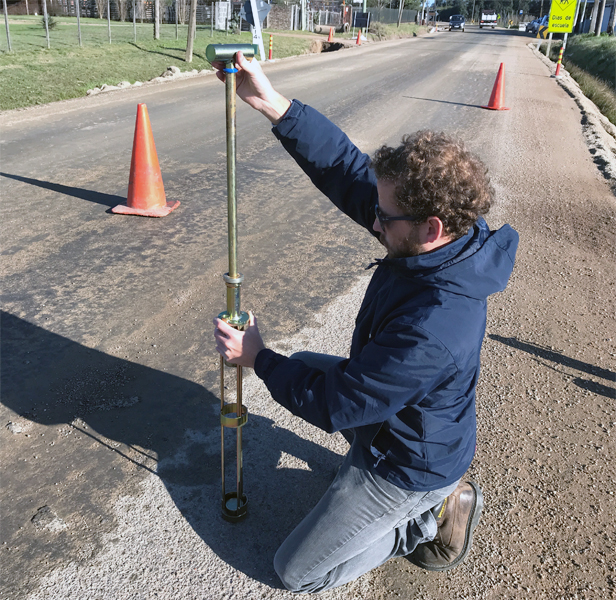
In the path that is being traced at the national level to standardize design criteria for surface treatments, we believe the inclusion of the ball penetrometer test is of utmost importance. It determines if the base is in proper condition to receive initial treatment, or if it requires additional work. It is also an indicator of the degree of compaction that has been achieved and the moisture contained in the base. The test was originally developed by South Africans and is also used in Australia and New Zealand to quantitatively measure the penetration potential of aggregate into the base.

En este frío mes de Agosto, junto con Lucio Borelli de CVC, pusimos a prueba este equipo de medición en diversas superficies: bases granulares no ligadas, bases estabilizadas con ligantes (cemento Portland y asfalto espumado) y mezclas asfálticas. A continuación se ilustran algunas de las conclusiones, acompañadas de fotos de la experiencia.

In the initial treatments (surface treatments on bases), the subsidence of the aggregate on the surface always occurs, to a greater or lesser extent. The degree of penetration will depend on the base material, its humidity, compaction and the traffic to which it will be subjected. Not taking these parameters into account results in exudate in the short term, becoming particularly evident in the tracks. The explanation for this phenomenon is intuitive: the tire pressure sinks the stone into a base that allows it and the voids that correspond to the asphalt and the air (to achieve the macrotexture of the wearing course) are occupied by the material of base, causing the asphalt to surface through the stone, which results in exudation in the tracks.

El ensayo que se propone es muy sencillo y de fácil aplicación: consiste en la penetración de una bola de 19 mm de diámetro que es golpeada por un martillo normalizado lanzado de una altura conocida (Australian Standards: AG-PT/T251 – Ball Penetration Test). El valor de penetración queda registrado en el aparato, ya sea en un indicador electrónico o en una regla graduada (que viene incorporada).

Los resultados de este ensayo se utilizan para ajustar la cantidad de ligante a regar o para seleccionar un tratamiento correctivo previo al definitivo. Su uso más importante es quizá el de establecer el límite en el que no se pueden realizar gravillados sin antes recompactar o estabilizar la base, dado que su riesgo de falla es muy elevado.

La primera y más importante de las conclusiones es que la preparación de la base es un factor determinante en los resultados. Un problema común es que las bases presentan un exceso de finos en la parte superior que genera que la bola penetre con facilidad. Aunque parecen estar lisas y homogéneas inicialmente, tan pronto como se barren, una gran cantidad de este material fino se dispersa, dejando una superficie áspera e inconsistente que es problemática para ejecutar un tratamiento.

Another issue to consider is the humidity at the time of the test: if the surface is visibly wet, the penetration gives higher values. We could corroborate this by testing the same surface early in the morning and close to noon. In some cases, the conditions of the base at the time of the test are good, but when a primer is applied, due to capillarity and temperature differences, humidity begins to increase in the first 5 cm, affecting the penetration result.

Developing

PRINT 50 AN ALLY FOR THE ENVIRONMENT

PRINT 50 AN ALLY FOR THE ENVIRONMENT

Since the introduction of the emulsion 50 in Uruguay PRINT form base priming it has changed considerably because of the technical and economic advantages

We have made little emphasis on the environmental benefits of its use to the detriment of asphalt diluted for priming as in the case of the MC1. Diluted contains 30% volatile solvents evaporating end to the atmosphere photochemical smog impact on the greenhouse effect and the reduction of the ozone layer while PRINT 50 only emits water in curing.
Also, temperatures of handling and application of different types of primers lead to significant fuel economy as the PRINT 50 It is fully liquid at room temperature and water it is possible at temperatures as low as 40 to 50 ° C while the MC1 must be heated to 90 ° C or 80 to be applied correctly.
In recent years the use of PRINT 50 in Uruguay achieved:
- Reduce by 3000 tons of solvents emitted into the atmosphere
- Reducing CO2 emitted to the atmosphere because of its lower temperature manufacturing, handling and application
- Improving safety and health of workers by lower operating temperatures and avoid inhaling solvents
- Eliminate the risk of explosion in regadores trucks.
As for flammability and explosion hazard we should worry seriously and only in 2019 there were 2 accidents which fortunately had no fatal casualties but substantial material losses.
March 14 2019: Explosion of a tank RC2 in Maldonado http://www.maldonado.gub.uy/?n=38251&mm=Obras
In many countries of the world the use of diluted asphalt is prohibited, as is the case of Argentina and Spain, or at the least there are state policies that tend to reduce these products. In the US and Canada have guidelines for not using dilute solvent regulate their content or used out only from the time of ozone generation (usually summer).
It has recently been proposed that can not manufacture or market any diluted containing more than 0.5% by volume of volatile solvents evaporated at 260 ° C or less as determined by ASTM D402.
Uruguay should consider this path if we want to be an environmentally responsible country and protect the lives of workers.
For further information on the technical advantages we approached them a paper presented at the 9th Congress of the Road Uruguaya: https://bitafal.com.uy/wp-content/uploads/2017/10/9%c2%ba-CVU-Trabajo-Imprimaci%c3%b3n-con-emulsiones-mejoras-t%c3%a9cnicas-y-ambientales.pdf
VEDA IN Surface treatments

VEDA IN Surface treatments

With the imminent entry of autumn, we should take the necessary precautions in the execution of surface treatments.

The ban begins in a few days and the most suitable for our summer climate emulsions begin to generate low yields in the execution by the cold and the few hours of insolation that we are already living.

Asphalts specifications based emulsions remain unchanged throughout the year. If the manufacturer wants a change in specifications to continue the work, we do get an email with the desired specification.

We recall that in remitos load the batch number corresponding detailed, and which can enter our website to have the Quality report and to corroborate with the requested specifications.

To maintain the quality of the works must run less meters per day before releasing traffic with some specific recommendations always looking to reduce the amount of water in the system.

We invite you to know in detail the recommendations on the following link "SEVEN RECOMMENDATIONS FOR USE OF EMULSIONS IN WINTER"

surface treatments:

1) heating the emulsion to be used above 70 ° C to promote evaporation of water from the emulsion itself.

2) Do not wet aggregates and try to use the top in the collection that are drier and drained, not load the gathering at the bottom.

3) Start the task early in the morning, regardless of the prevailing temperature, for that tranche has executed the most hours of exposure to air, wind and sun.

4) Apply TMT technologiesThat favor locking of aggregates applied, achieving superior quality and finish.

5) Have properly calibrated equipment graveled and irrigation to the quality objective is sought to be achieved.

Irrigations primer:

In these autumn and winter periods irrigation primer they are affected by the high rate of humidity in the foundations.

It must be respected as well as primers with dilute MC 1, optimum moisture application for the purpose of achieving a successful work.

By the above, it is normal for a primer in summer takes less than 1 hour in winter takes more than 24 hours to get to be acceptable.

Soil stabilization:

It is best suited to perform soil stabilization with cement or lime period.

Water needs hydration are very basic and profiling work, compaction and sealing are unmatched.

Here the sealing emulsion IRRIGATION BITAFAL 65 at 1 per square meter lt should be complemented with a sealed with quarry dust good quality.

These bases have such successful results supporting several months before recommencing graveled tasks in appropriate months.

We use own and third party cookies to help us optimize your visit to our website and also to improve service delivery and thus adapt to their most relevant and useful to better their experience needs. When you click OK to continue with navigation and thus confirm that you have read the information and accept the activation of cookies.

You can allow or reject use at any time can change the Configuration Options Privacy - Cookies Policy -

Privacy settings

When you visit a website, you can store or retrieve information in your browser, mainly in the form of cookies. Check your personal services cookies here.


We track anonymous user information to improve our website.
.
  • _ga
  • _gid
  • _gat

Decline all Services
Accept all Services