BASIC CONCEPTS ON FLEXIBLE FLOORING
Flexible flooring
The pavement is the set of layers of material that provide support and a bearing surface for traffic loads. It must be capable of distributing surface loads during its design period, in such a way that the allowable stresses and deformations are not exceeded, both in the foundation soil and in each of the layers. In addition, the upper layer of the structure must be impermeable to water, non-slip, and resistant to the abrasive action of tires (1). The behavior of a pavement can be defined as the measurable structural or functional capacity throughout its design period. The user public assigns subjective values to it according to its ride quality, safety and appearance (2).
In particular, flexible pavements are called those that in their constituent layers have low or zero values of resistance to flexo-traction. The distribution of the stresses is carried out through the contact between the aggregates of the structure, in the form of a stress bulb, where the stresses decrease with depth from the surface (3). In this way, the load is distributed to the natural terrain by means of layers whose resistance decreases as we move away from the pavement surface (4).
1 - Structure
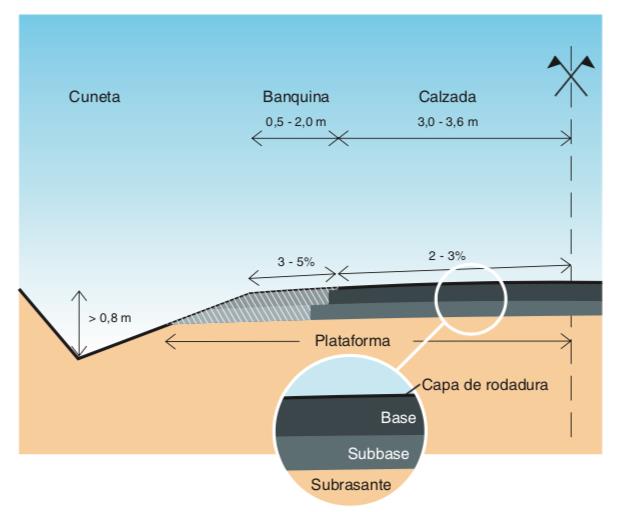
In general terms, flexible pavements consist of a sequence of layers as indicated in Figure 1.
Pavement layers
1.1 Rolling layer
As a layer exposed to traffic, it is designed to resist the wear caused by tires, withstanding traction and shear stresses, in addition to climatic effects such as precipitation. It must provide the greatest comfort and safety to vehicle traffic in the most economical way possible. There are basically three systems in which the wearing course can be presented in flexible pavements: the most elementary, simply with granular materials such as coarse; surface bituminous treatments for slightly busier roads and lastly, the asphalt mixture layers.
The use of any of the described systems involves technical and economic considerations. Technical in that all of them satisfactorily solve the transfer of the loads induced by traffic to the following layers and economic in that it defines the optimal use of suitable materials according to the needs of the project and that are also easily obtained in a certain area. (4).
The use of any of the described systems involves technical and economic considerations. Technical in that all of them satisfactorily solve the transfer of the loads induced by traffic to the following layers and economic in that it defines the optimal use of suitable materials according to the needs of the project and that are also easily obtained in a certain area. (4).
It is the structural layer that receives a large part of the stresses and where the tread layer will rest. The underlayment helps provide the full thickness to the pavement necessary to ensure it can withstand projected traffic for the life of the project (6). It is generally constructed of selected granular material in a mixture of fine and coarse aggregates, although what is known as 'black bases' are also used, which are layers of asphalt mixture that are laid below the tread in order to to increase the useful life of the structural package (1).
1.3 Subbase
It fulfills a structural function and of adding thickness to the pavement, hindering the ascent of water by capillarity and offering a stable and resistant work platform. It can be composed of granular material, generally larger than the base material but of a lower quality material.
2 - Design
The objective of pavement design is to produce a structure that distributes traffic loads efficiently and minimizes the lifetime cost of the pavement. The term "useful life" refers to the estimated duration that a structure can have, fulfilling the function for which it has been created. The costs incurred in this period include: works costs (construction, maintenance and residual value) and user costs (traffic delays, accidents, fuel consumption, tire wear, etc.). Pavement design is essentially a structural evaluation process, necessary to ensure that traffic loads are distributed in such a way that the stresses developed in each layer are within the allowable for that material. It also involves the selection of materials for the different layers, the calculation of the required thickness and the determination of its stiffness. Consequently, the mechanical properties of the materials that constitute each of the layers in a pavement are important to design the structure (7).
A pavement is then a complex structure that must fulfill several different functions. In general, the flexible pavement structure consists of two characteristic sets of layers with different mechanical properties: the “loose” aggregate layers sitting on the subgrade and the “asphalt-bound” layers sitting on top of the former. This separation of the structure is based on the different mechanical behavior of each layer and constitutes the basis for the development of any flexible pavement design methodology (1).
One of the first empirical methodologies consisted of an immense field test, carried out from 1958 to 1962, by AASHO (American Association of State Highway Officials) in the state of Illinois called the “AASHO Road Test”. The results were used to develop a pavement design guide, first issued in 1961 as the "AASHO Interim Guide for the Design of Rigid and Flexible Pavements," with major updates published in 1972, 1986, and 1993. In the latter , AASHTO (transportation officials are added to the nomenclature) takes the data that the test produced and posits a series of empirical structural behavior equations that remain the basis for pavement design procedures today. Although the investigation was limited to one set of soil and climatic conditions, the test results are usually extrapolated to fit other design conditions (8). The method proposes that the serviceability drop function (a measure of driving quality) with the number of reiterations of reference axes depends on a combination of thicknesses and qualities of the materials that make up the structure. The quality is defined by means of the structural contribution coefficient “ai”, by using the rigidity modulus together with the type of layer (2).
The AASHTO 93 'method has been used in Uruguay in the past, although currently the National Highway Administration uses mechanistic empirical methods, where it not only focuses on serviceability, but also on the prediction of the most common pavement deterioration. The mechanistic part calculates the pavement responses (stresses, deformations and deflections) and the damage that the pavement will accumulate over time, while the empirical section relates the damage over time with typical pavement deteriorations (9).
2.1 Performance prediction models
The traditional approach to asphalt pavement performance prediction is divided into two stages: pavement response prediction and pavement performance prediction. In this approach, the responses of an undamaged pavement (for example, tensile stress at the bottom of the asphalt layer) are estimated from a structural model (for example, multilayer elastic theory) using initial properties of the layer materials. Asphalt mix performance models are developed using laboratory test results and relate the initial response of asphalt mix specimens to their useful life. The responses estimated from the structural model are then input to the performance model to determine the useful life of the pavement. This approach is the method used in current practice that is adopted in most mechanistic-empirical design methods, including the Mechanistic-Empirical Pavement Design Guide (MEPDG) developed under the NCHRP project 1- 37A (10). However, there are several weaknesses in this traditional approach. First, the evolution of damage in complex and material-modified structures may not be accurately captured. Furthermore, most of the performance models used in the traditional approach depend on the mode of loading, which are performed in controlled stress or strain mode. This implies that the way in which the pavement will be requested must be guessed, which results in unreliable predictions. Finally, the limitation of selected conditions for laboratory tests means that, to predict pavement performance in a wide range of conditions, an undesirably large number of tests is required (10). The weaknesses of the traditional approach can be overcome using a mechanistic approach that combines the asphalt mixture models and the pavement response model. In this approach, the material model describes the stress-strain behavior of the material for a Representative Volume Element (RVE). An EVR is defined as the smallest volume element that can represent the effective properties of a larger scale compound. The material model is then implemented in the pavement response model where the boundary conditions of the pavement structure in question are applied. This approach allows a more accurate evaluation of the effects of the change in the stiffness of each layer due to the increase in damage on the performance of the pavement (10).
Bibliography
- Nikolaides, Athanassios. Highway Engineering: Pavements, Materials and Control of Quality. EUA : Taylor & Francis Group, 2015.
- Cordo, Oscar V. Cordo, Oscar V. Cordo, Oscar V.
- Cordo, Oscar V. Cordo, Oscar V. Cordo, Oscar V.
- Cordo, Oscar V. Cordo, Oscar V. Cordo, Oscar V.
- Cordo, Oscar V. Cordo, Oscar V. Cordo, Oscar V.
- Cordo, Oscar V. Cordo, Oscar V. Washington D.C : The National Academies Press, 2010.
- Read, John y Whiteoak, David. Read, John y Whiteoak, David. Read, John y Whiteoak, David.
- Washington D.C : The National Academies Press, 2010. Washington D.C : The National Academies Press, 2010. Washington D.C : The National Academies Press, 2010.
- Washington D.C : The National Academies Press, 2010. Washington D.C : The National Academies Press, 2010. Washington D.C : The National Academies Press, 2010.
- Washington D.C : The National Academies Press, 2010. Washington D.C : The National Academies Press, 2010. Washington D.C : The National Academies Press, 2010.