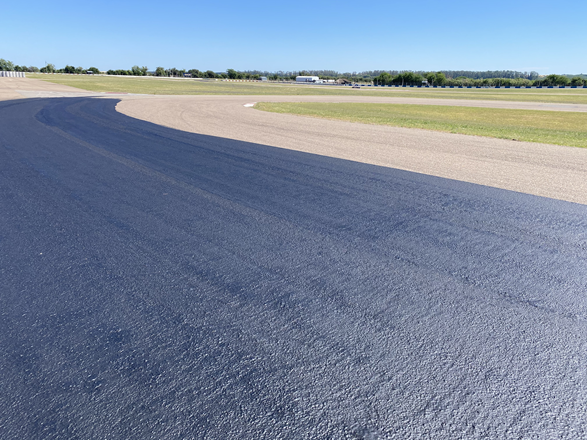
CAPE SEAL ON ROUTE 27
A new rehabilitation of a route of our road network with pavement recycling and Cape Seal
The GRINOR company began the rehabilitation works of 48 km on Route 27, Mr. Mario Heber, in the Department of Rivera. They started with a base surcharge, recycled in 20 cm with Portland cement and then a Cape Seal as a rolling layer. The progress at the moment is almost the entire recharged section, and about 6 km with the surface treatment on the recycled material where the company has been able to demonstrate the surface quality both in rolling comfort as well as in the resistant structure achieved.
The surcharge made is 15 cm, after which it is remixed in 20 cm together with the old existing surface treatment on the road. The refining works after recycling with cement are carried out by means of a motor grader with automatic control, then a curing irrigation with emulsion is carried out. IRRIGATION BITAFAL 65 along with sand to provide a suitable provisional rolling and maintain the humidity of the cemented material, until the execution of the micro-surfacing.
Simple bituminous treatment is being carried out with emulsion BITAFLEX IRRIGATION 65 P12 with 15-19 mm aggregate to then complete the Cape Seal using a cold microagglomerate made with emulsion BITAFLEX MICRO 62 P40. This last emulsion was formulated specifically for this work, adjusting the cutting times and increasing the polymer content since it is the emulsion exposed to traffic and weather.
The execution activities of the Cape Seal will be suspended during the winter closure, and it is planned to continue and finish them next spring.
GRINOR incorporated a new truck-mounted Romanelli UHR 700 unit with a capacity of 7 m3 of aggregates and 2,600 liters of emulsion for the execution of these works, which is producing an impeccable quality of cold microagglomerate.
The synergy between the recycling of pavements and the Cape Seal is increasingly convincing since the first sections carried out are still in excellent condition and without inconveniences of exudations or detachments that have often led to doubts about surface treatments such as wearing courses.
We hope that the successes of this technology will continue throughout our country.