STEEL SLAG AS AGGREGATE

STEEL SLAG AS AGGREGATE

We continue to bet on the circular economy using waste from other industries in paving

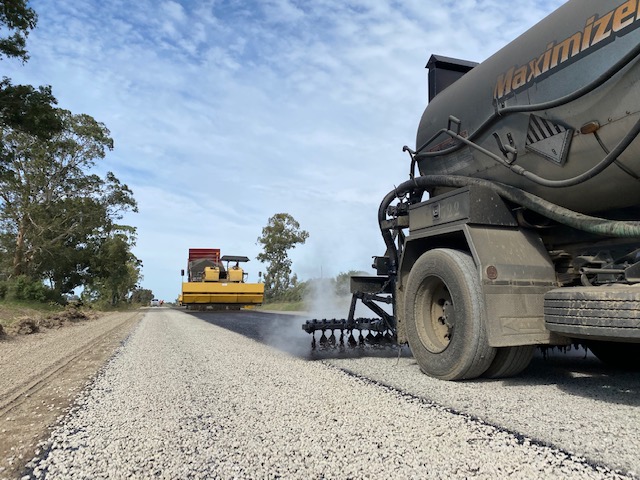
After several months of tests and adjustments in the way of classification, we were able to carry out the first section using steel slag as aggregate for surface treatment.

The most important steel mill in Uruguay, Gerdau-Laisa, generates around 10,000 tons of slag per year that ended up being buried in a landfill. With the approval of Dinama for use in road construction, it is possible to use a very valuable residue with good properties for surface treatments.

The material has excellent shape and high wear resistance in both the Los Angeles and Microdeval tests. The granulometries achieved fit very well with those we propose in the Book "High Performance Surface Treatments" achieving ranges of 2-6mm, 6-10mm, 10-14mm and 14-20mm. In terms of adhesion by Vialit plate, it exceeds 90%, complying with what is required.

The quality of the treatments carried out depends largely on the possibility of having resistant, cubic and well classified aggregates as is the case with this material. We leave you some photographs of the section made where you can see the quality of the aggregate used. We continue to take steps on the circular economy and caring for the environment in all our products and related techniques.

SURFACE TREATMENT COURSE WITH THE AUC

SURFACE TREATMENT COURSE WITH THE AUC

The Uruguayan Association of Roads conducted the course on Surface Treatments with 50 professionals from the sector in June and is preparing its repetition for the first days of July.

Last June 14th The Surface Treatments course taught by Ing. Ignacio Kröger was carried out in virtual mode, one of the courses within the Diploma program for Road Works Technician (DTOV) taught by the AUC. On this occasion, specific topics of material selection, design, construction and good practices were discussed, in front of an audience of 50 people, including engineers, assistants, foremen, laboratory workers and students.

The objective of this course, in addition to training in these specific topics, proposes to eliminate several prejudices that still exist at the national level about the efficacy of surface treatments, and to convince that instead of "cheap" and that "they require a lot of maintenance" are the options more cost efficient for road maintenance.

Due to the great interest in this subject, the AUC plans to repeat the course on the day July 5th, also in virtual mode. Registration closes this week and there are limited places. If you are interested in participating, write before Friday to Ana Damonte in secretaria@auc.com.uy
RECYCLING ON SITU - TECHNICAL AND ENVIRONMENTAL BENEFITS

RECYCLING ON SITU - TECHNICAL AND ENVIRONMENTAL BENEFITS

Technical Articles Archives - Grupo Bitafal

Technical Articles Archives - Grupo Bitafal

This technique entered Uruguay with the arrival of the first equipment in 2013. Given that the number of roads requiring structural rehabilitation is increasing in our country, the future of the on-site recycling technique looked very promising.

This technique entered Uruguay with the arrival of the first equipment in 2013. Given that the number of roads requiring structural rehabilitation is increasing in our country, the future of the on-site recycling technique looked very promising.

From the Center for Research in Road Technologies (CITEVI) a follow-up of the first executed sections was carried out both in the knowledge of recycled materials, in the studies for the determination of its working formula, in the project methods, in its prescriptions techniques and in the follow-up of the executed sections. The good results obtained in most of the projects helped to clear up doubts of many administrations, seeing the savings that it represents compared to reinforcement or reconstruction alternatives, and they began to include this technique in the specifications.

INTRODUCTION

From the Center for Research in Road Technologies (CITEVI) a follow-up of the first executed sections was carried out both in the knowledge of recycled materials, in the studies for the determination of its working formula, in the project methods, in its prescriptions techniques and in the follow-up of the executed sections. The good results obtained in most of the projects helped to clear up doubts of many administrations, seeing the savings that it represents compared to reinforcement or reconstruction alternatives, and they began to include this technique in the specifications.

In-situ cold recycling with cement is a road rehabilitation technique with which a new base layer of notable structural capacity is achieved, taking advantage of the existing road as a quarry or a source of aggregate supply.

In-situ cold recycling with cement is a road rehabilitation technique with which a new base layer of notable structural capacity is achieved, taking advantage of the existing road as a quarry or a source of aggregate supply.

Compared to other rehabilitation solutions, recycling with cement allows the use of these deteriorated layers, managing to recover and even increase their support capacity, and provides the material obtained after recycling with physical-mechanical characteristics in accordance with an adequate level of service. the infrastructure. A much more durable overall surface is achieved, with less susceptibility to water and greater resistance to erosion. The field of application is very wide since it covers all types of roads and paved surfaces.

It is a technique closely linked to the concept of sustainability and in addition to presenting various environmental advantages, important technical and economic benefits are added.

Properties of materials recycled with cement

It is a technique closely linked to the concept of sustainability and in addition to presenting various environmental advantages, important technical and economic benefits are added.

Regarding the fatigue behavior of recycled materials with cement, a series of tests carried out show that it is similar to that of vibrated concrete or rough-cement, that is, they are mixtures with a fatigue curve presenting a very low slope. Consequently, a slight decrease in the stresses in the recycled layer translates into a large increase in its service life. The methodology of the study consists of establishing the variation of the parameters to be determined as a function of the cement dosage, the variation of the water content and the density of the specimens. In Uruguay, the first sections have been carried out looking for a seven-day compressive strength of 15 kg/cm2.

Work execution

Before recycling, it is necessary to:

  • Verify the feasibility of recycling
  • Define the type of recycling
  • Before recycling, it is necessary to:

Before recycling, it is necessary to:

  1. Cement spread
  2. Scarification of the pavement in the required depth
  3. Material wetting
  4. Mixed
  5. Initial compaction
  6. Eventual surface refinement
  7. Final compaction

Before recycling, it is necessary to:

With regard to scarifying to the required depth, wetting and mixing the disaggregated material with cement and water, (that is, the equipment to carry out the actual recycling), an on-site recycler is used. In it, the fundamental component is a rotor equipped with spades, which performs the disintegration of the pavement and mixes the elements with the cement and water.

With regard to scarifying to the required depth, wetting and mixing the disaggregated material with cement and water, (that is, the equipment to carry out the actual recycling), an on-site recycler is used. In it, the fundamental component is a rotor equipped with spades, which performs the disintegration of the pavement and mixes the elements with the cement and water.

Environmental benefits

  • The reuse of materials in situ contributes to not having to open new quarries or reduce the reserves of existing ones. This saving in aggregates can be estimated at about 2000 ton/km compared to the aggregate required for a new pavement with a similar structural capacity.
  • The reuse of materials in situ contributes to not having to open new quarries or reduce the reserves of existing ones. This saving in aggregates can be estimated at about 2000 ton/km compared to the aggregate required for a new pavement with a similar structural capacity.
  • The reuse of materials in situ contributes to not having to open new quarries or reduce the reserves of existing ones. This saving in aggregates can be estimated at about 2000 ton/km compared to the aggregate required for a new pavement with a similar structural capacity.
  • The reuse of materials in situ contributes to not having to open new quarries or reduce the reserves of existing ones. This saving in aggregates can be estimated at about 2000 ton/km compared to the aggregate required for a new pavement with a similar structural capacity.

Technical benefits

  • It allows to rehabilitate fatigued and deformed roads, transforming them into more homogeneous treated layers with important mechanical characteristics and much greater bearing capacity.
  • The tensions that reach the sub-base are reduced
  • It allows to rehabilitate fatigued and deformed roads, transforming them into more homogeneous treated layers with important mechanical characteristics and much greater bearing capacity.
  • It allows to rehabilitate fatigued and deformed roads, transforming them into more homogeneous treated layers with important mechanical characteristics and much greater bearing capacity.
  • It can be combined with the execution of an extension, using for the latter the same equipment used in recycling. This does not require a minimum widening width and the construction of narrow wedges that often cause difficulties can be avoided.
  • It can be combined with the execution of an extension, using for the latter the same equipment used in recycling. This does not require a minimum widening width and the construction of narrow wedges that often cause difficulties can be avoided.
  • It can be combined with the execution of an extension, using for the latter the same equipment used in recycling. This does not require a minimum widening width and the construction of narrow wedges that often cause difficulties can be avoided.
  • The initial level is practically maintained.
  • The initial level is practically maintained.

Economic benefits

  • The initial level is practically maintained.
  • The initial level is practically maintained.
  • The initial level is practically maintained.

For inquiries or more information, you can write to us at bitafal@bitafal.com.uy

Qco. Santiago Kröger - Technical Director of Bitafal Group

INNOVATION WEEK OF THE CONSTRUCTION SECTOR

INNOVATION WEEK OF THE CONSTRUCTION SECTOR

Bitafal Group Archives - Bitafal Group

With the participation of 19 companies associated with the CCU, the first Innovation Week of the Construction Sector in Uruguay was held virtually. Originally scheduled for March 2020, it was finally possible to carry out via zoom with a duration of 5 weeks in dynamic and interactive activities taking advantage of the methodology of the Chilean consulting firm Transforme.

With the participation of 19 companies associated with the CCU, the first Innovation Week of the Construction Sector in Uruguay was held virtually. Originally scheduled for March 2020, it was finally possible to carry out via zoom with a duration of 5 weeks in dynamic and interactive activities taking advantage of the methodology of the Chilean consulting firm Transforme.

The program consisted of 8 theoretical-practical sessions and 4 personalized consulting sessions that dealt with topics such as Strategy, Governance, Focus and Challenges, Ideation, Incubation, Prototyping, Culture and Ecosystem in a total of almost 30 hours of work. There were also group dynamics that allowed each of the companies to develop an innovative project and a prototype of a solution to some challenge.
GRUPO BITAFAL INCORPORATES A NEW BUSINESS MANAGEMENT SOFTWARE

GRUPO BITAFAL INCORPORATES A NEW BUSINESS MANAGEMENT SOFTWARE

As of June 1, we will be migrating our management software to the new Odoo platform

We inform all our clients, suppliers, collaborators and other interested parties that as of June 1, 2021 we will be starting to use a new comprehensive business management system that will affect all our transactions and activities.

Odoo is a comprehensive management software that covers all areas of the company such as billing, finance, purchasing, manufacturing, human resources, marketing, projects, among others. Odoo applications are perfectly integrated with each other, allowing us to fully automate commercial and industrial processes. It has the benefit of being open source software, which means that it is easily adaptable to the needs of our company and has a community of thousands of developers around the world who are constantly improving the platform and incorporating new applications.

We hope that the change will be reflected in a better service and greater speed in meeting the needs of all parties.

FIRST SECTION WITH RECYCLED GLASS POWDER

FIRST SECTION WITH RECYCLED GLASS POWDER

We continue working on the Sustainable Development Goals incorporating recycled materials in pavements

We continue working on the Sustainable Development Goals incorporating recycled materials in pavements BITASEAL We continue working on the Sustainable Development Goals incorporating recycled materials in pavements
The first experimental section in Uruguay was carried out in the city of Trinidad with the participation of Fábrica Nacional de Cervezas (FNC), Arenas de Vidrio and the Intendencia de Flores. The BITASEAL The first experimental section in Uruguay was carried out in the city of Trinidad with the participation of Fábrica Nacional de Cervezas (FNC), Arenas de Vidrio and the Intendencia de Flores. The
The first experimental section in Uruguay was carried out in the city of Trinidad with the participation of Fábrica Nacional de Cervezas (FNC), Arenas de Vidrio and the Intendencia de Flores. The
In recent months, we have joined the company FNC, which has a special interest in finding an outlet for the recycling of discarded packaging, since a new Packaging Law is about to be approved, as well as several decrees that are on the way to recycling packaging in the short term. .

In recent months, we have joined the company FNC, which has a special interest in finding an outlet for the recycling of discarded packaging, since a new Packaging Law is about to be approved, as well as several decrees that are on the way to recycling packaging in the short term. . BITASEAL In recent months, we have joined the company FNC, which has a special interest in finding an outlet for the recycling of discarded packaging, since a new Packaging Law is about to be approved, as well as several decrees that are on the way to recycling packaging in the short term. .

BITASEAL sealant adjusts to different granulometries of glass powder according to the expected thickness to be applied, which can range from 1 to 4 mm and can also be colored in a wide range of colors according to need. In the coming months we will be executing the first section of BITACOLOR BITASEAL sealant adjusts to different granulometries of glass powder according to the expected thickness to be applied, which can range from 1 to 4 mm and can also be colored in a wide range of colors according to need. In the coming months we will be executing the first section of

SEALING CRACKS WITH BITABAND ASPHALT TAPE

SEALING CRACKS WITH BITABAND ASPHALT TAPE

BITABAND SELF-ADHESIVE tape seals and waterproofs where quick and easy manual placement is required

The company MTA Ingeniería has carried out a complex sealing of fissures in Shopping Tres Cruces using the tape BITABAND AUTOADHESIVA very successfully eliminating water seepage with a simple way of application.
The tape is composed of asphalt modified with polymers and special fillers that are presented in rolls with release paper for application in sealing different surfaces and as adhesion between materials. It comes in 10m long rolls in a 5cm width and 3mm thickness.
The applications of this product range from sealing cracks up to 5 mm wide in asphalt pavements to the construction of elastic bridge joints for fixing the reinforcement sheet and waterproofing the joint. We invite you to know more applications at this link: https://bitafal.com.uy/bitaband/
DOUBLE TREATMENT LOCKED IN CIRCUIT 1 PPP

DOUBLE TREATMENT LOCKED IN CIRCUIT 1 PPP

Traxpalco and Hernández and González perform at a very good pace with BITAFLEX RIEGO 65 P40 emulsion

The sections reconstructed by means of Surface Treatment include Route 54 and Route 57 and include a widening of the planimetric correction platform, surcharge and stabilized with Portland cement. Then, a double treatment is being carried out on the pavement at 7.2 m wide and a single treatment on shoulders at 1.8 m wide. The treatment is running with the technique Multiple Treatment Locked (TMT) with highly modified emulsion IRRIGATION BITAFLEX 65 P40 that allows high performance performance and early release to transit as well as saving materials without risk of exudation.
The works of Route 54 that the company Traxpalco is executing have made important progress in their execution since both the stabilization and the surface treatment are scheduled to be completed during the month of May. The works consist of a platform widening to 12 m wide together with planimetric adjustment of the entire section, then the granular material is stabilized with Portland cement to achieve a simple compressive strength of at least 20Kg / cm2. Then the TMT is carried out with highly modified emulsion IRRIGATION BITAFLEX 65 P40 with 6-12 mm aggregate and 12-19 mm with mist irrigation. The performance of the double treatment is above 15,000 m2 / day.
We thank Eng. Guido Saizar and Emilio Aitcin for sharing their concerns and collaborating with our company in continuous improvement.
The complete “Circuit 1” project consists of the reconstruction and maintenance of 260 km of existing route for a time horizon of 20 years, on Routes 12, 54, 55 and 57, as well as the construction of the Bypass in the city of Carmelo.

We use own and third party cookies to help us optimize your visit to our website and also to improve service delivery and thus adapt to their most relevant and useful to better their experience needs. When you click OK to continue with navigation and thus confirm that you have read the information and accept the activation of cookies.

You can allow or reject use at any time can change the Configuration Options Privacy - Cookies Policy -

Privacy settings

When you visit a website, you can store or retrieve information in your browser, mainly in the form of cookies. Check your personal services cookies here.


We track anonymous user information to improve our website.
.
  • _ga
  • _gid
  • _gat

Decline all Services
Accept all Services