BITAFLEX PG AIRPORT RUNWAY 70-28
Works are currently suspended until after Tourism Week.
The milling of the track is carried out in sections between 500 and 600 m long continuously, corroborating in each of the passes that the project requirements are being met. The removed material is being used for the construction of the airport's auxiliary roads, which did not exist. After milling, it is necessary to thoroughly clean it to ensure the adherence of the asphalt layer to be applied. For this, good logistical work is first necessary to minimize traffic on loose material, then a good sweep, blowing and scraping in case if necessary.
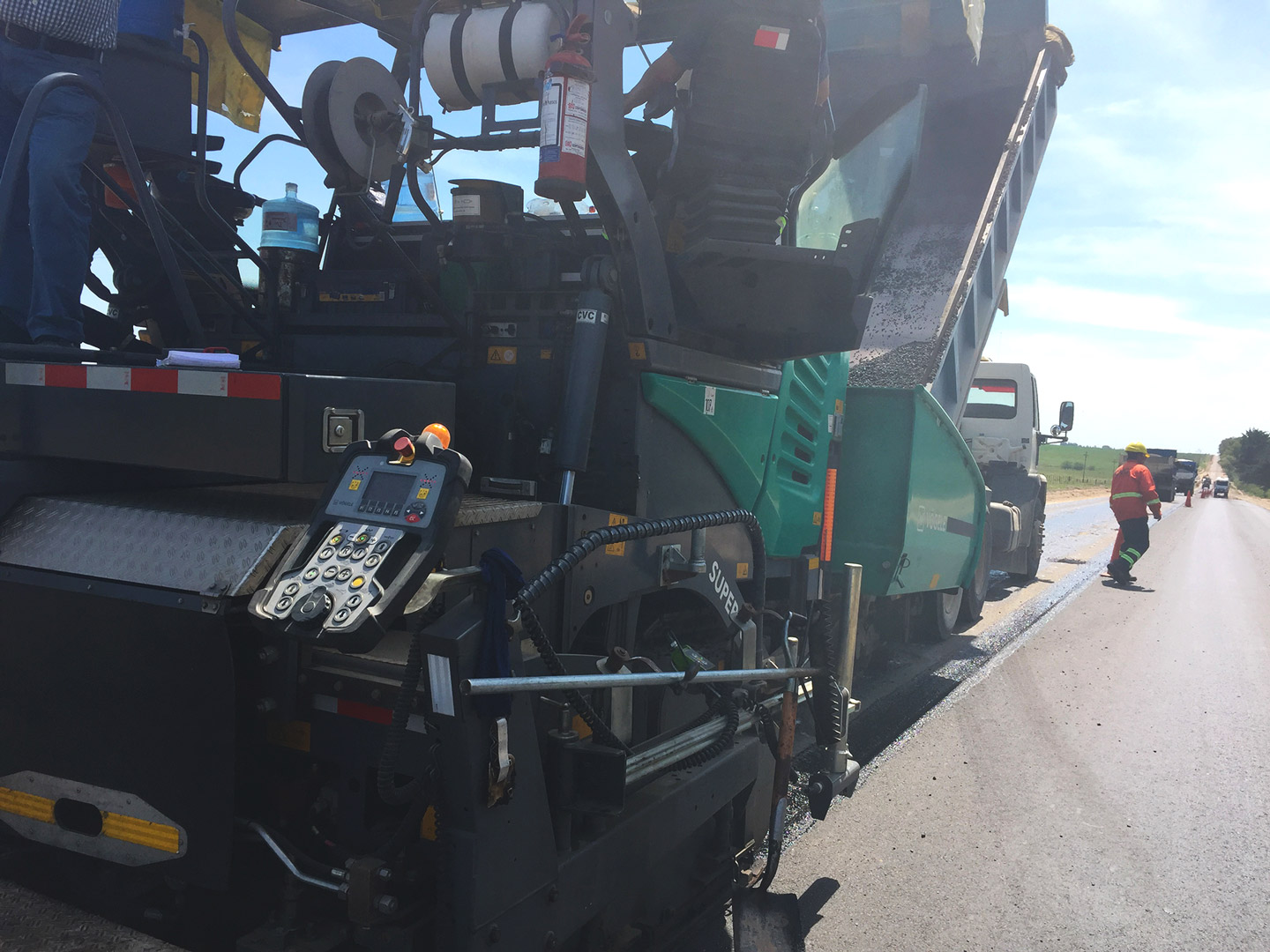
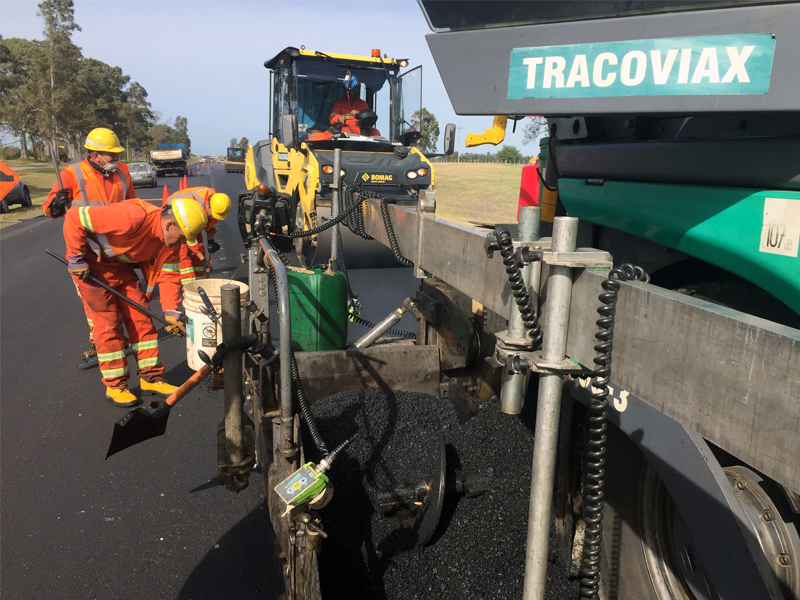
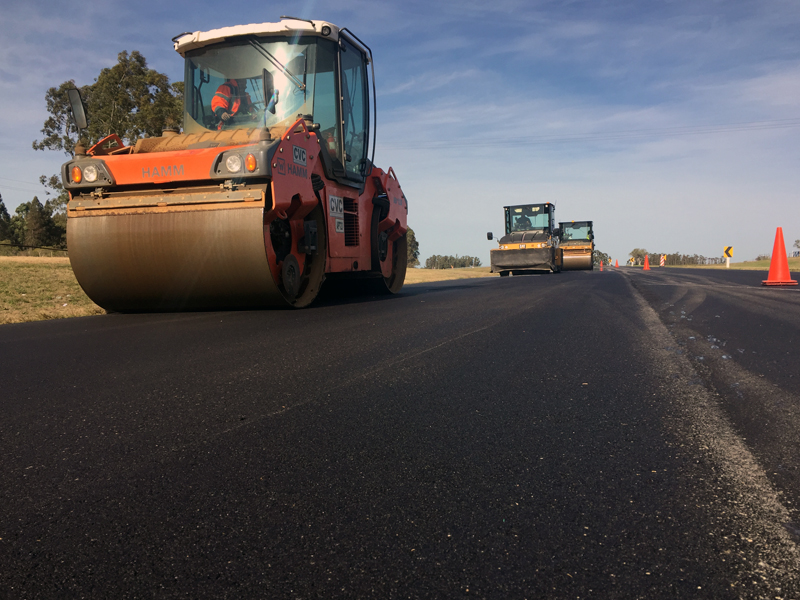
For irrigation asphalt layer adhesion is performed with emulsion IRRIGATION BITAFAL 65 and then the laying and compaction of the asphalt mix in 7 cm thickness with modified asphalt BITAFLEX PG 70-28 using two pavers in parallel. One of them equipped with a multiplex ruler with 3 sensors on one side and a laser sensor (or copying skid) or electronic pendulum on the other; the other paver has automatic leveling through laser copier sensors on both sides or pendulum and sensor that copies what was done by the first one and extends outwards until completing the programmed width. The recoat width is between 9.26 – 10.26 m per shift to minimize cold joints on a runway that is 45 m wide. It begins with a central strip of 4 m mounted on the slope break of the runway axis (with broken plate in the middle regulated at 1.5% cross slope) and an adjoining one towards one of the sides of 5.26 m (second regulated finisher at 5.40 m to mount about 10-14 cm on the hot joint); this completes the 9.26 m. Then it follows with widths of 5.00 m for the paver equipped with multiplex (corrects small deviations in the longitudinal profile) and 5.26 m in the second paver (5.40 m to absorb the assembly in the hot joint). Towards one of the sides, the total width of 45 m is completed with a single paver regulated at 5.00 m wide.
In addition to these works, repairs are being made to the concrete and asphalt pavements of the aircraft parking platforms, improvements to runway accesses and runway intersections – level transitions, replacement of edge lighting systems and runway thresholds. – AGL (Airfield Ground Lighting) as well as the adaptation of the ALS (Approach Lighting Systems) for runway 08-26 and other visual aids. The areas of the runway Resas are also being readjusted to the latest ICAO requirements in terms of extension and levels, to fulfill this task some 30,000 m3 of soil movement are estimated. The deadline to complete all the works is 4 months, with completion estimated for the month of June.
* We thank Engineer Horacio García Terra from CVC for the collaboration provided for this note
ADVANCES IN ROUTE 14
Road Circuit 3 advances according to the schedule foreseen in the rehabilitation of Route 14.
ASPHALT PG70-28 ROUTE 14
Making good progress rebuilding Route 14 through the PPP mechanism by the Consortium Espina-Copasa
The consortium has six work fronts are doing widening platform, recycling with cement existing pavement 20 cm and placing an asphalt mixture with modified bitumen 4 cm.
Asphalt selected by the Consortium is a modified asphalt type PG70-28E supplied Bitafal. It is a AM2 according to IRAM 6596 standard but very close to a AM3. We invite you to know details of progress.
The excellent quality of the cement asphalt type PG70-28E it has been shown in a recent study of different mixtures were made in the 12th Congress of the Road Uruguaya. The same improvement was obtained 3 times in both the resistance to permanent deformation as compared to fatigue over conventional asphalt type AC-30. This classified as asphalt for heavy traffic (Extremely Heavy) AASHTO T350.
We had the opportunity to visit the front CVC work of the company, where they could see the different stages of the reconstruction of Route. A first cleaning stage and widening strip, then the recycling train with portland cement to which was followed by a curing irrigation Emulsion Bitafal Riego 65 and finally applying the front paving asphalt mixture with PG70-28E.
In the other sections we visited this time we see the company Frivial focused on clearing embankments to improve longitudinal profile of the route but turn has a front cleaning, widening and recycling and the company Emilio Diaz Alvarez preparations to start recycling and near the intersection with Route 5. the front paving of this company is doing the stretch peach-Trinidad at a good pace.
We want to highlight the incorporation of technology from different companies, 4 m rules for Pavers, automatic motor grader control systems, oscillating roller compactors, among others, as well as safety and tidiness of the works.
We thank the Consortium and contractors the confidence provided for supplying important input as is the modified asphalt and emulsions both common or modified. We are already preparing to visit the remaining work fronts from the city of Trinidad to Mercedes so keep you posted shortly.
PG 70-28 asphalt NEW
Bitafal Special Asfaltos incorporates a new high-quality modified bitumen called PG 70-28.
The new surface has excellent results in laboratory, achieving resistance to permanent deformation and the like fatigue one asphalt AM3. If you are perform traditional tests it can be classified as an asphalt AM2 (almost AM3) of the IRAM 6596 standard but is a performance grade asphalt PG 70-28 E (for extremely heavy traffic).
And there are several works that are using this new alternative modified asphalt on the one hand is being used in the retreading on concrete Route 8 by Tracoviax and CVC and another is beginning to be used in the reconstruction of Route 14 you have to perform the PPP Circuit Vial 3 by the Espina-Copasa consortium.
At 12th Congress of the Road Uruguaya the benefits of this new modified asphalt and comparative studies with other asphalt cements were presented at the square.
On Route 8, it is conducting a retreading over the existing concrete section of Mataojo Solis - Minas. First a base layer of 5 cm and then a 4cm surface, both prepared with the asphalt PG 70-28 (AM2).
The mixing temperature is in the range of 160 ° C, maintaining the characteristics of a conventional asphalt work and high performance work to achieve good workability in the vicinity of 150 ° C.
Both companies are making a very good job in both manufacturing and laying and compaction of asphalt mixture which is reflected in surface quality, both macrotexture and IRI. We emphasize safety equipment used as mobile radars and donkey backs of much needed in a high traffic route. Moreover, for the roughness of the section are being used skates 6 m with sensors coupled to the terminating and results feel gait.
We thank the companies and the MTOP the offered confidence.