Author Archives: Bitafal Group Communication

CELEBRATING CHILDREN - Actions that make the difference # 2

CELEBRATING CHILDREN - Actions that make the difference # 2

On Sunday 20 August, on the occasion of the celebration of Children's Day, Athletic Club Flamengo and the Municipality of Colonia Nicolich, organized a big celebration entertaining the little ones in an afternoon of inflatable games, a delicious snack and gifts for boys.

Since June, a group of young Club Atlético FlamengoHe committed to the neighborhood and its people, began a toy collection campaign, calling friends, neighbors, businesses, shops and Grupo BITAFAL to collect about 200 toys that were put up, packaged and delivered.

The locals and families of about 100 children to share a sunny and joyful evening attended.

Since Bitafal group We support this initiative with pride and commitment, celebrating the good work and management of Club boys to their community.

In addition we applaud the support of municipio Nicolich, Youth and Sports Center Quebracho, Sectional # 28, local Tiki Toco, local Just here and company Danone who they collaborated with toys, desserts, sweets and treats.

THANK YOU ALL FOR HELP!

EXPERIMENTAL SECTION: DIFFERENT BASES ON CEMENTED taxiways.

EXPERIMENTAL SECTION: DIFFERENT BASES ON CEMENTED taxiways.

An experiment carried out 18 months ago shows how the use of bituminous treatments reduce the reflection surface cracks.

C.V.C held in Route 69 in Montevideo in early 2016 an interesting experimental section of Portland cement stabilized base which they were applied different layers of rolling to see its evolution:

1. Hot asphalt layer of asphalt AC20 3cm

2.- Bituminous treatment Simple -TBS- fog irrigation (14-20mm arid emulsion IRRIGATION BITAFAL 65 )

3. Cape seal (TBS with aggregate and emulsion 14-20mm IRRIGATION BITAFAL 65 + Micro Type II TMN 5mm emulsion BITAFLEX MICRO 62 P25)

4.- microsurfacing Type III (TMN 10mm emulsion BITAFLEX MICRO 62 P25)

After 18 months in service you can determine that all taxiways are used in very good condition overall and are alternatives to consider when protecting a stabilized with cement.

As reflection of shrinkage cracks in the cemented basis substantial differences exist between each of the layers used that detail below.

STABILIZED BASE:

The cement stabilized performed looking for a simple compressive strength of between 15 and 20 Kg / cm2. He was executed in place with a cold recycler and no crazing was performed. Irrigation curing was performed with emulsion IRRIGATION BITAFAL 65 and gravillín.

Wearing courses:

After 18 months of service shows that:

1. Hot asphalt layer of asphalt AC20 3cm. The cracks in this case are transverse to the roadway between 3 and 5 m. Also it is shown in much of the length of the longitudinal crack in the shaft which corresponds to the overlapping of the execution of the cement base.

2. Treatment Bituminous Simple irrigation fog (14-20mm arid emulsion IRRIGATION BITAFAL 65 ). Fissures surface but are difficult to identify the observed are between 9 and 18 m and no longitudinal crack is identified. In some identified fissure could be seen a slight loosening of aggregate.

3. Cape seal (TBS with aggregate and emulsion 14-20mm IRRIGATION BITAFAL 65 + Micro Type II TMN 5mm emulsion BITAFLEX MICRO 62 P25). In this case the cracks are clearly visible because the smooth surface which achieves the Micro Type II. They are transverse between 5 and 12 m apart. Nor longitudinal fissure of the overlap of the base shown.

4.- microsurfacing Type III (TMN 10mm emulsion BITAFLEX MICRO 62 P25). In this section transverse cracks between 2 and 3 m apart and longitudinal cracks of overlap almost the whole section are identified.

PRIMARY CONCLUSIONS (First 18 months)

• Bituminous simple treatment is the wearing at the time shows better performance in the reflection of cracking, not so much so in the comfort of the user (and neighbors) because it is quite noisy. (Patch initial sand: 3.75 mm). Something that could easily be solved with a finer stone or a sealing treatment.

• Then follow the Cape Seal with a very good performance against the reflection of cracks which obviously is contributed by the Bituminous simple treatment. In this case the sealed surface gives quiet and safe running. (Patch initial arena: 0.95 mm)

• The folder has a good asphalt performance but still has more Cracking the Cape Seal for security and is thinner than the rest of the taxiways (Patch initial arena: 0.45 mm) Macrotexture. In turn it would have to make an economic comparison against the cold techniques, but at the same cost would be reasonable to use treatments or Cape Seal.

• The Micro Type III had the worst performance against reflection even crack your Macrotexture is suitable (Patch initial arena: 1.10 mm)

For future tranches of these features we suggest:

Perform 1_ TBS with modified emulsion BITAFLEX P25 or P40 65 IRRIGATION to further reduce the reflection of cracks and have more cohesion in the asphalt to prevent premature detachment.

2_ Test with TBS with a little fine stone (10 to 14 mm) and made in Australia and New Zealand, to have good resistance to cracks without neglecting the noise generated.

3_ Perform a double treatment Trabado (TDT) with modified emulsion BITAFLEX P25 or P40 65 IRRIGATION to contemplate the above as well as high yields of work and minimal waste of materials.

IMPROVEMENTS IN ROUTE 81

IMPROVEMENTS IN ROUTE 81

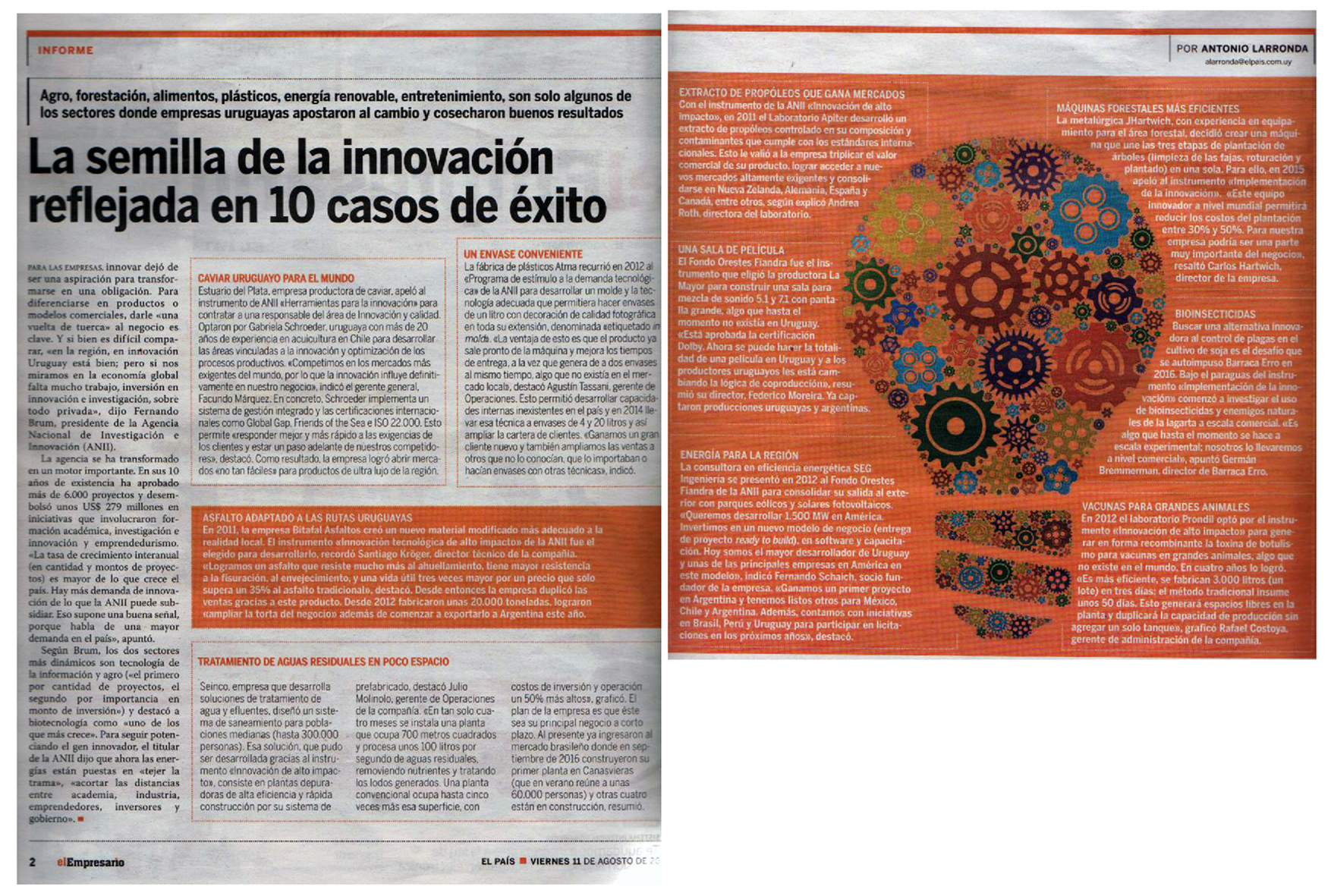
INCOCI RENTALS BITAFAL trust for the execution of a stretch of cold recycling on site.

They are making improvements to Route 81 in the section that connects the new bridge over the St. Lucia. Once the works are completed there will be a corridor between Route 11 and Route 5 giving it the importance it deserves the new bridge and bypaseando St. Lucia and Canelones substantially improving travel times.

The work done by INCOCI includes an expansion platform, recycling of the existing macadam, performing an offset Portland cement stabilized layer and a concrete floor 21 cm.

For the implementation of recycling and stabilized base, BITAFAL RENTALS He collaborated in the dosage of Portland cement, recycled walkway and initial compaction.

For widening of the platform teeth on both sides of the existing roadway is made with successive layers of granular materials CBR 10, 40 and 60. A cement stabilized granular layer remaining flush with the existing roadway is then executed for have similar rigidities.

Across the width of the new roadway a regularizing layer was made. To do recharged with crude which was then stabilized in place by adjusting the dosages of cement according to the thickness profile. At this stage of the existing recycled macadam. For thick thicknesses were made was fundamentally a heavy compaction equipment kickstand to achieve densification.

Currently running the concrete pavement 21 cm thick is achieving very good resistance values ​​and excellent surface finish.

INCOCI thank the confidence provided BITAFAL group.

INAUGURATION CANAL BRIDGE ANDREONI

INAUGURATION CANAL BRIDGE ANDREONI

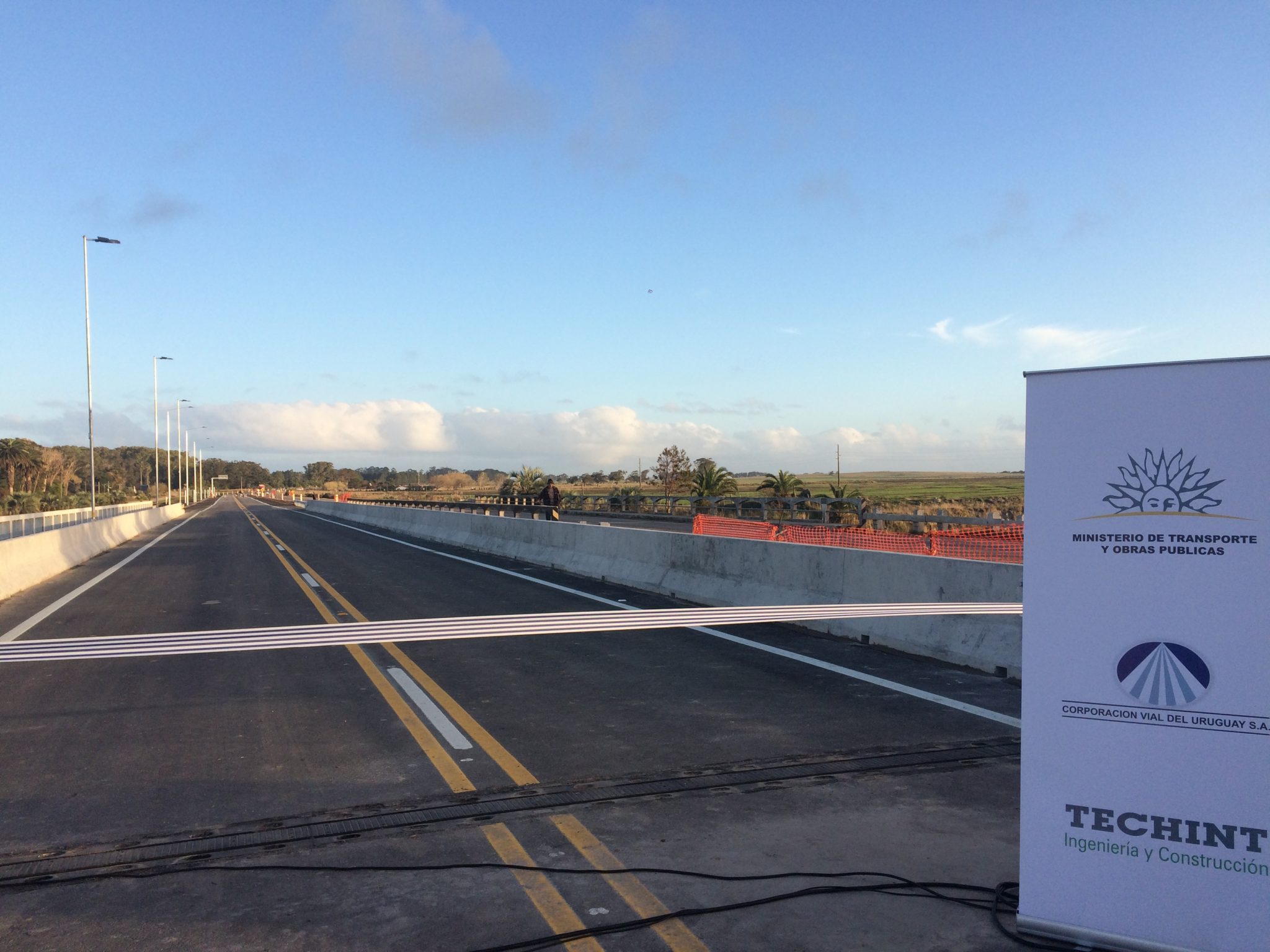
Last July 11 in the presence of the Minister of Transport and Public Works, Victor Rossi and Mayor Rocha, Anibal Pereyra, the new bridge over the Canal Andreoni on Route 9 he was inaugurated.

The Techint SACI the new bridge built in just 7 months after a temporary seriously affect the existing one. After 60,000 hours without accidents and strict work schedule was inaugurated in the presence of several residents of the Chaplet, MTOP Engineers, elected officials and colleagues in the field. (NOTE THE COUNTRY - July 13, 2017)

GROUP BITAFAL thanks for the provided confidence in the provision of anchored together neoprene (Making Roads Bulletin June 2017 - # 85)

EFFECTS OF STABILIZED RESTRICTION ON LOSS OF FINES BY PUMPING

EFFECTS OF STABILIZED RESTRICTION ON LOSS OF FINES BY PUMPING

Granular basis of any type whatsoever in quality, texture or homogeneity suffer unavoidable variations in the presence of water and is the big problem with road engineering if that happens.

For this is that it gives great importance to the drainage systems in the design of routes, waterproofing the foundations built with asphaltic materials in most of the time and then expected during routine maintenance look that water does not Enter the bases.

We know that there is not a virgin granular material that is not affected by water, hinchándolo in some cases or acting as a lubricant when traffic acts, pumping it from its original location causing potholes.

Stabilizing Portland cement solves the problem of pumping fine and 100% mitigates generating bumps or wells.

Vials know the virtues of Portland cement as a major stabilizer of granular materials for over 50 years, but the actual practical results were very heterogeneous, complex to implement and low yields due to such a long time between perfect mixing cement ( in concentrations as low as 3 to 4%), wetting and final compacting.

It is for this reason that the Germans begin in the 70s to design anti-roll bars atomizing water where the time between the cement is mixed with aggregates and required additional moisture occurs in less than one hour period.

Why less than an hour? ... what happens is that the cement setting begins in contact with moisture and applied in less than an hour to achieve optimum compaction density for that project.

The setting is not another chemical process and crystallization those crystals are attached form a IRREVERSIBLE network equipment and logistics execution adequate to achieve the required times are needed.

We entered 2 very important concepts such as the Crystallization and irreversibility.

This network of crystals irreversible link system while pumpable particles move or change their structure preventing premature deterioration of the pavement.

In the photograph we can observe in sections stabilized where mixing and compaction was conducted, granular materials suffer displacement action of water and traffic.

For these observations we can say that after having done a good project stabilized and have used the best equipment available, but good logistics is achieved in the implementation, we will have surface defects which the user will be perceived and which probably made the first maintenance operations.

SUCCESS STORIES IN WINTER GRAVILLADOS

SUCCESS STORIES IN WINTER GRAVILLADOS

The use of the technique TDT (Double Treatment Trabado) graveled in various works that have recently implemented show that emulsions may be used during the winter successfully without risk of landslides and significant material savings.

Such is the case of the work done by NECKLACE Ruta 19, executed by the banquinas BITAFAL RENTALS for SERVIAM in Route 5 and TECHINT in Route 9 and Route 16.

All these works were done with modified emulsions Bitaflex P40 or P25 Riego 65 using the technique TDT (Note: "Innovative technologies for surface treatments in winter") Without any detachment.

This is due to the combination of good materials and implementing ways appropriate to the era. The key is to run two risks in the day achieving total mechanical interlock and to even make irrigation fog on the same day to ensure adherence of the entire stone and a superior aesthetic finish. Moreover it is essential dosing intelligently materials to have the optimal amounts in each irrigation and save on the materials used.

We invite you to know the procedure used in our blog:INNOVATIVE SURFACE TREATMENT TECHNOLOGIES IN WINTER

Strength studies ductility performed on the binders for surface treatments show that the modified emulsions Bitaflex Riego 65 P25 and P40 have a cohesive energy far superior to any common emulsion and not to mention the asphalt diluted, which contributes to the durability of the matrix achieved in the implementation of DTT.

As the images of the enclosed work COLIER in Route 19 can be seen that achieved is homogeneous matrix, containing suitable gaps for expansion of the bitumen in summer and very little excess stone in the shoulders.

We invite you to contact if considered necessary to deepen the dosage form and implementation of a TDT or the selection of suitable materials: bitafal@bitafal.com.uy

THE IMPORTANCE OF PORTLAND CEMENT STABILIZED.

THE IMPORTANCE OF PORTLAND CEMENT STABILIZED.

Our company in 2013 introduced the first Uruguay Wirtgen WR2000 stabilizer knowing that coming times of change in our industry due to increasingly tight budgets to meet a growing demand for road maintenance.

Moreover, the provisions of Dinama and Dinamige for quarrying are increasingly restrictive implying that these technologies, reuse of existing materials, are here to stay.

The more than 14 machines that are operating in our place to prove it. more economic and lasting foundations are achieved using existing materials and also with yields never imagined execution.

This technology allows us to think of other alternatives for pavement design, especially in the surface layers, which are not disseminated by the lean life they had in defective granular bases.

It's not new, but We are convinced that the foundations of our roads are the foundation and the life of asphalt which we place on them.

It is our vocation known surface treatments, very successful experience in new binders and search for new alternatives of implementing them prove it.

It is a technology that fits perfectly with the costs that Uruguay can pay for your roads and excellent cost / benefit based on traffic routes we have in our relationship.

We are studying sion All manual published in the roads of Australia, New Zealand and South Africa where more than 90% of the kilometers are executed surface treatments and where they used the stabilized with cement massively.

This work is being developed thoroughly and bringing it closer to the realities of this side of the southern hemisphere to transmit knowledge to the sector being adquiriendo.Prontamente be informing them about the progress of this work.

SEALS anchored in the new bridge ANDREONI

SEALS anchored in the new bridge ANDREONI

Techint relied on BITAFAL RENTALS for installing anchored neoprene gaskets on the new bridge over Andreoni canal at kilometer 314 of Route 9 at Spa La Coronilla. Boards are placed SC-80 type movements that support 80 mm.

As we reported in Bulletin # 81 Making Roads, execution of work comes within the stipulated time frame. It is a bridge of 90 meters long with a roadway of 9.20 m wide and pedestrian path 2 meters wide. (SEE NOTE: "New bridge over Andreoni canal")

The estimated date for its opening is on July 11.

We use own and third party cookies to help us optimize your visit to our website and also to improve service delivery and thus adapt to their most relevant and useful to better their experience needs. When you click OK to continue with navigation and thus confirm that you have read the information and accept the activation of cookies.

You can allow or reject use at any time can change the Configuration Options Privacy - Cookies Policy -

Privacy settings

When you visit a website, you can store or retrieve information in your browser, mainly in the form of cookies. Check your personal services cookies here.


We track anonymous user information to improve our website.
.
  • _ga
  • _gid
  • _gat

Decline all Services
Accept all Services