BITAFAL GROUP FINALIST OF THE PwC 100 YEARS INNOVATION AWARD

BITAFAL GROUP FINALIST OF THE PwC 100 YEARS INNOVATION AWARD

We were awarded as finalists together with important companies in the country.

The award organized by PwC with the support of ANII and the weekly Busqueda had its award ceremony the past mywednesday November 4th in Magnolio Sala where ATGen ended up being the winner for the development of the Covid-19 diagnostic kits. The other finalist companies for the Innovation Award were: Carrasco Airport, Lanas Trinidad and Montes del Plata, which together with Grupo Bitafal were also recognized for their innovative initiatives.

This initiative complements the Nova Award organized by the ANII together with the business chambers. Grupo Bitafal was the winner of the 2014 Nova Award, was a finalist in 2013 and obtained a special mention in 2010.

Module 3 - Webinar Surface Treatments

Module 3 - Webinar Surface Treatments

This was the third and last module of the Webinars cycle. In this instance, the theme of Irrigation with gravel was developed: the most efficient option for conservation.

The role of surface treatments in pavement management was studied in depth.
We had the presence of Jorge Prozzi, Professor at the University of Texas at Austin, who told us, among other things, about his research in this area.

Here is the recording and presentation in pdf:

ROUTE 104 REHABILITATION

ROUTE 104 REHABILITATION

Serviam began the rehabilitation works that will culminate before the tourist season

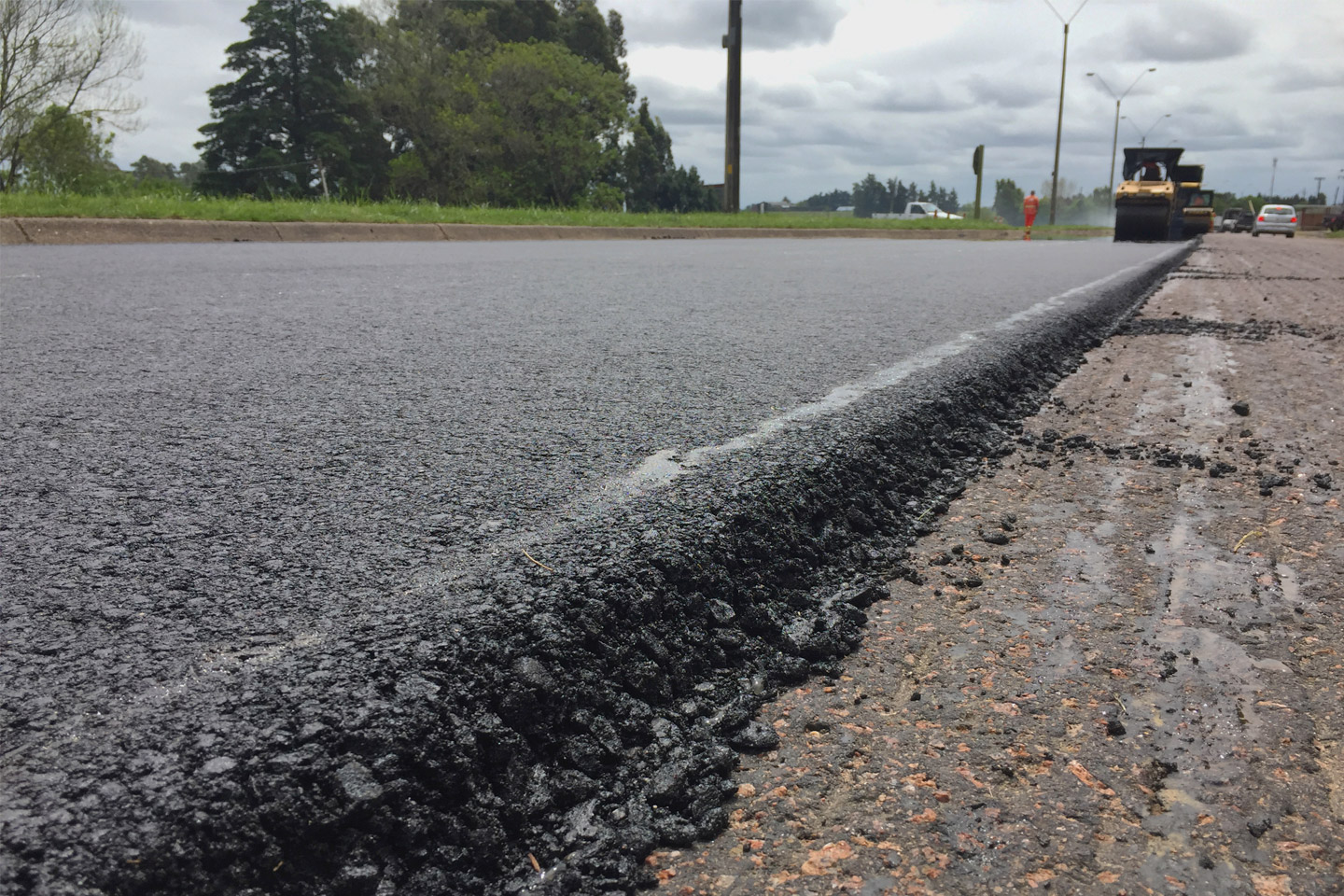
The route that connects Routes 9 and 10 at Manantiales is being rebuilt along its 15 km length through recycling with Portland cement and a Capeseal as wearing course, similar to what was done on Route 60.
It is an ideal solution due to the aesthetic and functional quality of the combination of treatments for a route that has high light traffic in the summer season.
The works began with a strip cleaning and ditch deepening as well as the surcharge of between 15 and 20 cm of coarse that is being stabilized with cement together with the existing old bituminous treatment.
As in the rehabilitation of Route 18 (Making Paths Newsletter #102), a series of transverse cuts with emulsion is made to control cracking. IRRIGATION BITAFAL 65 with equipment specially designed for it. A radiofrequency motor grader guidance system is also being used that allows a great improvement in the roughness of the section that will later receive a surface treatment.
Irrigation Curing with Emulsion IRRIGATION BITAFAL 65 and grinding sand has excellent adhesion and performs very well as a stabilized base protection.
In the next few days, the Capeseal type paving works will begin with a simple bituminous treatment with emulsion IRRIGATION BITAFLEX 65 P40 and cold microagglomerate with emulsion BITAFLEX MICRO 62 P25.
We will keep you informed of the development of the work in future editions of our newsletter.
9TH TECHNICAL DAY OF ASPHALT

9TH TECHNICAL DAY OF ASPHALT

The biannual event of the Uruguayan Association of Roads was held in online format

The virtual activity co-organized with the Permanent Asphalt Commission (CPA) and the Argentine Highway Association (AAC) had a great attendance of almost 450 people from all over the world.

In this edition, emphasis was placed on modified asphalts for asphalt mixtures such as the new highly modified asphalt (HiMA), which we have already delved into in previous editions (Nota HiMA) and novel experiences with AM3 such as the recapping of Route 1 carried out by Tracoviax (Note route 1).
We hope to continue having such an active participation in person as well as virtually in future editions.
The conferences were held on the 22nd and June 23 through the AAC platform. They began with a conference of the Ings. Rafael Lopes Martins and Gary Fitts from the Kraton company doing an "Introduction to high performance modified asphalt (HiMA)", technology introduced in Uruguay by GRUPO BITAFAL with the support of the Kraton company in the development and Colier in the execution of the section test. This technology has been extensively studied at CITEVI and is part of the degree thesis of BITAFAL Engineers, Carlos Pfeiff and Ignacio Kröger (Thesis Note: https://bitafal.com.uy/novedades/desempeno-de-asfaltos-altamente-modificados/).
Then for the CPA, Eng. Alejandro Bisio, who until a few months ago was in charge of the Research and Development Quality Management of the National Highway in Argentina, made an excellent overview of the “Asphalt mix design methods”.
He Tuesday June 23 opened the day the Ings. Diego Larsen and Lisandro Daguerre with “Solutions for high performance pavements” where they detailed the 200 km project with HiMA asphalt carried out in Argentina on Route 9 (Rosario-Campana) and other sections with high modulus asphalt.
For the closing, Eng. Marcelo Borrelli detailed what the Tracoviax company had done in the "Rehabilitation in asphalt mixture of Route 1 double track between accesses to Montevideo and Santiago Vázquez" where modified asphalt was used BITAFLEX AM3 for the three layers of the overcoat, an asphalt sand to delay the reflection of cracks, a semi-dense one for leveling and an F10 for rolling. For more information about this work you can see in our BLOG (https://bitafal.com.uy/novedades/arena-asfalto-con-am3-en-ruta-1/) or in the presentation of the day.
The presentations are available on the AUC and AAC websites (http://www.aacarreteras.org.ar/noticia-jornada-asfalto.php).
MOST COMMON FAILURES IN THE REGION'S FLOORS

MOST COMMON FAILURES IN THE REGION'S FLOORS

The surface deterioration of the pavement provides a measure of the damage caused by traffic, environmental conditions and aging of the materials that constitute the wearing course. The type and cost of maintenance operations required for a road section is significantly influenced by the type, extent and severity of the defects present in the pavement (1). It is recognized that in reality, the set of indicators that characterize the state of the surface does not evolve in isolation, but through an interaction between them, other elements and the previous state of the set. It has been shown that the progress of cracking and rutting are related: at the beginning of the service life, an initial rutting occurs, the growth rate of which decreases with the increase in the number of cycles. Once cracking begins to be evident, the modulus of the asphalt layers falls, which causes an increase in the stresses that accelerate the rutting process, together with the possible entry of water into the structure depending on the maintenance tasks (2 ). Figure 1 outlines the deterioration behavior of the pavement considering both evolutionary periods.

Figure 1. Evolution of the deterioration of a pavement structure. Taken from Rational Design Models: Failure Criteria (2)

In today's pavements, the action of repeated loads is the most notable cause of deterioration. As previously mentioned, the growth in the volumes of cargo transported and the increase in the allowable weight per axle increase the probability that the pavement will experience fatigue and cumulative deformation failures (3).

1 Fatigue cracks

The National Highway Directorate of Uruguay defines fatigue cracks as failure lines mainly caused by stresses and / or lack of bearing capacity of the pavement (1).

The triggering of fatigue cracks is mainly attributed to tensile stresses in the lower part of the asphalt layer due to the bending of said layer due to the repeated passage of vehicles. This cracking starts and progresses through the asphalt phase and/or at the asphalt-aggregate interface and gradually propagates to the surface (bottom-up cracks) (4). They begin to show up as small longitudinal fissures in the tracks branching out, to later form a closed mesh (colloquially called crocodile skin). At that point, the failure is declared severe, eventually causing material detachment (1).

The fatigue process affects the asphalt layers, progressively reducing their effective work modules, which causes a redistribution of the induced stresses throughout the structure. This stress variation is dependent on the contribution of these asphalt layers to the overall stiffness of the structure. It may then happen that structures that have greater relative rigidity of the asphalt layers with respect to the structure as a whole, result in a decrease in useful life (2).

The fatigue failure criterion relates the allowable number of load repetitions to the tensile strain, until the condition of the pavement is considered sufficiently deteriorated to establish the end of its life. Fatigue laws are generally elaborated from laboratory tests and calibrated in the field (5).

Folder fatigue failures have historically been combated in two ways. On the one hand, an attempt has been made to give the folder such a thickness that the stress applied by traffic generates small deformations that do not produce the possibility of cracking or cumulative deformation. A greater thickness reduces the magnitude of the tensile stresses in the lower fiber of the asphalt layer and makes it more difficult for cracks to propagate, since they have to travel a longer distance to reach the surface (6). This approach is the most intuitive and simple to solve, but also the most expensive (7). On the other hand, the tensions in the asphalt layer can be reduced by supporting the folder on other layers that are sufficiently resistant and not very deformable. In these cases, it is important to compare the cost of each of the reinforcement options and study that the behavior of these layers does not affect the performance of the folder. For example, a cemented base will substantially improve its resistance capacity but will eventually generate shrinkage cracks that will be transmitted to the asphalt layer.

2 Permanent deformation

By permanent deformation phenomenon, also known as rutting, it is understood the alteration of the level of the tread layer due to subsidence along the treads (1) that brings about a lack of safety and comfort of the users who walk on the pavement.

Permanent deformations in asphalt mix layers are caused in a specific way or in combination by a set of factors. In the first place, the exposure of the pavement to high temperatures directly affects the viscoelastic properties of the asphalt present in the asphalt mixture causing it to flow under lower loads and it is generally evident early, even during the first months of summer. Other climatic factors such as thermal gradient and reflectivity of the pavement affect the severity of rutting to a greater or lesser extent (8).

On the other hand, traffic gives rise to cyclical loads, where in each cycle some work is done to deform the pavement surface as a combination of densification and shear deformation. Densification implies a decrease in the volume of the material, while shear deformation involves a plastic flow of the material with or without changes in volume (8). The factors that intervene in this behavior are the magnitude of the load, the inflation pressure of the tires and the speed of movement of the vehicles (9).

There are also other factors that directly contribute to rutting related to the composition of the asphalt mix, such as the low void content, high percentage of asphalt content, the use of an inappropriate asphalt and the use of uncrushed aggregates (10). Finally, there are factors related to the geometric characteristics of the route such as the width of the lane, which influences the transversal distribution of the vehicles, and the longitudinal slope that affects the distribution of the load transmitted by the tires to the pavement (9).

Bibliography

  1. DNV. Pavement evaluation instructions. Montevideo : s.n., 2000.
  2. Giovanon, Oscar. Rational design models: Failure criteria. Rosario : s.n., 2001.
  3. Rico Rodríguez, Alfonso, Téllez Gutiérrez, Rodolfo and Garnica Anguas, Paul. Flexible pavements: Problems, design methodologies and trends. Querétaro: Mexican Institute of Transportation, 1998.
  4. Safaei, Farinaz, Castorena, Cassie and Kim, Richard. Linking asphalt binder fatigue to asphalt mixture fatigue performance using viscoelastic continuum damage modeling. North Carolina : Mechanics of Time-Dependent Materials, 2016. Vol. 20.
  5. Monteros, Carlos Javier Vasquez. Damage equivalence factors in flexible pavements: analysis for typical conditions in Argentina. Buenos Aires: s.n., 2016.
  6. Ogundipe, Olumbide. Mechanical Behaviour of Stress Absorbing Membrane Interlayers. United Kingdom: University of Nottingham, 2012.
  7. Gaspar, Matheus, and others. Highly Modified Asphalt Binder for Asphalt Crack Relief Mix. 2017, Transportation Research Record: Journal of the Transportation Research Board, págs. 110–117.
  8. Morea, Francisco. Analysis of the rutting behavior of different mixtures in loaded wheel tests according to BS 598-110 and CEN 12697-22. Antigua Guatemala: XVII Ibero-Latin American Asphalt Congress, 2013.
  9. Martucci, José Luis and Pastorini, Magdalena. Rehabilitation of rutted pavements. Montevideo: VII Congress of the Uruguayan Highway, 2009.
  10. Nikolaides, Athanassios. Highway Engineering: Pavements, Materials and Control of Quality. EUA : Taylor & Francis Group, 2015.
PRINT 50 AN ALLY FOR THE ENVIRONMENT

PRINT 50 AN ALLY FOR THE ENVIRONMENT

Since the introduction of the emulsion 50 in Uruguay PRINT form base priming it has changed considerably because of the technical and economic advantages

We have made little emphasis on the environmental benefits of its use to the detriment of asphalt diluted for priming as in the case of the MC1. Diluted contains 30% volatile solvents evaporating end to the atmosphere photochemical smog impact on the greenhouse effect and the reduction of the ozone layer while PRINT 50 only emits water in curing.
Also, temperatures of handling and application of different types of primers lead to significant fuel economy as the PRINT 50 It is fully liquid at room temperature and water it is possible at temperatures as low as 40 to 50 ° C while the MC1 must be heated to 90 ° C or 80 to be applied correctly.
In recent years the use of PRINT 50 in Uruguay achieved:
- Reduce by 3000 tons of solvents emitted into the atmosphere
- Reducing CO2 emitted to the atmosphere because of its lower temperature manufacturing, handling and application
- Improving safety and health of workers by lower operating temperatures and avoid inhaling solvents
- Eliminate the risk of explosion in regadores trucks.
As for flammability and explosion hazard we should worry seriously and only in 2019 there were 2 accidents which fortunately had no fatal casualties but substantial material losses.
March 14 2019: Explosion of a tank RC2 in Maldonado http://www.maldonado.gub.uy/?n=38251&mm=Obras
In many countries of the world the use of diluted asphalt is prohibited, as is the case of Argentina and Spain, or at the least there are state policies that tend to reduce these products. In the US and Canada have guidelines for not using dilute solvent regulate their content or used out only from the time of ozone generation (usually summer).
It has recently been proposed that can not manufacture or market any diluted containing more than 0.5% by volume of volatile solvents evaporated at 260 ° C or less as determined by ASTM D402.
Uruguay should consider this path if we want to be an environmentally responsible country and protect the lives of workers.
For further information on the technical advantages we approached them a paper presented at the 9th Congress of the Road Uruguaya: https://bitafal.com.uy/wp-content/uploads/2017/10/9%c2%ba-CVU-Trabajo-Imprimaci%c3%b3n-con-emulsiones-mejoras-t%c3%a9cnicas-y-ambientales.pdf
OPENING OF ROUTE 50

OPENING OF ROUTE 50

Serviam inaugurated the section linking Route 1 with Tarariras

The rehabilitation of 22 kilometers of Route 50 in the department of Colonia was attended by Minister of Transport and Public Works, Victor Rossi, the Mayor of Cologne, Carlos Moreira and other national, departmental and local.
bacheo and one double bituminous treatment was performed in almost the entire length of the path executed emulsion IRRIGATION BITAFLEX 65 P25 and a double Spreader SECMAIR CHIPSEALER 41. In turn, between Route 1 and the locality El Semillero, a micro computer was placed in cold emulsion BITAFLEX MICRO 62 P25 that markedly improved the surface finish of treatment.
The works also included improvements in various sections such as the urban area of ​​El Semillero and Tarariras where asphalt was laid and the correction of the layout of some curves and the construction of eight culverts. The works demanded an investment of three million dollars.
Serviam thank the provided confidence in the supply of products and services.
MERRY CHRISTMAS AND SUCCESSES FOR 2020

MERRY CHRISTMAS AND SUCCESSES FOR 2020

From Group BITAFAL we wish them every success for the coming year

We arrived at the end of the year 2019, undoubtedly marked by the electoral cycle, which has involved almost the entire road network. We have worked hard and we have put our efforts on improving the quality of everything BITAFAL Group offers. Invest in technology, a new plant and train our employees, seeking to follow the path of innovation, commitment, responsibility, teamwork and transparency.
As every year, we highlight the work we are doing all players in the sector, as our roads is a reference worldwide for the level of innovation we apply to the construction and maintenance of our roads. We thank all our raving fans who believed, believe and believe that Bitafal Group is a company that promotes the development of the sector.
Thank you for the confidence offered in these years and we hope to accompany them in their future projects.
We share with you some highlights of the 2018-2019 work cycle that position us to a 2020 full of new objectives:
We see a promising 2020 both in our work in Uruguay and the region. We develop new technologies and products to keep us apart. We follow the path of the generation and dissemination of knowledge, so much so that we will be doomed to the organization of the XXI IBWC in Uruguay to be held in 2021.
We will remain close to our customers and friends always seeking the best for our country and strengthen the ties that are most important for long-term sustainable development.
Congratulations and much success for 2020.
Road maintenance

Road maintenance

We made a tour of the fronts of works which are being used Bitafal products.

This time we made 1400 km traveled by different works in progress, or a year of operations, for the purposes of check the technical situation and being in contact with the realities of the same.
In general all routes flown are in good condition but we have to convince us that interventions on the roadways when done in a timely manner so substantially lengthen the quality and durability of our floors. On the other hand we must continue to innovate and look for continuity mechanisms that do not generate electoral cycles ups and downs in the construction industry.
1) Laying asphalt mixture with modified BITAFLEX AM3 on driveway route 5It executed by the company HYG, great work rate and tidiness, a substantial improvement on driveways executed noticeable, providing a long service life of the road.
2) Then we visited the works on route 3 Pass of the Port to Young about 6 years ago and made it in very good shape and visited the recent works carried out by the firm Gofinal / Lemiro Pietroboni in retreading executed asphalt modified asphalt BITAFLEX AM3. I became essential that retreading modified asphalt because it was the only stretch of Route 3 in the vicinity of Young was fatigued.
3) Just finished running route 25 also modified asphalt BITAFLEX AM3. We were accompanying the company Colier Opening of the section of Young to Route 90 which has a traffic of 300 trucks per day wood and general condition of the road it was very bad due to the age of the last interventions.
4) They are starting the work by signing the INCOCI route 90, Which is stabilized with portland cement and seal with a surface treatment made with highly modified emulsions.
5) On Route 30 Route 3, Diaz Alvarez signature is running treatments emulsions IRRIGATION Bitaflex 65 P40, Achieving aggregate adhesion / asphalt very good and well behaved at the high temperatures of the region.
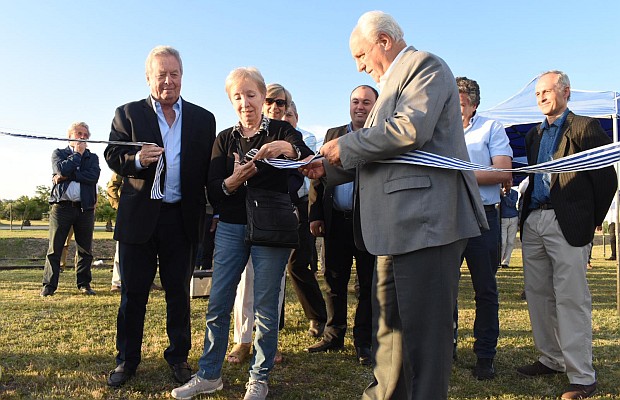
6) We participate in the cuts ribbon inaugurating bridges all route 30, Works of very good quality and excellent execution deadlines were completed 7 months before the deadline, congratulations to the four companies that participated: Saceem, Incoci, Grinor and Cujo.
7) Bases route 30 are being prepared by the firm Tracoviax in its entirety for treatment reinforced emulsions highly modified type IRRIGATION 65 P40 as required by the standard and the respective region.
Sieve executed with bases are being stabilized very well and really congratulates them for the arduous task of mastering the basalts of the north.
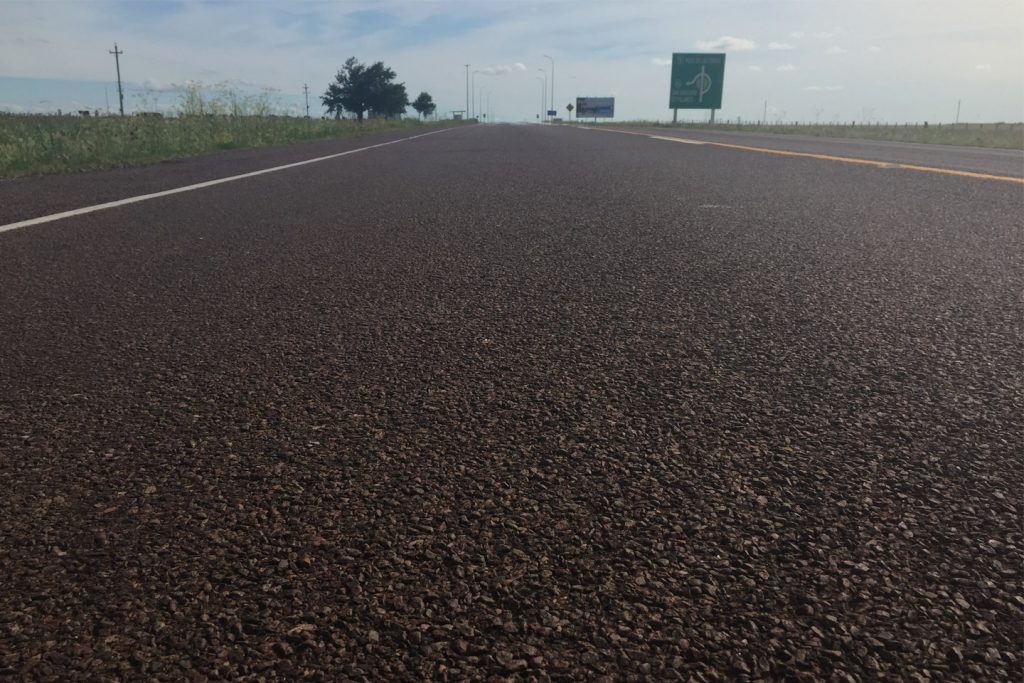
8) We review the overall asphaltic treatments region surrounding the city of Artigas and we can certify that his condition is very good. We visited the section executed by Incoci on Routes 30 and 31 as well as performed by Tracoviax on Route 30 and kept in good shape, without exudates or potholes. They are very well executed with the correct dosage, presenting a texture that can be seen in the photos taken.
9) And returning, we passed the landmark CHIPING executed by Colier on route 5 in the sections of hits on Route 43, San Gregorio de Polanco. That stretch was performed for the purpose of a necessary and immediate intervention to last 1 or 2 years, as we have been 8 years and continues to provide adequate service. Only they have been some meters bridging sealing.
We have to convince us that interventions on the roadways, when done in a timely manner, so substantially lengthen the quality and durability of our floors.
That calculation is handled that for every dollar we spend on maintenance, spare 8 future dollars, in this and many other cases are checked handsomely.
We have cases of the Chiping de Ruta 8 of Serviam 4 years, the retreading 2 cm asphalt Arnel Bitaflex AM3 on route 8 which it lasted more than 10 years and only last year was milled and Recapo by the firm Techint. It is very good for our company to see the progress of the work and make returns to our friends.
Until next time.
XX IBWC IN MEXICO

XX IBWC IN MEXICO

A large contingent of Uruguayan at the XX Congress of the Asphalt Iberolatinoamericano held in Guadalajara, Mexico

From the 25 to the November 29th He was held at the Performing Arts Center of Guadalajara a new edition of the most important congress in the world of asphalt. This time more than 800 technicians from 27 countries were present to show progress in binders and asphalt paving technology.

The strong presence of Uruguay was to ratify the realization of the XXI IBWC in the city of Punta of the East in November 2021. The launch was performed by a campaign of expectation during the Congress with a stand of Uruguay, an information campaign through leaflets and finally the announcement at the closing ceremony along with a video prepared for the occasion.

Organized by the AMAAC (Mexican Association of Asphalt), the WHAT XX It was held in conjunction with the Expo Asphalt Mexico and consisted of 5 days of intense knowledge sharing and closer ties between the different actors in the world of asphalt.

They presented more than 150 technical papers in various forms such as plenary lectures 2 auditoriums and simultaneous presentations in the same room with multiple screens and in which participants approached according to topics of interest.

There were also six lectures by prominent experts who spoke on asphalt mixes, infrastructure, design methods and auscultation of pavements.

Uruguay was present with 10 technical papers presented of which 7 were performed oral presentation format. Bitafal group He presented on emulsions degree of performance on mixtures with highly modified asphalts and on agile trials DSR (rheometer) to determine characteristics of asphalt mixtures. Serviam presented a paper on the design and implementation of a foamed bitumen recycling by Ing. Faustina Keuliyan and also on the rehabilitation of Route 60 with the Capeseal technology by Ing. Rodrigo Tejería and Pablo Carranza.

Furthermore Eng. Oscar Giovannon (Arg.) Presented the thesis of Ing. José Luis Martucci on recycled foamed performed in Route 3 and James Kröger presented thesis Ing. Gerardo Fernandez on primer emulsions.

He Tuesday in the afternoon, in a special session, Bitafal Group presented his book "High Performance Surface Treatment" of which were delivering copies of the same to all participants and which had an excellent reception.

The week was full of hard work broadcast next IBWC to be held in Punta of the East, first with the dissemination of material on Uruguay and customs, then on our natural beauty and closing Tipped East and an express invitation to participate in the XXI IBWC to be held in 2021 with a promotional video. We're on track and we will fulfill the expectations of all "cileros".

Nuevamente "one more!"

We use own and third party cookies to help us optimize your visit to our website and also to improve service delivery and thus adapt to their most relevant and useful to better their experience needs. When you click OK to continue with navigation and thus confirm that you have read the information and accept the activation of cookies.

You can allow or reject use at any time can change the Configuration Options Privacy - Cookies Policy -

Privacy settings

When you visit a website, you can store or retrieve information in your browser, mainly in the form of cookies. Check your personal services cookies here.


We track anonymous user information to improve our website.
.
  • _ga
  • _gid
  • _gat

Decline all Services
Accept all Services