ROUTE OPENING 18

ROUTE OPENING 18

Last October 10th Serviam inaugurated the work carried out on Route 18.

Route 18 Archives - Grupo Bitafal

Addition was performed on the sections still had good structural condition but any sign of surface damage, a micro cold emulsion BITAFLEX MICRO P25 62 with excellent quality implementation. We commend the company for work performed and the confidence provided.

The inauguration took place in Pueblo Rincón in the presence of the Minister of Transport, Victor Rossi, the Director of Roads Leonardo Cola and other members of the MTOP. In turn participated the mayor of Vergara, representatives of the Treinta y Tres, colleagues and friends.

A detail of execution and the new control technique mentioned cracking may be found at: https://bitafal.com.uy/nueva-tecnica-de-control-de-fisuracion-para-cementados/

OPENING OF ROUTE 7

OPENING OF ROUTE 7

They rehabilitated three sections to complete more than 82 km of Route 7 between Reboledo and Jose Batlle y Ordonez.

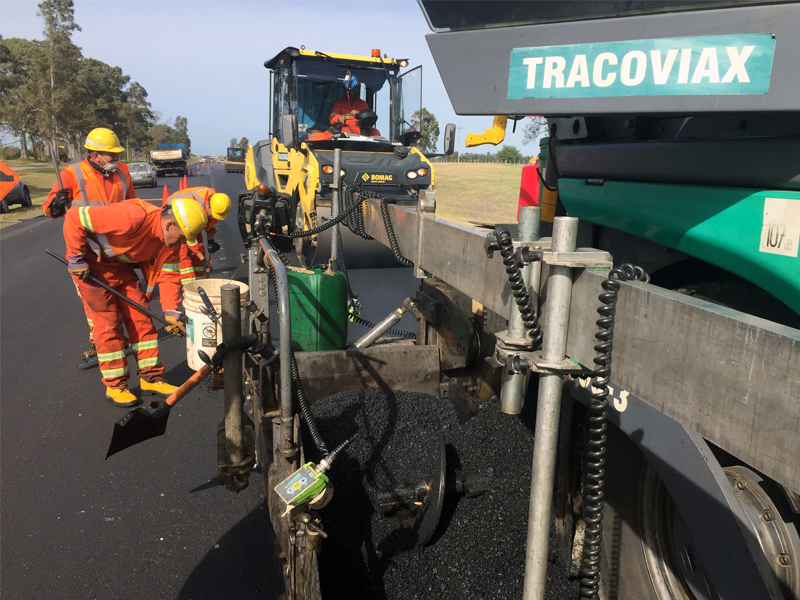
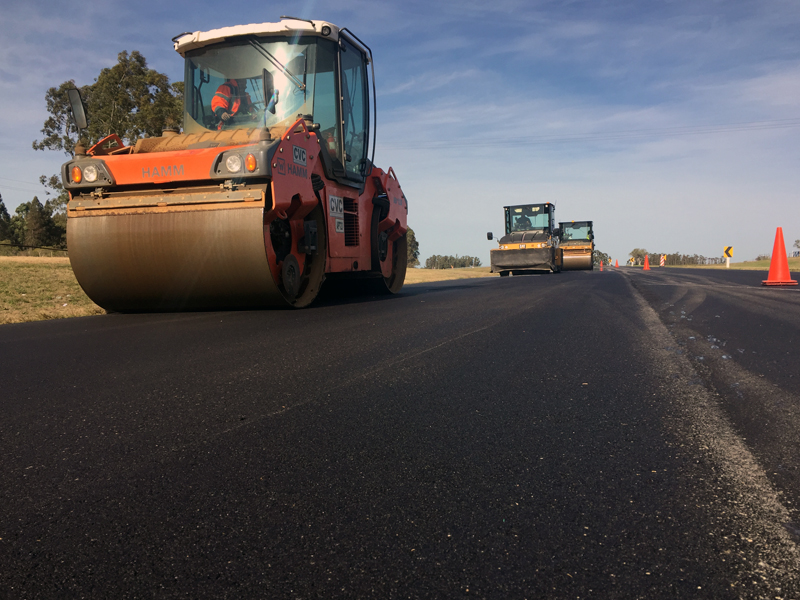
Tracoviax, Meliter and Colier were in charge of the rehabilitation and widening of carriageway to reach a total width of 11 meters. where recycling was performed with cement to increase the bearing capacity. As for the surface layer double bituminous treatment was conducted with watering fog in the driveway of 7.2 meters. and then banquinas simple bituminous treatment. Contractors trusted BITAFAL supplying the modified emulsions BITAFLEX P25 and P40 IRRIGATION 65.

In addition to work on the route they were made extensions and reinforcements of bridges over streams and Mansavillagra El Potrero and a layout correction in Reboledo making a bypass to such people.

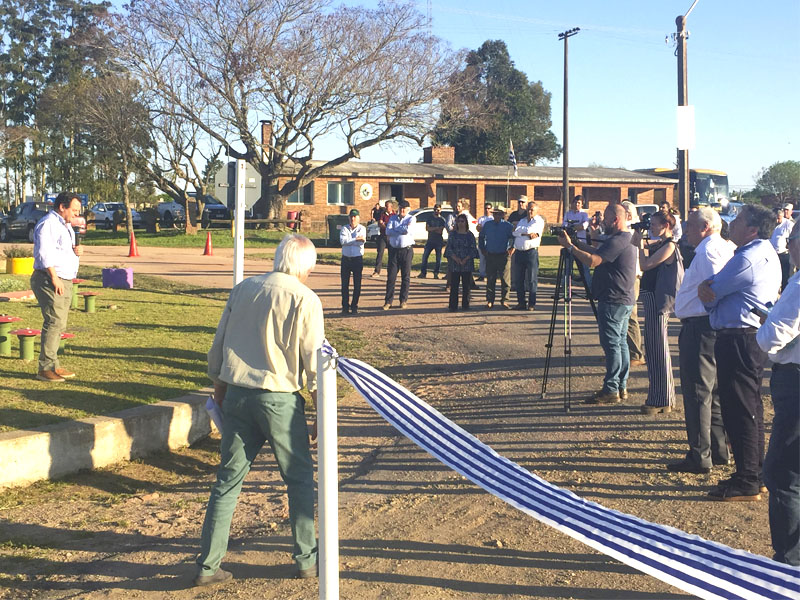
The opening last September 19 was held and attended by Transport Minister Victor Rossi, the Director of Roads Leonardo Cola, elected officials and representatives of the Municipality of Florida and Lavalleja and several colleagues from other road companies of the MTOP and suppliers.

It was carried out in 4 stages: First in Cerro Colorado (Alejandro Gallinal) the Tracoviax company made the ribbon cutting of its section, then a toast was made at the San Pedro del Timote farm, then the opening of the Meliter section was held along with the inauguration of the two bridges mentioned above. Finally, late in the afternoon, the inauguration of the Colier section was held, with the presence of the Mayor of Lavalleja, Adriana Peña.

The work done in this particular stretch, which involved an investment of 530 million pesos, in addition to the sections already opened in Fraile Muerto (along with a new bridge) and between Casupá and Reboledo few years ago. On the other hand these same companies are working in two tranches more to the north of the newly opened. It is estimated that by the end of this year Route 7 will find 80% in very good condition.

12th CONGRESS OF ROADS URUGUAYA

12th CONGRESS OF ROADS URUGUAYA

On 25, 26 and 27 September, the biannual conference of the Uruguayan Association of Roads was performed.

LATU again in the more than 350 players in the Uruguayan roads were present to exchange and learn about the latest developments in local infrastructure, maintenance, mobility, road safety and artwork, among other topics.

The same Bitafal Group participated in the exhibition presenting the new rheometer (DSR) of CITEVI well as new products supported by this equipment as are the HIMA, the PG 70-28 and new level of performance emulsions (EPG) . Technical presentations were linked to the performance of the above products and the recently published book "High Performance Surface Treatments".

The opening of the Congress was delivered by President of the AUC, Ing. Gerardo Fernandez, Minister of Transport, Víctor Rossi, Director of Mobility of the IMM, Pablo Inthamoussú, the Director of LATU and IDB representative for Uruguay.

Special conferences were given by Ing. Maria Mar Colas, from CEPSA and ATEB(Spain) “Surface treatments with asphalt emulsions for low-traffic highways”, by Mr. Jorge Setelich (Undersecretary of Transport and Public Works, Uruguay) “Central Railway Project – Uruguay in progress”, from Ec. Gonzalo Márquez (Municipal Government of Montevideo, Uruguay) “Electric Mobility in Montevideo: Where are we and where are we going?”, by Ing. Fabián Schvartzer (Independent Consultant, Argentina) with “Contribution of high-performance geocells in the calculation of pavement structures” and Dr. Ing. José Ramón Marcobal (SACYR, Spain) “Contributions to pavement engineering in Uruguay: a look towards the future”

In addition a thematic table "Proposals of Political Parties for the sector" where representatives gave their vision of how we are and proposals for the next period of government was conducted.

Within the thematic blocks, more than 30 technical papers on Transport, Road Safety, Structures, management and maintenance as well as pavements are presented.

The BITAFAL Group participated with four technical papers on "Surface treatments High Performance", "Advanced study of mixtures using different asphalts", "New asphalt emulsions level of performance" and "Recycling with cement and multiple treatments locked" together with the DNV.
At the close of the Congress there was a distinction as the best work of the Congress "Implementation of a mechanistic-empirical method for pavement design in Uruguay" of Ing. Martin Scavone and Gerardo Flintsch.

The novelty of the exhibition was that the outdoor showed new Wirtgen KMA 220 recent acquisition of CVC for recycling mixtures using foamed bitumen.
We look forward to the next Congress of Roads Uruguaya that possibly be done with the IBWC XXI.

INAUGURACION ROUTE 8 melo-Aceguá

INAUGURACION ROUTE 8 melo-Aceguá

the section built by the company CVC on Route 8 connecting Melo with the Brazilian border was opened.

On 10 September the ribbon cutting took place in the village Isidoro Noblía found in the newly renovated section. The ceremony was attended by Minister Victor Rossi, the Mayor of Cerro Largo, Pablo Duarte, representatives of the company, DNV and other national and local authorities as well as colleagues and friends.

The section was recycled in 9 m and then a road of 7.2 m was conducted in double bituminous treatment with fog. In some sites existing sewers widened and conditioned with asphalt some sections as traversing Noblía.

Recycling cement was performed in 25 cm depth giving a great bearing capacity to stretch. irrigation curing is then performed with

Recycling cement was performed in 25 cm depth giving a great bearing capacity to stretch. irrigation curing is then performed with Emulsion IRRIGATION 65 which allowed the release to traffic during last winter without problems. Bituminous simple treatment was performed on the 9 m wide while the fog twice using only road always Emulsion IRRIGATION 65 P25.

Exudation problems that appeared last year were already controlled in January and hopefully a good pavement performance this season and next summer following. The sealed surface texture was evenly across the entire width making resemblance to a asphalt.

We commend the company for having completed all the sections in very good condition and high quality. It is expected durability and enjoyment for users who can circulate in a safe and comfortable route.

Presidency note: https://www.presidencia.gub.uy/sala-de-medios/videos/ministerio+de+transporte++ruta+8++inaugura+tramo+entre+melo+y+acegua

PG 70-28 asphalt NEW

PG 70-28 asphalt NEW

Bitafal Special Asfaltos incorporates a new high-quality modified bitumen called PG 70-28.

The new surface has excellent results in laboratory, achieving resistance to permanent deformation and the like fatigue one asphalt AM3. If you are perform traditional tests it can be classified as an asphalt AM2 (almost AM3) of the IRAM 6596 standard but is a performance grade asphalt PG 70-28 E (for extremely heavy traffic).

And there are several works that are using this new alternative modified asphalt on the one hand is being used in the retreading on concrete Route 8 by Tracoviax and CVC and another is beginning to be used in the reconstruction of Route 14 you have to perform the PPP Circuit Vial 3 by the Espina-Copasa consortium.

At 12th Congress of the Road Uruguaya the benefits of this new modified asphalt and comparative studies with other asphalt cements were presented at the square.

On Route 8, it is conducting a retreading over the existing concrete section of Mataojo Solis - Minas. First a base layer of 5 cm and then a 4cm surface, both prepared with the asphalt PG 70-28 (AM2).

The mixing temperature is in the range of 160 ° C, maintaining the characteristics of a conventional asphalt work and high performance work to achieve good workability in the vicinity of 150 ° C.

Both companies are making a very good job in both manufacturing and laying and compaction of asphalt mixture which is reflected in surface quality, both macrotexture and IRI. We emphasize safety equipment used as mobile radars and donkey backs of much needed in a high traffic route. Moreover, for the roughness of the section are being used skates 6 m with sensors coupled to the terminating and results feel gait.

We thank the companies and the MTOP the offered confidence.

PERFORMANCE OF ASPHALT MODIFIED HIGH

PERFORMANCE OF ASPHALT MODIFIED HIGH

the thesis of Ignacio Kröger Engineers and Carlos Pfeiff on the performance of highly modified asphalts (HiMA) was recently introduced.

Last July 4th fought against the Ing. Magdalena Pastorini, Ing. Arturo Forteza and Lic. Laura Luzuriaga with the final thesis which took more than eight months of intense work on a comparative study between the Hima the AM3 and AC30.

Continue read: REGIONAL MEETING IN BOLIVIA CIVIL ENGINEERING

In this thesis several technical papers to be presented at the 12th Congress of the Road Uruguaya and in the XX IBWC to be held in November in Mexico are released. Moreover it is performing a scaling himâ asphalt plant are preparing the experimental sections to assess their field performance in the long term.

FIRST TRANCHE OF ASPHALT IN URUGUAY HiMA

FIRST TRANCHE OF ASPHALT IN URUGUAY HiMA

the first experimental section using highly modified asphalt (HiMA) was performed in Uruguay

The new highly modified asphalt (HiMA) developed by sion, He was executed by Necklace last August in the widening of Route 101. The section in question consists of 600 meters above prior to entering the roundabout junction Nicolich (direction Montevideo) outside lane. The aim of HIMA provide durability to asphalt, primarily because of its outstanding resistance to cracking and permanent deformation.

Continue read: DAY OF THE CHILD IN BARRIO COLONIA Nicolich

The original project consists of a black base with conventional AC-30 asphalt 12 cm on which a road surface with 5 cm AM3 is then applied. Colier was proposed, with the approval of the MTOP, 600 m replace the AC-30 HIMA of which 300 m in thickness was reduced to 10 cm (17% reduction).

Asphalt (17)

And extracted with witness samples of the asphalt plant will proceed to perform tests of dynamic modulus, and fatigue loaded in four-point beam wheel. With structural package information and research, it will proceed to use mechanistic empirical design programs, such as BackViDe (IMAE) to predict their behavior.

We appreciate the confidence Colier MTOP and apply technology to allow himâ for the first time on our roads. The research results will be presented at the XII Congress of the Road Uruguaya on 25, 26 and 27 September and the XX IBWC Mexico 25-29 November.

Credits: Rafael L. Martins

NEW INDUSTRIAL PLANT

NEW INDUSTRIAL PLANT

Bitafal group expands its installed capacity by acquiring the plant Urupema

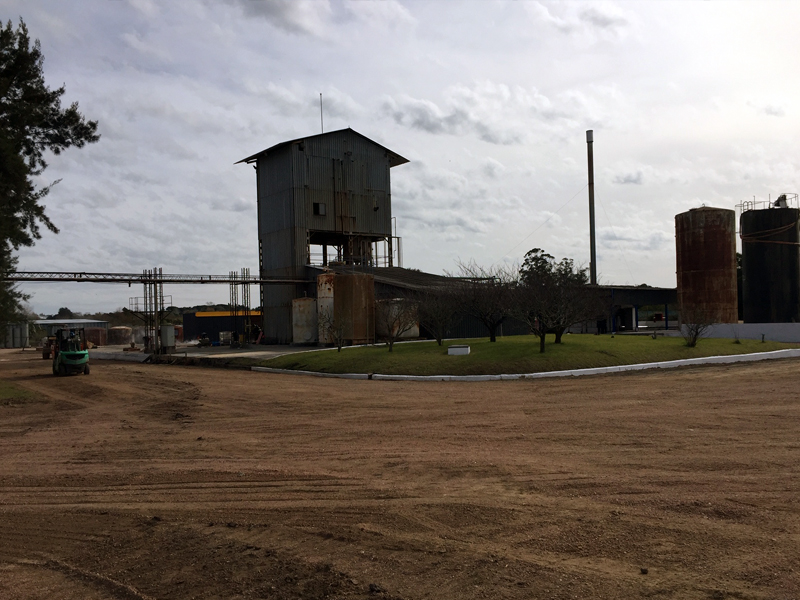
The new plant, located in Barros Blancos at km 27 of Route 8, is the new commitment to develop the local market with new products and reach the regional market with high quality products and technical level.

They are more than 5 ha in area with 2000 m2 of roofed warehouses, plant chemicals advanced and more than 1000 m3 tank where we will develop a new generation of modified asphalts and other products for road maintenance.

He is currently performing a set point and the installation of equipment, an integral vehicle scale and adapted for handling asphalts waiting to be conducting the first tests in tanks next July.

Urupema was a processing plant plasticizers for PVC industry and other chemicals, being a plant that elaborated products both domestically and regionally. The whole plant is functional and adaptable to the preparation of other types of chemical compounds advanced for road maintenance.

CITEVI is working intensively on the development of a new range of innovative products that will be available commercially in the coming months and correspondingly present at events and fairs to participate.

We will keep you informed of developments in the next editions of "Making Roads".

INAUGURATION OF LOW RIDE IN BUENOS AIRES

INAUGURATION OF LOW RIDE IN BUENOS AIRES

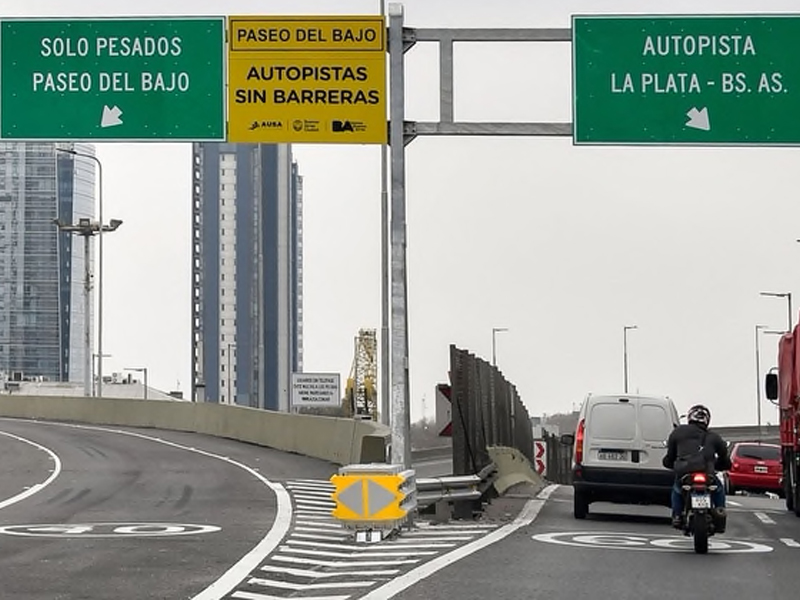
Under the Walk is a 7.1 kilometer road corridor connecting the Illia and Buenos Aires-La Plata highway.

We had the opportunity to tour the recently opened Paseo del Bajo works, construction facilitating cross the city of Buenos Aires in just ten minutes already benefit some 12 thousand vehicles per day, between heavy and light. We invite you to read the note to know the details of the various stages where we were present and see pictures of such a work of engineering.

At the junction of the 25 de Mayo and Ricardo Balbín highways (Buenos Aires-La Plata), this work begins, which, although it had been planned since the 1980s, had never been carried out. The project consisted of about 7,300 meters in total length, in viaduct typologies, level sections, semi-covered trenches and open pit. The work was built in three sections (A, B and C) by 4 construction companies, IECSA, COARCO, GREEN and CEOSA. Section A consists of a viaduct and in particular was divided into two sections: A-South, which connects with the Buenos Aires-La Plata and 25 de Mayo highways, and A-Norte with the Illia highway. Sections B and C are mostly low level. Transversal crossings between Microcentro and Puerto Madero were also installed through several streets, and together with the 60,000 m² of new green spaces of squares and parks, the historical barriers that separated Buenos Aires from the Río de la Plata were eliminated. The terms of the work were 17 months for section A and 28 months for sections B and C, at an approximate cost of US$650 million.

The configuration of the highway is two lanes in each direction of traffic, each lane approximately 11 meters wide, with New Jersey TL5 concrete guardrails. The rolling course in the viaduct sections consisted of a fine leveling layer of asphalt sand with modified asphalt type AM3, about 3 cm, followed by a 7 cm layer of SMA 19. In the low-level sections, a 7 cm layer of conventional asphalt added to another 7 cm of SMA 19. Some 832 beams were placed in the viaduct sections, of which 796 were manufactured in the plant, with a double T section and lengths between 21 and 26 meters, in all alleged cases. Then there were 36 special beams which break down as follows:

- nine beams 36 meters long, 1.90 high and 120 tons, manufactured in situ, post-tensioned and mounted on spans of 36 meters above the Illia highway.

- two beams 42 meters, 1.90 tall, made in situ post-tensioned and mounted on a branch access.

- 25 beams 42 meters, height 2.5, 180 tons of which 6 were manufactured in situ, post-tensioned, and 19 which were prefabricated segments (7 segments per beam) to be assembled and tesaron in the trace. These beams were mounted on the main boards where will the lower rail level.

All the special beams were assembled by means of two frames that ran along tracks perpendicular to the layout. The beams were moved to the assembly site with an innovative traction buggy system, where they were raised and mounted above the spans. Placing the beams for the viaduct presented great challenges. We had the immense pleasure of witnessing the placement of the monumental piece of 42 meters and 180 tons, as can be seen in the photos.

Like any project of this magnitude, the work on Paseo del Bajo had other challenges, which had to be resolved with fair schedules. Among other factors, they had to work in very confined spaces, always allowing (although with difficulties) traffic at all times. In addition, when working in the vicinity of the Río de la Plata, it was also important to take into account the water table when excavating for the trenches, and also to consider sanitation services with large pipes that had to be avoided. Despite these complications, the work was completed in a timely manner, being inaugurated on the 27th of last month.

We congratulate all the professionals responsible for carrying out this magnificent work of engineering and we appreciate the kind invitation to witness a project of this nature.

More photos and note INFOBAE

We use own and third party cookies to help us optimize your visit to our website and also to improve service delivery and thus adapt to their most relevant and useful to better their experience needs. When you click OK to continue with navigation and thus confirm that you have read the information and accept the activation of cookies.

You can allow or reject use at any time can change the Configuration Options Privacy - Cookies Policy -

Privacy settings

When you visit a website, you can store or retrieve information in your browser, mainly in the form of cookies. Check your personal services cookies here.


We track anonymous user information to improve our website.
.
  • _ga
  • _gid
  • _gat

Decline all Services
Accept all Services