BITAFAL GROUP RESPONSIBLE CARE AND ENVIRONMENT

BITAFAL GROUP RESPONSIBLE CARE AND ENVIRONMENT

He December 3 We welcome the representative of the Responsible Care Program Environment and an external auditor of the LSQA, to conduct the audit on compliance with the requirements of this program, which the company is attached.

Was one more instance verification and enrichment of management, the positive result of it, stimulates continue working in this direction.

The purpose of the Program of Responsible Care Environment, is to manage the risks they are exposed the different actors involved in the management of chemicals, looking for continuous improvement and excellence in their interaction with the environment, occupational health and safety of employees and the community.

PRINT 50 AN ALLY FOR THE ENVIRONMENT

PRINT 50 AN ALLY FOR THE ENVIRONMENT

Since the introduction of the emulsion 50 in Uruguay PRINT form base priming it has changed considerably because of the technical and economic advantages

We have made little emphasis on the environmental benefits of its use to the detriment of asphalt diluted for priming as in the case of the MC1. Diluted contains 30% volatile solvents evaporating end to the atmosphere photochemical smog impact on the greenhouse effect and the reduction of the ozone layer while PRINT 50 only emits water in curing.
Also, temperatures of handling and application of different types of primers lead to significant fuel economy as the PRINT 50 It is fully liquid at room temperature and water it is possible at temperatures as low as 40 to 50 ° C while the MC1 must be heated to 90 ° C or 80 to be applied correctly.
In recent years the use of PRINT 50 in Uruguay achieved:
- Reduce by 3000 tons of solvents emitted into the atmosphere
- Reducing CO2 emitted to the atmosphere because of its lower temperature manufacturing, handling and application
- Improving safety and health of workers by lower operating temperatures and avoid inhaling solvents
- Eliminate the risk of explosion in regadores trucks.
As for flammability and explosion hazard we should worry seriously and only in 2019 there were 2 accidents which fortunately had no fatal casualties but substantial material losses.
March 14 2019: Explosion of a tank RC2 in Maldonado http://www.maldonado.gub.uy/?n=38251&mm=Obras
In many countries of the world the use of diluted asphalt is prohibited, as is the case of Argentina and Spain, or at the least there are state policies that tend to reduce these products. In the US and Canada have guidelines for not using dilute solvent regulate their content or used out only from the time of ozone generation (usually summer).
It has recently been proposed that can not manufacture or market any diluted containing more than 0.5% by volume of volatile solvents evaporated at 260 ° C or less as determined by ASTM D402.
Uruguay should consider this path if we want to be an environmentally responsible country and protect the lives of workers.
For further information on the technical advantages we approached them a paper presented at the 9th Congress of the Road Uruguaya: https://bitafal.com.uy/wp-content/uploads/2017/10/9%c2%ba-CVU-Trabajo-Imprimaci%c3%b3n-con-emulsiones-mejoras-t%c3%a9cnicas-y-ambientales.pdf
Crossed by Route 7

Crossed by Route 7

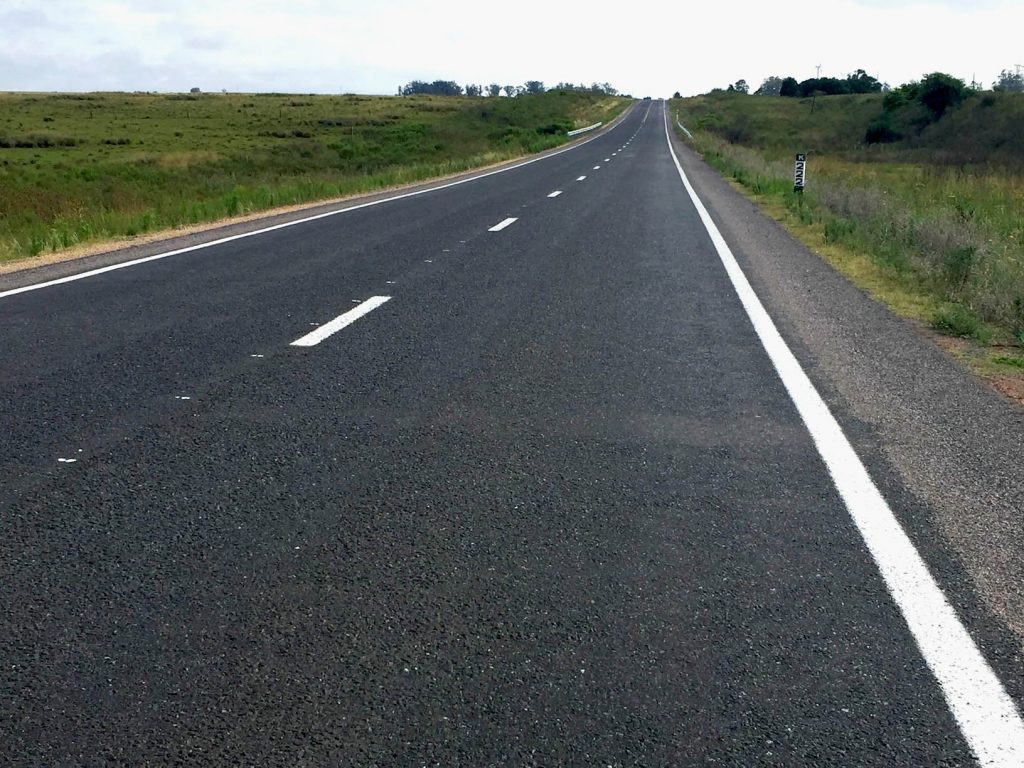
The general state of the route is good and has done good work that will have long life.

In recent years, a great effort has been made on Route 7 to improve its structural capacity and bring it to a primary route standard. To this end, a widening of the road has been carried out in almost its entire extension to reach a total width of 11 m and double bituminous treatments have been carried out on the 7.2 m road and simple treatments on the shoulders. Cement has been recycled over more than 100 km and granulometric stabilized sections have been carried out to increase the bearing capacity of the pavement.
Structural results speak for themselves, there are no potholes or sinkholes despite the tremendous growth that had heavy route, but we still have way to go to achieve double bituminous treatment resistant and durable from day one.
Exudation treatments presented in several sections of the works recently opened but have been remedied by the construction companies time and no risk for rising or severe bleeding now. It is clear that the sections carried out during the winter are most affected but there are still sections executed in good time they had exudation.
On the other hand those made from October 2019 to date show a very good performance and have not submitted exudates and has been achieved adequate dosing and has been made in good time.
Irrigations A are always in very good condition and this is because the appropriate proportions of aggregate and asphalt are used (because if there are landslides, the base is visible and it is necessary to redo the section), which allows having the necessary voids in the system to prevent exudation. On the other hand, when there are landslides in aggregate B, not much attention is paid to it, since aggregate A “hides” the problem, but that is where the necessary voids are lost, since the asphalt of both irrigations is there, but only to adhere the aggregate. A. This is verifiable in the field since the most compromised sections have a cushion of aggregate B in the ditch and the sections in better condition do not.
In this regard we insist on the following points to prevent premature exudates:
1) Respect the ban
2) Incorporating ball penetration test for the ramming potential at the base arid
3) Make dosing based on rational method Austroads where in addition to the characteristics of the aggregates are incorporated concepts based and traffic
4) In the selection of aggregates, narrow strips search granulometric aridos for irrigation A and B that do not overlap in their belts or are contiguous
5) Executing processing B should be next to or immediately after the A cure system for simultaneously minimizing loss arid B as proposed in multiple treatments locked
6) Use highly modified emulsions (P40 or P60) for those sections which have a high traffic and are in thermal Mediterranean area
7) Making only the risks A
We need to rethink the usefulness of double treatments as new work. Today Today we are making almost all stabilized bases, so a simple treatment that provides impermeability and an adequate macrotexture is more than enough. Irrigation A already cured and in service have a very good mechanical resistance and are capable of withstanding high traffic without problems, there are plenty of examples in Uruguay and in the world. In New Zealand and Australia, only simple irrigation is done in new construction and they are maintained frequently to maintain the necessary safety and functionality characteristics.
January 2020 - Bitafal Group
XX IBWC IN MEXICO

XX IBWC IN MEXICO

A large contingent of Uruguayan at the XX Congress of the Asphalt Iberolatinoamericano held in Guadalajara, Mexico

From the 25 to the November 29th He was held at the Performing Arts Center of Guadalajara a new edition of the most important congress in the world of asphalt. This time more than 800 technicians from 27 countries were present to show progress in binders and asphalt paving technology.

The strong presence of Uruguay was to ratify the realization of the XXI IBWC in the city of Punta of the East in November 2021. The launch was performed by a campaign of expectation during the Congress with a stand of Uruguay, an information campaign through leaflets and finally the announcement at the closing ceremony along with a video prepared for the occasion.

Organized by the AMAAC (Mexican Association of Asphalt), the WHAT XX It was held in conjunction with the Expo Asphalt Mexico and consisted of 5 days of intense knowledge sharing and closer ties between the different actors in the world of asphalt.

They presented more than 150 technical papers in various forms such as plenary lectures 2 auditoriums and simultaneous presentations in the same room with multiple screens and in which participants approached according to topics of interest.

There were also six lectures by prominent experts who spoke on asphalt mixes, infrastructure, design methods and auscultation of pavements.

Uruguay was present with 10 technical papers presented of which 7 were performed oral presentation format. Bitafal group He presented on emulsions degree of performance on mixtures with highly modified asphalts and on agile trials DSR (rheometer) to determine characteristics of asphalt mixtures. Serviam presented a paper on the design and implementation of a foamed bitumen recycling by Ing. Faustina Keuliyan and also on the rehabilitation of Route 60 with the Capeseal technology by Ing. Rodrigo Tejería and Pablo Carranza.

Furthermore Eng. Oscar Giovannon (Arg.) Presented the thesis of Ing. José Luis Martucci on recycled foamed performed in Route 3 and James Kröger presented thesis Ing. Gerardo Fernandez on primer emulsions.

He Tuesday in the afternoon, in a special session, Bitafal Group presented his book "High Performance Surface Treatment" of which were delivering copies of the same to all participants and which had an excellent reception.

The week was full of hard work broadcast next IBWC to be held in Punta of the East, first with the dissemination of material on Uruguay and customs, then on our natural beauty and closing Tipped East and an express invitation to participate in the XXI IBWC to be held in 2021 with a promotional video. We're on track and we will fulfill the expectations of all "cileros".

Nuevamente "one more!"

12th CONGRESS OF ROADS URUGUAYA

12th CONGRESS OF ROADS URUGUAYA

On 25, 26 and 27 September, the biannual conference of the Uruguayan Association of Roads was performed.

LATU again in the more than 350 players in the Uruguayan roads were present to exchange and learn about the latest developments in local infrastructure, maintenance, mobility, road safety and artwork, among other topics.

The same Bitafal Group participated in the exhibition presenting the new rheometer (DSR) of CITEVI well as new products supported by this equipment as are the HIMA, the PG 70-28 and new level of performance emulsions (EPG) . Technical presentations were linked to the performance of the above products and the recently published book "High Performance Surface Treatments".

The opening of the Congress was delivered by President of the AUC, Ing. Gerardo Fernandez, Minister of Transport, Víctor Rossi, Director of Mobility of the IMM, Pablo Inthamoussú, the Director of LATU and IDB representative for Uruguay.

Special conferences were given by Ing. Maria Mar Colas, from CEPSA and ATEB(Spain) “Surface treatments with asphalt emulsions for low-traffic highways”, by Mr. Jorge Setelich (Undersecretary of Transport and Public Works, Uruguay) “Central Railway Project – Uruguay in progress”, from Ec. Gonzalo Márquez (Municipal Government of Montevideo, Uruguay) “Electric Mobility in Montevideo: Where are we and where are we going?”, by Ing. Fabián Schvartzer (Independent Consultant, Argentina) with “Contribution of high-performance geocells in the calculation of pavement structures” and Dr. Ing. José Ramón Marcobal (SACYR, Spain) “Contributions to pavement engineering in Uruguay: a look towards the future”

In addition a thematic table "Proposals of Political Parties for the sector" where representatives gave their vision of how we are and proposals for the next period of government was conducted.

Within the thematic blocks, more than 30 technical papers on Transport, Road Safety, Structures, management and maintenance as well as pavements are presented.

The BITAFAL Group participated with four technical papers on "Surface treatments High Performance", "Advanced study of mixtures using different asphalts", "New asphalt emulsions level of performance" and "Recycling with cement and multiple treatments locked" together with the DNV.
At the close of the Congress there was a distinction as the best work of the Congress "Implementation of a mechanistic-empirical method for pavement design in Uruguay" of Ing. Martin Scavone and Gerardo Flintsch.

The novelty of the exhibition was that the outdoor showed new Wirtgen KMA 220 recent acquisition of CVC for recycling mixtures using foamed bitumen.
We look forward to the next Congress of Roads Uruguaya that possibly be done with the IBWC XXI.

INAUGURACION ROUTE 8 melo-Aceguá

INAUGURACION ROUTE 8 melo-Aceguá

the section built by the company CVC on Route 8 connecting Melo with the Brazilian border was opened.

On 10 September the ribbon cutting took place in the village Isidoro Noblía found in the newly renovated section. The ceremony was attended by Minister Victor Rossi, the Mayor of Cerro Largo, Pablo Duarte, representatives of the company, DNV and other national and local authorities as well as colleagues and friends.

The section was recycled in 9 m and then a road of 7.2 m was conducted in double bituminous treatment with fog. In some sites existing sewers widened and conditioned with asphalt some sections as traversing Noblía.

Recycling cement was performed in 25 cm depth giving a great bearing capacity to stretch. irrigation curing is then performed with

Recycling cement was performed in 25 cm depth giving a great bearing capacity to stretch. irrigation curing is then performed with Emulsion IRRIGATION 65 which allowed the release to traffic during last winter without problems. Bituminous simple treatment was performed on the 9 m wide while the fog twice using only road always Emulsion IRRIGATION 65 P25.

Exudation problems that appeared last year were already controlled in January and hopefully a good pavement performance this season and next summer following. The sealed surface texture was evenly across the entire width making resemblance to a asphalt.

We commend the company for having completed all the sections in very good condition and high quality. It is expected durability and enjoyment for users who can circulate in a safe and comfortable route.

Presidency note: https://www.presidencia.gub.uy/sala-de-medios/videos/ministerio+de+transporte++ruta+8++inaugura+tramo+entre+melo+y+acegua

PG 70-28 asphalt NEW

PG 70-28 asphalt NEW

Bitafal Special Asfaltos incorporates a new high-quality modified bitumen called PG 70-28.

The new surface has excellent results in laboratory, achieving resistance to permanent deformation and the like fatigue one asphalt AM3. If you are perform traditional tests it can be classified as an asphalt AM2 (almost AM3) of the IRAM 6596 standard but is a performance grade asphalt PG 70-28 E (for extremely heavy traffic).

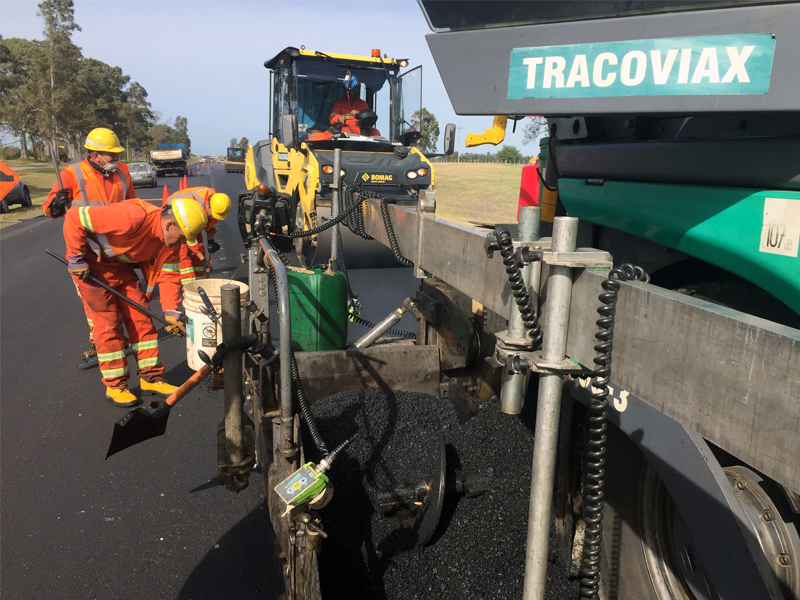
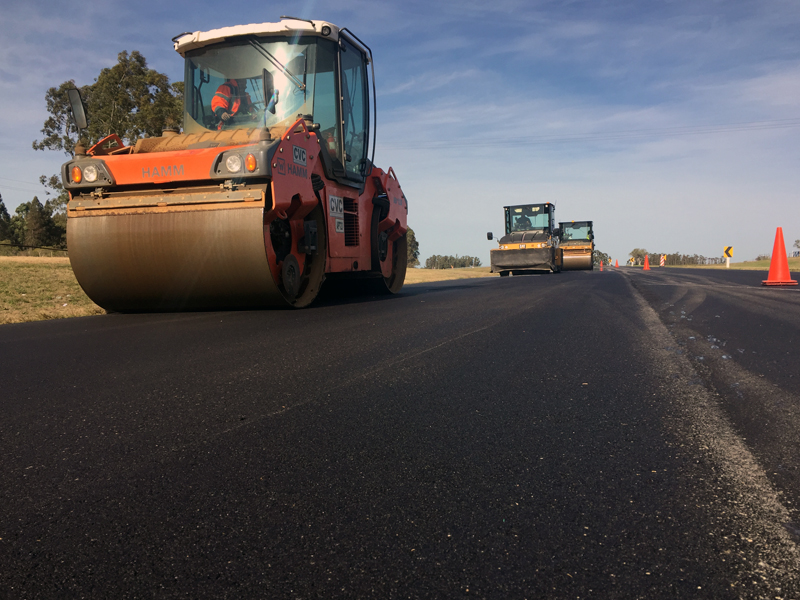
And there are several works that are using this new alternative modified asphalt on the one hand is being used in the retreading on concrete Route 8 by Tracoviax and CVC and another is beginning to be used in the reconstruction of Route 14 you have to perform the PPP Circuit Vial 3 by the Espina-Copasa consortium.

At 12th Congress of the Road Uruguaya the benefits of this new modified asphalt and comparative studies with other asphalt cements were presented at the square.

On Route 8, it is conducting a retreading over the existing concrete section of Mataojo Solis - Minas. First a base layer of 5 cm and then a 4cm surface, both prepared with the asphalt PG 70-28 (AM2).

The mixing temperature is in the range of 160 ° C, maintaining the characteristics of a conventional asphalt work and high performance work to achieve good workability in the vicinity of 150 ° C.

Both companies are making a very good job in both manufacturing and laying and compaction of asphalt mixture which is reflected in surface quality, both macrotexture and IRI. We emphasize safety equipment used as mobile radars and donkey backs of much needed in a high traffic route. Moreover, for the roughness of the section are being used skates 6 m with sensors coupled to the terminating and results feel gait.

We thank the companies and the MTOP the offered confidence.

PERFORMANCE OF ASPHALT MODIFIED HIGH

PERFORMANCE OF ASPHALT MODIFIED HIGH

the thesis of Ignacio Kröger Engineers and Carlos Pfeiff on the performance of highly modified asphalts (HiMA) was recently introduced.

Last July 4th fought against the Ing. Magdalena Pastorini, Ing. Arturo Forteza and Lic. Laura Luzuriaga with the final thesis which took more than eight months of intense work on a comparative study between the Hima the AM3 and AC30.

Continue read: REGIONAL MEETING IN BOLIVIA CIVIL ENGINEERING

In this thesis several technical papers to be presented at the 12th Congress of the Road Uruguaya and in the XX IBWC to be held in November in Mexico are released. Moreover it is performing a scaling himâ asphalt plant are preparing the experimental sections to assess their field performance in the long term.

FIRST TRANCHE OF ASPHALT IN URUGUAY HiMA

FIRST TRANCHE OF ASPHALT IN URUGUAY HiMA

the first experimental section using highly modified asphalt (HiMA) was performed in Uruguay

The new highly modified asphalt (HiMA) developed by sion, He was executed by Necklace last August in the widening of Route 101. The section in question consists of 600 meters above prior to entering the roundabout junction Nicolich (direction Montevideo) outside lane. The aim of HIMA provide durability to asphalt, primarily because of its outstanding resistance to cracking and permanent deformation.

Continue read: DAY OF THE CHILD IN BARRIO COLONIA Nicolich

The original project consists of a black base with conventional AC-30 asphalt 12 cm on which a road surface with 5 cm AM3 is then applied. Colier was proposed, with the approval of the MTOP, 600 m replace the AC-30 HIMA of which 300 m in thickness was reduced to 10 cm (17% reduction).

Asphalt (17)

And extracted with witness samples of the asphalt plant will proceed to perform tests of dynamic modulus, and fatigue loaded in four-point beam wheel. With structural package information and research, it will proceed to use mechanistic empirical design programs, such as BackViDe (IMAE) to predict their behavior.

We appreciate the confidence Colier MTOP and apply technology to allow himâ for the first time on our roads. The research results will be presented at the XII Congress of the Road Uruguaya on 25, 26 and 27 September and the XX IBWC Mexico 25-29 November.

Credits: Rafael L. Martins

We use own and third party cookies to help us optimize your visit to our website and also to improve service delivery and thus adapt to their most relevant and useful to better their experience needs. When you click OK to continue with navigation and thus confirm that you have read the information and accept the activation of cookies.

You can allow or reject use at any time can change the Configuration Options Privacy - Cookies Policy -

Privacy settings

When you visit a website, you can store or retrieve information in your browser, mainly in the form of cookies. Check your personal services cookies here.


We track anonymous user information to improve our website.
.
  • _ga
  • _gid
  • _gat

Decline all Services
Accept all Services