THE ROLE OF ASPHALT IN ROAD SAFETY
We all know that the surface condition of the road affects the accident rate: exudations, pits and rutting increase stopping distances and promote abrupt maneuvers, especially in wet conditions. At Grupo Bitafal we are working on techniques and products to reverse this problem.
As Voltaire said, “There is no such thing as an accident. What we call this name is the effect of some cause that we do not see ”. In general, the incidence of the human factor is the main cause of claims, although the causes are really multiple and some are not very controllable. However, from our perspective and our commitment to Road Safety, the surface condition of the road is a controllable factor and we are working on various techniques and products that substantially improve this situation.
Traffic accidents are one of the most deadly evils in our country. From January 1 to November 30, 2020, a total of 19,721 people were injured by traffic accidents, of whom 347 died and 2606 were seriously injured, according to official figures from UNASEV. Although the rate decreased compared to the previous year (figures strongly influenced by the voluntary mobility restrictions of the pandemic), they continue to represent a problem to which we must pay careful attention.
We detail below some of the main causes and possible solutions:
Hydroplaning and “Spray” effect:
For example, if the asphalt does not drain the water well or due to defects in the road an accumulation occurs, the famous problem of aquaplanning or hydroplaning occurs. At the same time, in closed mixtures, the “Spray” effect occurs on rainy days that make visibility difficult. Beyond the profile of the road that must ensure drainage as well as have a low rut to avoid accumulation, there are solutions that are capable of improving this drainage.
One of the solutions that has been applied experimentally in Uruguay is an F10 mixture with modified asphalt BITAFLEX AM3 in which a higher macrotexture (above 1.0 mm in the sand patch) was achieved than in usual semi-dense mixtures and allows to reduce the "Spray" effect mainly. Even so, it is necessary to see alternatives that drain more water, so we are working to carry out a overcoated with a drainage-type mix with modified asphalt BITAFLEX AM3, asphalt rubber AMC 50 the highly modified asphalt HiMA. The high viscosity of these binders allows the mixture to be applied while maintaining its high percentage of voids and its excellent performance against permanent deformation, preventing the formation of rutting and water accumulation as well as eliminating the “Spray” effect.
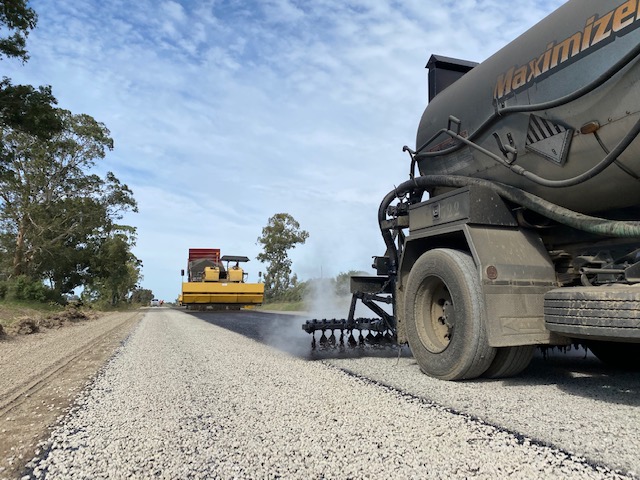
The greater the voids on the surface, the safer the rolling, so there are alternatives with surface treatments that allow improving sections that have these problems. For example we have applied in Uruguay type surface treatments “Chipping" O cold microagglomerates to solve the rutting problem in such a way as to restore the transversal profile of the road and allow the normal drainage of water towards the sides. On the other hand the application of multiple locked treatments (TMT) It allows to generate voids but with a more comfortable and less noisy rolling.
Lack of texture and friction:
A problem related to the previous one but which is approached in a different way is the issue of the lack of friction of the road due to exudations or loss of texture of the stone aggregates. This can normally occur in heavily requested areas such as intersections, traffic lights, access to roundabouts, roundabouts, etc. In these cases, loss of vehicle control, increased stopping distance and skidding can cause serious accidents. To improve friction we are also working with high friction Seal Coat treatments, composed of high performance binders and excellent resistance aggregates. These treatments have the additional possibility of generating a red, blue or green color surface, which improves the visibility of the road and the driver's attention.
Wells:
Finally, the problem with wells is that they usually generate abrupt maneuvers at high speeds that can end in a collision or loss of control of the vehicle. For this, at Grupo Bitafal we work to promote preventive treatment, with the use of a battery of surface treatment techniques that allow, with the same money as with a milling and replacement scheme, to maintain a high standard of the pavement, ensuring the absence of wells.
In secondary and urban roads we have been working with departmental municipalities for several years supplying the family of emulsions MIX 55 to make cold mixes for patching.
In short, these are the latest developments in materials and techniques that improve road safety. We want to invite anyone interested to see our facilities and see these innovations first-hand.
SUSTAINABLE DEVELOPMENT GOALS BITAFAL GROUP
We work on many of the 17 Sustainable Development Goals (SDGs) for a happier and healthier world
Under the UN initiative "Make change possible" we focus on several of the SDGs to live in a more sustainable way at work and at home, changing consumption patterns, focusing on the use of renewable energy and others. We invite you to learn about our initiatives.
- Implement an Innovation Management System to develop the initiatives we take in an orderly manner.
- Promote sustainable and long-lasting technologies such as pavement recycling, soil stabilization, high-performance surface treatments, and asphalt mixtures with modified binders.
- Promote a philosophy of preventive maintenance of pavements using mainly cold techniques.
- Promote asphalt emulsions as the most user-friendly alternative to the use of asphalt binders.
- We work on the incorporation of recovered waste in paving such as: end-of-life tire dust, crushed glass, steel slag, recycled plastics, recovered hydrocarbons and other large amounts of waste that are a great problem for our society.
- Study the life cycles of the cold techniques that we promote, seeking to minimize the carbon footprint with different initiatives.
- We have a total Waste Management looking for alternatives for reuse and recycling.
- Install photovoltaic solar power generation systems.
- Implement recovered oils as an alternative fuel to Fuel Oil.
- Install sensor-based control systems along with frequency inverters, timers, and lighting fixtures to promote energy savings.
All these initiatives are closely related to GOAL 13: ACTION FOR CLIMATE to adopt urgent measures to combat climate change and its effects. With these initiatives we seek to reduce carbon emissions from our operations and supply chains, improving energy efficiency; reducing the carbon footprint of our products, services and processes; and increasing investment in the development of innovative and inclusive low-carbon products and services.
- Within our company as well as in the neighborhood where we are installed for information, collaboration, training on various topics of interest.
- We collaborate with gardens, schools, CAIF and other local institutions to improve living and working conditions with financial donations, shelter campaigns, toys, food, among others.
- We incorporate young students in dual modality, internships, internships and others for their training and work experience.
- We seek to achieve a work table on the contribution of pavements to road safety.
- We have strict protocols for the protection of employees and the community against different risks such as chemicals or COVID-19.
We will go deeper into the different initiatives in future editions of our Newsletter to count the progress and spread the enthusiasm for a happier and healthier world.
THE WORKS OF THE PPP CIRCUIT 7 BEGAN
Grupo San José trusts Bitafal to supply asphalt products
INAUGURATION OF ROUTE 104 AND ROUTE 10
The synergy between recycled cement and surface treatments show that a route can be rehabilitated at low cost with high performance and quality
Last January 28 The official inauguration of the works took place at the intersection of both routes, in front of Manantiales beach. The Minister of Transportation and Public Works, Luis Alberto Heber, the Mayor of Maldonado, Enrique Antía, the Director of Roads, Hernán Ciganda and the Directors of the company participated in the meeting.
There are several accolades that the Serviam company has received for the Capeseal that was carried out in more than 33 km of route that were rehabilitated in just 3 months. Not only for the quality of the finished work but also for the speed of execution as well as for the aesthetic and functional improvement of one of the main tourist corridors in Punta del Este.
As we discussed in the Bulletin # 118, the works on Route 104 consisted of cleaning the strip and deepening the gutters as well as the surcharge of between 15 and 20 cm of roughness that was recycled with cement along with the old existing bituminous treatment.
XXI CILA IN PUNTA DEL ESTE - NOVEMBER 2021
With the expectation set by the arrival of COVID-19 vaccines and the opening of borders
We invite you to submit summaries of technical papers until March 30, 2021. East XXI WHAT It will be a unique opportunity for local authors to present at one of the most important congresses in the world of asphalt.
32 years have passed since the V CILA, which was also held in Punta del Este in 1989, and it is to be expected a long time for another CILA Congress to be held in the region.
We enclose again the Bulletin N ° 1 with all the necessary information of the event.
BITAFAL GROUP FINALIST OF THE PwC 100 YEARS INNOVATION AWARD
We were awarded as finalists together with important companies in the country.
The award organized by PwC with the support of ANII and the weekly Busqueda had its award ceremony the past mywednesday November 4th in Magnolio Sala where ATGen ended up being the winner for the development of the Covid-19 diagnostic kits. The other finalist companies for the Innovation Award were: Carrasco Airport, Lanas Trinidad and Montes del Plata, which together with Grupo Bitafal were also recognized for their innovative initiatives.
This initiative complements the Nova Award organized by the ANII together with the business chambers. Grupo Bitafal was the winner of the 2014 Nova Award, was a finalist in 2013 and obtained a special mention in 2010.
XXI CILA IN PUNTA DEL ESTE - NOVEMBER 2021
The AUC confirms the holding of the XXI CILA together with the 13th Uruguayan Highway Congress
The Uruguayan Association of Roads launched the Bulletin N ° 1 of the XXI Ibero-Latin American Asphalt Congress (CILA) that will be held in Punta del Este from 21 to November 26 of 2021 together with the 13th Congress of the Uruguayan Highway. Both events will be held simultaneously, taking advantage of the facilities of the Convention Center and Enjoy Hotel that provides an optimal setting for holding this type of Congress.
We enclose Bulletin N ° 1 with all the necessary information about the event.
MOST COMMON FAILURES IN THE REGION'S FLOORS
The surface deterioration of the pavement provides a measure of the damage caused by traffic, environmental conditions and aging of the materials that constitute the wearing course. The type and cost of maintenance operations required for a road section is significantly influenced by the type, extent and severity of the defects present in the pavement (1). It is recognized that in reality, the set of indicators that characterize the state of the surface does not evolve in isolation, but through an interaction between them, other elements and the previous state of the set. It has been shown that the progress of cracking and rutting are related: at the beginning of the service life, an initial rutting occurs, the growth rate of which decreases with the increase in the number of cycles. Once cracking begins to be evident, the modulus of the asphalt layers falls, which causes an increase in the stresses that accelerate the rutting process, together with the possible entry of water into the structure depending on the maintenance tasks (2 ). Figure 1 outlines the deterioration behavior of the pavement considering both evolutionary periods.

Figure 1. Evolution of the deterioration of a pavement structure. Taken from Rational Design Models: Failure Criteria (2)
In today's pavements, the action of repeated loads is the most notable cause of deterioration. As previously mentioned, the growth in the volumes of cargo transported and the increase in the allowable weight per axle increase the probability that the pavement will experience fatigue and cumulative deformation failures (3).
1 Fatigue cracks
The National Highway Directorate of Uruguay defines fatigue cracks as failure lines mainly caused by stresses and / or lack of bearing capacity of the pavement (1).
The triggering of fatigue cracks is mainly attributed to tensile stresses in the lower part of the asphalt layer due to the bending of said layer due to the repeated passage of vehicles. This cracking starts and progresses through the asphalt phase and/or at the asphalt-aggregate interface and gradually propagates to the surface (bottom-up cracks) (4). They begin to show up as small longitudinal fissures in the tracks branching out, to later form a closed mesh (colloquially called crocodile skin). At that point, the failure is declared severe, eventually causing material detachment (1).
The fatigue process affects the asphalt layers, progressively reducing their effective work modules, which causes a redistribution of the induced stresses throughout the structure. This stress variation is dependent on the contribution of these asphalt layers to the overall stiffness of the structure. It may then happen that structures that have greater relative rigidity of the asphalt layers with respect to the structure as a whole, result in a decrease in useful life (2).
The fatigue failure criterion relates the allowable number of load repetitions to the tensile strain, until the condition of the pavement is considered sufficiently deteriorated to establish the end of its life. Fatigue laws are generally elaborated from laboratory tests and calibrated in the field (5).
Folder fatigue failures have historically been combated in two ways. On the one hand, an attempt has been made to give the folder such a thickness that the stress applied by traffic generates small deformations that do not produce the possibility of cracking or cumulative deformation. A greater thickness reduces the magnitude of the tensile stresses in the lower fiber of the asphalt layer and makes it more difficult for cracks to propagate, since they have to travel a longer distance to reach the surface (6). This approach is the most intuitive and simple to solve, but also the most expensive (7). On the other hand, the tensions in the asphalt layer can be reduced by supporting the folder on other layers that are sufficiently resistant and not very deformable. In these cases, it is important to compare the cost of each of the reinforcement options and study that the behavior of these layers does not affect the performance of the folder. For example, a cemented base will substantially improve its resistance capacity but will eventually generate shrinkage cracks that will be transmitted to the asphalt layer.
2 Permanent deformation
By permanent deformation phenomenon, also known as rutting, it is understood the alteration of the level of the tread layer due to subsidence along the treads (1) that brings about a lack of safety and comfort of the users who walk on the pavement.
Permanent deformations in asphalt mix layers are caused in a specific way or in combination by a set of factors. In the first place, the exposure of the pavement to high temperatures directly affects the viscoelastic properties of the asphalt present in the asphalt mixture causing it to flow under lower loads and it is generally evident early, even during the first months of summer. Other climatic factors such as thermal gradient and reflectivity of the pavement affect the severity of rutting to a greater or lesser extent (8).
On the other hand, traffic gives rise to cyclical loads, where in each cycle some work is done to deform the pavement surface as a combination of densification and shear deformation. Densification implies a decrease in the volume of the material, while shear deformation involves a plastic flow of the material with or without changes in volume (8). The factors that intervene in this behavior are the magnitude of the load, the inflation pressure of the tires and the speed of movement of the vehicles (9).
There are also other factors that directly contribute to rutting related to the composition of the asphalt mix, such as the low void content, high percentage of asphalt content, the use of an inappropriate asphalt and the use of uncrushed aggregates (10). Finally, there are factors related to the geometric characteristics of the route such as the width of the lane, which influences the transversal distribution of the vehicles, and the longitudinal slope that affects the distribution of the load transmitted by the tires to the pavement (9).
Bibliography
- DNV. Pavement evaluation instructions. Montevideo : s.n., 2000.
- Giovanon, Oscar. Rational design models: Failure criteria. Rosario : s.n., 2001.
- Rico Rodríguez, Alfonso, Téllez Gutiérrez, Rodolfo and Garnica Anguas, Paul. Flexible pavements: Problems, design methodologies and trends. Querétaro: Mexican Institute of Transportation, 1998.
- Safaei, Farinaz, Castorena, Cassie and Kim, Richard. Linking asphalt binder fatigue to asphalt mixture fatigue performance using viscoelastic continuum damage modeling. North Carolina : Mechanics of Time-Dependent Materials, 2016. Vol. 20.
- Monteros, Carlos Javier Vasquez. Damage equivalence factors in flexible pavements: analysis for typical conditions in Argentina. Buenos Aires: s.n., 2016.
- Ogundipe, Olumbide. Mechanical Behaviour of Stress Absorbing Membrane Interlayers. United Kingdom: University of Nottingham, 2012.
- Gaspar, Matheus, and others. Highly Modified Asphalt Binder for Asphalt Crack Relief Mix. 2017, Transportation Research Record: Journal of the Transportation Research Board, págs. 110–117.
- Morea, Francisco. Analysis of the rutting behavior of different mixtures in loaded wheel tests according to BS 598-110 and CEN 12697-22. Antigua Guatemala: XVII Ibero-Latin American Asphalt Congress, 2013.

- Martucci, José Luis and Pastorini, Magdalena. Rehabilitation of rutted pavements. Montevideo: VII Congress of the Uruguayan Highway, 2009.
- Nikolaides, Athanassios. Highway Engineering: Pavements, Materials and Control of Quality. EUA : Taylor & Francis Group, 2015.
BITAFLEX PG AIRPORT RUNWAY 70-28
Works are currently suspended until after Tourism Week.
The milling of the track is carried out in sections between 500 and 600 m long continuously, corroborating in each of the passes that the project requirements are being met. The removed material is being used for the construction of the airport's auxiliary roads, which did not exist. After milling, it is necessary to thoroughly clean it to ensure the adherence of the asphalt layer to be applied. For this, good logistical work is first necessary to minimize traffic on loose material, then a good sweep, blowing and scraping in case if necessary.
For irrigation asphalt layer adhesion is performed with emulsion IRRIGATION BITAFAL 65 and then the laying and compaction of the asphalt mix in 7 cm thickness with modified asphalt BITAFLEX PG 70-28 using two pavers in parallel. One of them equipped with a multiplex ruler with 3 sensors on one side and a laser sensor (or copying skid) or electronic pendulum on the other; the other paver has automatic leveling through laser copier sensors on both sides or pendulum and sensor that copies what was done by the first one and extends outwards until completing the programmed width. The recoat width is between 9.26 – 10.26 m per shift to minimize cold joints on a runway that is 45 m wide. It begins with a central strip of 4 m mounted on the slope break of the runway axis (with broken plate in the middle regulated at 1.5% cross slope) and an adjoining one towards one of the sides of 5.26 m (second regulated finisher at 5.40 m to mount about 10-14 cm on the hot joint); this completes the 9.26 m. Then it follows with widths of 5.00 m for the paver equipped with multiplex (corrects small deviations in the longitudinal profile) and 5.26 m in the second paver (5.40 m to absorb the assembly in the hot joint). Towards one of the sides, the total width of 45 m is completed with a single paver regulated at 5.00 m wide.
In addition to these works, repairs are being made to the concrete and asphalt pavements of the aircraft parking platforms, improvements to runway accesses and runway intersections – level transitions, replacement of edge lighting systems and runway thresholds. – AGL (Airfield Ground Lighting) as well as the adaptation of the ALS (Approach Lighting Systems) for runway 08-26 and other visual aids. The areas of the runway Resas are also being readjusted to the latest ICAO requirements in terms of extension and levels, to fulfill this task some 30,000 m3 of soil movement are estimated. The deadline to complete all the works is 4 months, with completion estimated for the month of June.
* We thank Engineer Horacio García Terra from CVC for the collaboration provided for this note